






Pakistan’s National Tech Fellowship and the race to build a digital workforce in Web3, AI, Analytics & Zero-Trust
A Pathfinder CITADEL nation-building initiative· Career JumpStart Institute
Pakistan stands at a demographic crossroads. Sixty-four percent of its people are under thirty, and the United Nations Development Program estimates the country must generate 2.5 million new jobs every year to keep pace. Yet graduate unemployment hovers near 31 percent, and the demographic window that could power a generation of growth begins to close around 2040. The arithmetic is unforgiving: a youth bulge is either a dividend or a deficit, and the difference is skill.
It is against this backdrop that Pathfinder CITADEL — the Center for Innovation, Technological Advancement, Digital Entrepreneurs and Leadership — launches PARWAAZ, its National Tech Fellowship. The name is deliberate. Parwaaz (پرواز) is Urdu for flight and ascent, echoing Iqbal’s Shaheen — the falcon that climbs on its own strength — and nodding to the aviation heritage of CITADEL’s leadership. As an acronym it is equally precise: Pakistan’s Applied Readiness in Web3, AI, Analytics and Zero-Trust. Its promise is captured in one line — Hunar se Parwaaz tak, from skill to soaring.
PARWAAZ runs under CITADEL’s Career JumpStart Institute, the vertical built to close the employability gap at its source. Where conventional training delivers theory, PARWAAZ delivers job-readiness. Each of its four tracks — Applied AI & LLM Engineering, Blockchain Development, Cybersecurity & Ethical Hacking, and Data Science in Cloud — is backtracked from live job postings, so fellows learn what the market is actually hiring for, not what a syllabus assumes.
“One curriculum, three synchronized access modes — a fellow in Gilgit or Gwadar sits in the same live class as one in Blue Area.”
The design is twelve weeks per track and capstone-led. Weeks one through ten build the skill; week eleven is a dedicated employability and freelancing sprint covering portfolios, interviews and global gig platforms; week twelve is a public Demo Day where fellows present working products to hiring partners. Completion is earned, not assumed — eighty percent attendance plus a finished capstone yields a certificate co-branded by CITADEL and Pathfinder.
Crucially, the fellowship is hybrid. Physical hubs in Islamabad and Karachi anchor the program, while a live virtual cohort opens it to learners anywhere in Pakistan and the diaspora. This is what turns a training course into a national campaign: one curriculum, three synchronized access modes, and a deliberate target of at least twenty-five percent female participation. Cohort 1 mobilizes on 15 June 2026 and begins instruction on 1 August.
The ambition aligns squarely with Pakistan’s national IT agenda and the objectives of the Prime Minister’s Youth Program. CITADEL is approaching the PMYP for a non-financial partnership — endorsement, reach and recognition rather than funding — offering reserved scholarship seats and shared placement data in return: a clean win for the national youth-skilling narrative at zero cost to the exchequer. Placement itself runs through a Job Bank built aligned with the goals of P@SHA, the Pakistan Software Houses Association, targeting at least sixty percent of graduates placed or freelancing within ninety days.
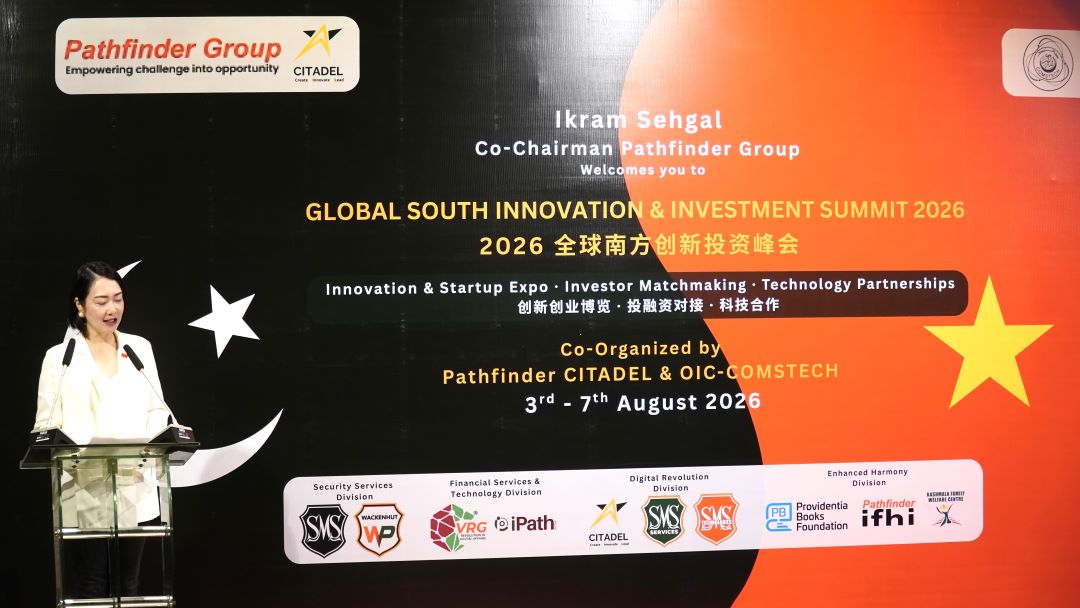
PARWAAZ does not stand alone; it is the human-capital engine of a larger machine. CITADEL — conceived by Pathfinder Group Co-Chairman Ikram Sehgal and led operationally by AVM (Retd) Asad Ikram — is built as Pakistan’s “escape-velocity engine,” the thrust needed to break free of economic gravity. Its three verticals move talent to employment, startups to scale, and enterprises to productivity. The same ecosystem carried Pakistan’s startups to the Pakistan Pavilion at Davos 2026 and on to the Jeddah Startup Challenge. PARWAAZ ensures the pipeline feeding those stages never runs dry.
For the readers of this journal — leaders in security, policy and national development — the case is strategic, not merely economic. A digitally skilled workforce is national resilience by another name: the difference between importing capability and exporting it, between a young population that drifts and one that builds. Web3, artificial intelligence, cloud analytics and zero-trust security are not abstractions; they are the terrain on which the next decade of competitiveness will be contested.
Pakistan’s next decade belongs to those who build it.
PARWAAZ is the runway.
Hunar se Parwaaz tak · From Skill to Soaring
Applications Are Open — Cohort 1 Begins 1 August 2026
Apply at www.CITADELpk.com/parwaaz