


Beyond the Battlefield: Reimagining Pakistan’s Security
Discussions on national security in Pakistan have been dominated by one central concern for decades: military threats. The possibility of conflict with neighboring countries, the challenge of terrorism, and regional geopolitical rivalries have traditionally shaped Pakistan’s strategic thinking. While military strength remains essential for safeguarding sovereignty, Pakistan’s most serious threats are no longer limited to its borders, the country’s greatest challenges now come from within. A secure Pakistan is one where citizens have access to food, education, healthcare, justice, and economic opportunities. A population suffering from poverty, unemployment, and deprivation poses a greater threat to long-term stability than many external adversaries.
Pakistan has produced extensive literature on defence, foreign policy, and military affairs; there remains a significant gap in the articulation of a truly comprehensive National Security Strategy that integrates all elements of national power.
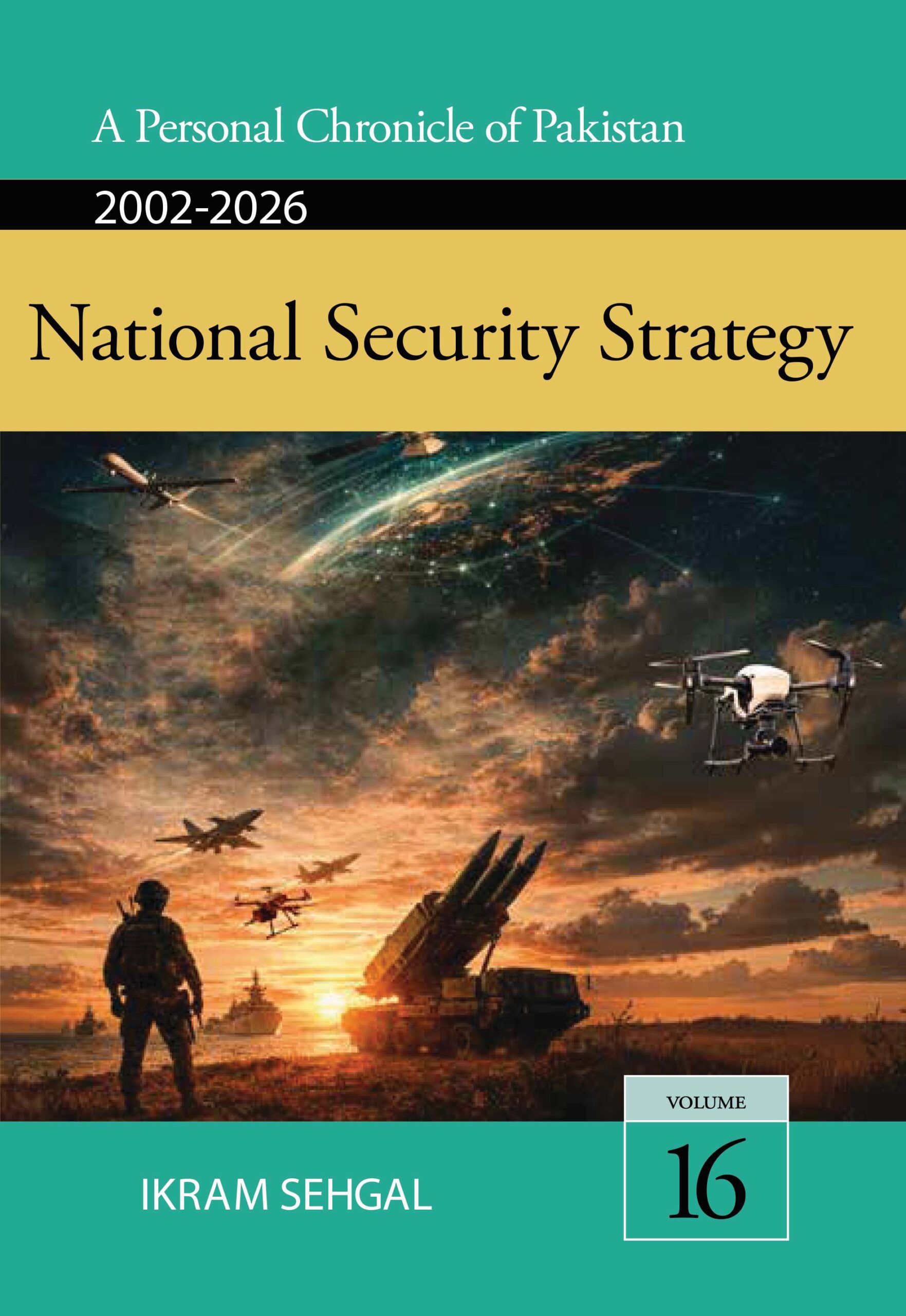
The fight for Pakistan’s future must occur across its military frontiers, agricultural fields, declining industrial zones, overcrowded schools, and water-scarce villages. In this context, Ikram Sehgal’s book “National Security Strategy,” the 16th volume in his series “A Personal Chronicle of Pakistan,” is a great contribution. To be launched on 17 July, 2026, the book reflects decades of observation, analysis, and concern for Pakistan’s future, serving as a comprehensive roadmap for national survival and progress. A country facing economic decline, widespread poverty, educational shortcomings, severe climate change, and weakening social cohesion remains vulnerable regardless of the strength of its military capabilities.
The country is going through one of the most difficult periods in its history, marked by economic instability, climate-related disasters, political uncertainty, and shifting global power dynamics. These challenges have combined to create a complex national crisis. Public debate is often dominated by political polarization, populist narratives, and short-term solutions, whilst deeper structural problems remain largely unaddressed. What has been missing is a balanced, objective, and carefully researched assessment of Pakistan’s challenges, along with practical recommendations for reform. Pakistan’s current circumstances call for a grand strategy, a holistic framework that views security as the coordinated application of political, economic, diplomatic, social, psychological, technological, and military capabilities to achieve national objectives. Pakistan’s major internal vulnerabilities are food, water, energy, climate, education, healthcare and economic challenges as well as governance, justice and demographic pressures.
Ikram Sehgal combines strategic insight with practical experience in business, governance, media and security affairs. His recommendations and analysis are based on real-world experience rather than theoretical concepts. Addressing various problems existing in almost every sector of the economy it provides innovative and simple solutions. It is valuable because it confronts the prevalent pessimism about Pakistan’s future and simplifies complex national security issues into manageable and solvable components.
A broader understanding of national security is given in its discussion of the “Concept of National Security” and the “Preamble for the National Security Concept for Pakistan,” Ikram Sehgal argues that human welfare must remain at the centre of national security policy.
Moving beyond the traditional military-centric approach, he advocates integrating economic development, governance, and social well-being into strategic thinking. The preamble, therefore, acts as the intellectual foundation of the entire volume, linking diverse issues together within a single framework of national resilience. After establishing this conceptual basis, he provides an honest evaluation of the country’s challenges across multiple sectors.
Rather than promoting despair,it provides reasons and solutions for lifeseeking to establish a realistic starting point for reform. Effective solutions can only emerge from a clear understanding of existing problems. The work also displays considerable courage by openly challenging entrenched systems of elite capture, institutional inefficiency, and political inertia. It offers a framework for constructive national debate focused on practical reforms and actionable solutions. It highlights the critical role of political leadership and national resolve in translating ideas into meaningful change.
The consistent methodology for every sector is to first identify the major issues and challenges before presenting detailed recommendations. This structure ensures that proposed solutions are directly connected to the realities on the ground. This conceptual shift is important because it reframes social and economic issues as national security concerns. Every recommendation that follows is presented not merely as a development policy but as an essential component of national security. By identifying root causes before suggesting remedies, the book becomes a practical guide for reform. This approach is applied across all thematic areas, creating a logical and coherent framework.
For the future stability of Pakistan, the country requires much more than just its security apparatus. It highlights major shortcomings in the agricultural sector, emphasizing the need for climate-resilient infrastructure, improved water management practices, expanded water storage capacity through new reservoirs, and comprehensive energy sector reforms.
To address these challenges, he proposes practical measures including support for farmers, efficient water conservation and management strategies, the development of climate-resilient infrastructure, and enhanced storage facilities to strengthen Pakistan’s long-term sustainability and resilience.
Other challenges addressed include social security and institutional security that have a direct impact on the country’s stability.
These include population growth and family planning methods, social inequality and access to justice for common people, corruption and elite capture, inadequacies in the legal systems, and unnecessary centralized power controls. Issues with regard to housing and challenges in the education system are highlighted, along with issues such as pension crisis and enhancing Pakistan’s export competitiveness and a sound strategy to secure cybersecurity systems from attacks on key sectors, infrastructure and digital sovereignty are discussed. Even areas that are often ignored, like the health sector, prison facilities and telecommunication systems, are reviewed, and practical recommendations are provided. Thechanging forms of conflict require adaptation in military organization and doctrine. The discussion on modern threats, including hybrid warfare, insurgencies, cyberattacks, and terrorism, provides genuine analysis and suggests that Pakistan requires armed forces that are technologically advanced, highly mobile, and capable of operating in complex security environments.
The reforms are aimed at improving force structure, operational effectiveness, and strategic preparedness. The book advocates stronger coordination among the military, police, and intelligence agencies to create a more integrated homeland security system.
“National Security Strategy” is an ambitious, comprehensive, and deeply thoughtful contribution to Pakistan’s policy discourse. It bridges the gap between public debate and strategic analysis, presenting complex national challenges in a clear, logical, and accessible manner. The book is patriotic not because it promotes slogans or nationalism, but because it honestly examines both Pakistan’s strengths and weaknesses. It encourages self-reflection while providing a roadmap for improvement. At a time when many Pakistanis feel overwhelmed by the scale of the country’s challenges, Ikram Sehgal offers a message of cautious optimism: that meaningful reform is possible if accompanied by political will, institutional commitment, and strategic planning. Ultimately, the book argues that Pakistan’s greatest source of security lies not only in its military capabilities but also in the resilience of its people and the strength of its institutions.
It is a compelling call to move beyond perpetual crisis management and toward a clear national purpose. For policymakers, academics, military professionals, students, and citizens alike, “National Security Strategy” is essential reading, one that deserves to be studied, debated, and, most importantly, acted upon.