

Security Dilemmas, Strategic Distrust, and Regional Power Competition
Abstract
Pakistan–Afghanistan relations remain among the most complex and volatile bilateral relationships in South and Central Asia. Despite deep historical, cultural, and geographic linkages, the relationship is increasingly defined by security tensions, strategic mistrust, and competing regional interests. The return of the Taliban in 2021 was expected to stabilize ties but has instead intensified cross-border militancy, border disputes, and geopolitical competition. This article examines the structural drivers of instability, including the Tehrik-i-Taliban Pakistan (TTP) threat, contested border management, and Afghanistan’s shifting trade geography. It further analyzes the role of major powers and proposes a multidimensional policy framework for Pakistan that integrates deterrence, diplomacy, and geo-economic strategy. The study concludes that without institutionalized cooperation and enforceable counterterrorism commitments, the relationship is likely to remain characterized by managed hostility with periodic escalation risks.
1. Introduction
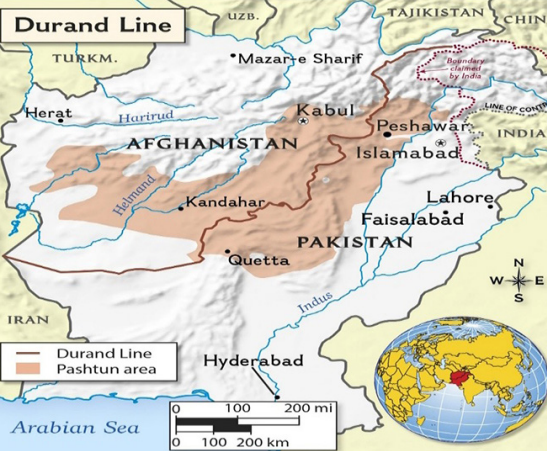
Pakistan–Afghanistan relations are shaped by a complex interplay of geography, history, ideology, and regional geopolitics. The approximately 2,600-kilometer border—commonly referred to as the Durand Line—remains contested and difficult to regulate due to rugged terrain and cross-border tribal linkages.
Historically, the relationship has oscillated between cooperation and confrontation. While ethnic and cultural ties—particularly among Pashtun communities—have fostered social connectivity, political disputes and security concerns have entrenched mutual mistrust.
The Taliban’s return to power in 2021 marked a critical inflection point. Contrary to expectations of improved relations, bilateral ties have deteriorated, driven by increased militant activity, border clashes, and diverging strategic priorities. Consequently, Pakistan–Afghanistan relations have evolved from a bilateral issue into a broader regional security challenge involving major global and regional powers.
2. Geostrategic Significance
Afghanistan occupies a pivotal position at the crossroads of South Asia, Central Asia, the Middle East, and China. Its geography provides both strategic opportunity and structural vulnerability.
As a landlocked state, Afghanistan is heavily dependent on neighboring countries for trade, energy, and transit access. Pakistan offers the shortest and most cost-effective route to the sea via Karachi and Gwadar ports, historically making it Afghanistan’s primary transit partner. However, this dependency has also generated friction, particularly during periods of political tension and border closures.
In recent years, Afghanistan has diversified its trade routes through Iran (Chahbahar Port) and Central Asia, reducing reliance on Pakistan and reshaping regional trade dynamics. This shift reflects a broader transition toward a multi-vector economic strategy aimed at enhancing resilience.
3. Historical Context
Early Relations(1947–1979)
Pakistan was the first country to recognize Afghanistan after independence in 1947, but relations deteriorated quickly due to disagreements over the Durand Line. Afghanistan refused to formally recognize the Durand Line as an international border.
Soviet Period(1979–1989)
During the Soviet invasion of Afghanistan:
● Pakistan became a frontline state
● Millions of Afghan refugees entered Pakistan
● Pakistan supported the Afghan Mujahideen
This period created strong links between Pakistani security institutions and Afghan resistance groups.
Taliban Era(1996–2001)
Pakistan supported the Taliban government during its first rule thinking of:
● Strategic depth against India
● Stability in Afghanistan
● Trade access to Central Asia
However, Taliban support for extremist groups created international pressure on Pakistan.
Post-9/11 Period (2001–2021)
After the September 11 attacks:
● Pakistan supported the U.S. war in Afghanistan
● Taliban leadership relocated into Afghan-Pakistan border areas
The border region became a center of militancy. Militant organizations developed strong networks in the region.
Taliban Return to Power(2021–Present)
The Taliban returned to power after the U.S. withdrawal in 2021.
Pakistan initially expected improved relations.
Instead:
● Terror attacks increased
● Border clashes intensified
● Political tensions grew
Pakistan insists that Afghanistan must prevent militant groups from using Afghan territory against Pakistan.
4. Current Bilateral Dynamics
Security Perspective
Security concerns dominate Pakistan-Afghanistan relations. The primary issue is militant safe havens (sanctuaries). Pakistan accuses Afghanistan of allowing TTP militants to operate from Afghan territory. The TTP seeks to overthrow the Pakistani state and has conducted hundreds of attacks with direct intelligence, militarily and financial support from India and Israel: For example:
● Suicide attacks
● Border infiltration
● Military convoy attacks
● Border infiltration continues regularly.
Pakistan conducts military operations to prevent infiltration and has killed dozens of militants but had to give a number of sacrifices in the shape of lives and property.
External Support Concerns
Pakistan believes that militant organizations operating from Afghanistan receive indirect external support primarily from India and Israel through Indian RAW agency. Security agencies have repeatedly expressed concern that hostile intelligence networks exploit Afghan territory. Pakistan’s concerns include:
● Financial support channels
● Training assistance
● Communication support
● Militarily and Intelligence sharing
● Logistical facilitation
Pakistan believes such support strengthens militant capabilities and complicates counterterror operations. Pakistan argues that without external support militant networks would weaken significantly.
Afghan Perspective
Taliban Capacity Constraints and Governance Challenges
While Pakistan’s security concerns particularly regarding the presence of Tehrik-i-Taliban Pakistan (TTP) elements remain central to bilateral tensions, it is equally important to contextualize the limitations faced by the Afghan Taliban administration. A comprehensive assessment of Pakistan–Afghanistan relations requires acknowledging the structural constraints under which the Taliban government operates.
Institutional and Administrative Limitations
Since assuming power in 2021, the Taliban have struggled to transition from an insurgent movement to a functioning governing authority. The absence of a fully institutionalized state apparatus has constrained their ability to enforce policy uniformly across the country. Governance remains fragmented, with varying degrees of control exercised by local commanders and regional authorities.
This institutional weakness limits the Taliban’s capacity to effectively monitor and control all armed actors operating within Afghan territory, including transnational militant groups.
Security Control and Fragmentation
Although the Taliban maintain nominal control over most of Afghanistan, their ability to exercise centralized authority is uneven. Various militant factions, including the TTP and other non-state actors operate within a complex security environment where:
● Local alliances
● Tribal dynamics
● Ideological affinities
often complicate enforcement efforts. As a result, even where there may be political willingness to address cross-border militancy, operational capacity constraints reduce the effectiveness of such commitments.
Economic Survival Pressures
Afghanistan’s economic situation remains precarious, characterized by:
● Severe liquidity shortages
● Limited access to international financial systems
● Reduction in foreign aid
● High unemployment and poverty levels
These economic pressures significantly shape Taliban decision-making. The leadership’s primary focus remains regime survival and internal stability, often limiting its ability to prioritize external security concerns, including those raised by Pakistan (World Bank, 2024).
Furthermore, the need to maintain internal cohesion among diverse factions may discourage the Taliban from taking decisive action against certain militant groups, particularly those with historical or ideological linkages.
Implications for Pakistan
These constraints suggest that Pakistan’s expectations regarding immediate and comprehensive action against TTP sanctuaries may not fully align with ground realities in Afghanistan.
This does not negate Pakistan’s legitimate security concerns; rather, it highlights the need for a calibrated and multi-layered policy approach that combines:
● Security measures
● Diplomatic engagement
● Incentive-based cooperation
Understanding Taliban limitations can enable Pakistan to design more realistic and effective strategies that balance pressure with engagement.
Taliban leadership believes:
● Pakistan interferes in Afghan affairs
● Pakistan supports opposition groups
● Pakistan violates sovereignty
● Afghan government has a different view on Durand line
● Afghanistan criticizes Pakistani airstrikes inside Afghan territory and claiming civilian casualties and a violation of international law
This perception increases mistrust which India has been actively exploiting and further playing a negative role.
Border Disputes
The Durand Line is one of the main causes of conflict. Afghanistan does not fully recognize the border. Problems include:
● Border fencing disputes
● Crossing points disputes
● Smuggling routes
The border region is mountainous and difficult to control. Militants exploit this geography.
Afghanistan Overall Trade Profile (Baseline year 2025)
● Total Trade: ≈ $13.9 billion (Reuters)
● Exports: ≈ $1.8 billion (Reuters)
● Imports: ≈ $12.1 billion (Reuters)
● Trade Deficit: ≈ –$10+ billion
Key Export Goods: Dry fruits, saffron, carpets, coal, agricultural produce (Reuters)
Key Import Goods: Fuel (≈33%), machinery, food, metals (Trading Economics) Afghanistan = import driven survival economy
Country-wise Trade + Goods Composition
Pakistan
Trade Volume
● Total: $1.8 – 2.2 billion
● Exports (Afghanistan → Pakistan): ~$0.6 – 1.0B
● Imports (Pakistan → Afghanistan): ~$1.0 – 1.3B (Amu TV)
Major Goods
Afghan Exports to Pakistan
● Fresh fruits & vegetables
● Coal
● Cement raw materials
● Carpets
Imports from Pakistan
● Wheat, sugar, food items
● Cement, steel, fertilizer
● Pharmaceuticals
● Textiles
Strategic Role
● Primary land transit route (Karachi ports)
● Historically largest trade partner
India
Trade Volume
● Total: ~$1.0 – 1.2 billion
● Exports to India: ~$600 – 700M
● Imports from India: ~$300 – 400M (Pakistan Business Council)
Major Goods
Exports
● Dry fruits (almonds, raisins)
● Saffron
● Herbs & medicinal plants
Imports
● Pharmaceuticals
● Tea, sugar
● Manufactured goods
Strategic Insight
● High-value export destination
● Trade largely via:
● Air corridors
● Iran (Chahbahar)
Afghanistan enjoys trade surplus with India
Iran
Trade Volume
● Total: ~$3.0 – 4.0 billion
● Imports from Iran: ~$2.5 – 3.0B
● Exports to Iran: ~$300 – 500M
Major Goods
Imports
● Fuel & petroleum (critical)
● Electricity
● Construction materials
● Food
Exports
● Agricultural goods
● Minerals
Strategic Role
● One of the largest suppliers of fuel
● Key alternative route via Chahbahar Port
Iran = lifeline economy partner
China
Trade Volume
● Total: ~$1.2 – 1.5 billion
● Imports from China: ~$1.0 – 1.3B
● Exports to China: <$200M (Pakistan Business Council)
Major Goods
Imports
● Machinery & electronics
● Construction equipment
● Consumer goods
Exports
● Pine nuts
● Minerals
Strong trade imbalance (China-dominant)
Russia
Trade Volume
● Total: ~$300 – 500 million
Major Goods
Imports
● Fuel (oil, diesel)
● Wheat
● Flour
Exports
● Minimal
Russia is an energy and food security supplier
Central Asia
(Uzbekistan, Turkmenistan, Tajikistan, Kazakhstan)
Trade Volume
● Total: ~$2.0 – 3.0 billion
Major Goods
Imports
● Electricity (Uzbekistan, Tajikistan)
● Gas & fuel (Turkmenistan)
● Wheat & flour (Kazakhstan)
Exports
● Coal
● Fruits & vegetables
Strategic Role
● Fast-growing trade corridor
● Reduced reliance on Pakistan (Reuters)
Consolidated Trade Table
| Region | Total Trade ($B) | Exports | Imports | Key Goods |
| Pakistan | 1.8-2.2 | Agri, Coal | Food, cement, pharma | Transit hub |
| India | 1.0-1.2 | Dry fruits, saffron | Pharma, tea | High-value exports |
| Iran | 3.0-4.0 | Agri | Fuel, electricity | Energy lifeline |
| China | 1.2-1.5 | Nuts, minerals | Machinery | Industrial imports |
| Russia | 0.3-0.5 | Minimal | Fuel, wheat | Food security |
| Central Asia | 20-3.0 | Coal, agri | Electricity, wheat | Growing corridor |
Core geopolitical trade structure
● Southern Corridor (Pakistan)
● Afghanistan → Torkham / Chaman → Karachi / Gwadar
● Fastest & cheapest sea access
● Still the primary traditional route
● Western Corridor (Iran)
● Afghanistan → Herat → Chahbahar / Bandar Abbas
● Increasingly used due to political reliability and incentives
● Northern Corridor (Central Asia)
● Afghanistan → Uzbekistan / Turkmenistan / Tajikistan Links to:
● Russia
● Europe (via Caspian region)
These three corridors define 90% of Afghanistan’s trade movement
Financial Impact Analysis
a. Massive Trade Deficit
● Imports ≈ 7× exports
● Deficit ≈ $10+ billion annually
Effects:
● Currency weakness
● Fiscal stress
● Aid dependency
b. Import Dependence Risk
Afghanistan depends on imports for:
● Fuel (Iran, Russia)
● Food (Pakistan, Central Asia)
● Machinery (China)
Any disruption = inflation + shortages
c. Revenue Structure
● Customs duties = major state income source
● Trade routes = economic backbone
d. Shift in Trade Geography
➤ Old System
Pakistan-centric (Karachi access)
➤ New System
● Iran (Chahbahar)
● Central Asia corridors
● Air corridors to India
Diversification improved resilience (Reuters)
e. Geopolitical Leverage
● Pakistan closures → trade collapse
● Iran → sanctions risk
● Central Asia → emerging stability
Trade = tool of geopolitical pressure
Trade relations remain important but unstable. Pakistan is Afghanistan’s largest trading partner. However:
● Border closures affect trade
● Political tensions reduce economic cooperation
Pakistan sometimes uses trade restrictions to pressure Afghanistan. These restrictions reduce Afghan revenue significantly.
Refugee Issue
Pakistan hosts millions of Afghan refugees and this creates:
● Economic burden
● Security concerns
● Social tensions
Refugee policy affects bilateral relations. Mass deportations increase tensions.
Diplomatic Relations
Diplomatic relations remain fragile.
Negotiations have failed multiple times.
Peace talks mediated by international actors have not produced lasting solutions.
Mutual mistrust remains high.
Military Escalation
Military escalation is increasing. Recent clashes show the seriousness.
In 2026:
● Airstrikes occurred
● Border posts attacked
● Casualties reported
Pakistan declared severe military response measures.
This represents the most serious crisis in decades.
Ideological Differences
Ideology also affects relations.
Taliban ideology: Islamic Emirate model and tribal leadership
Pakistan ideology: Constitutional state and differences create tension.
Internal Taliban Divisions
The Taliban movement is not a monolithic or fully cohesive entity; rather, it comprises multiple factions with differing ideological orientations, tribal affiliations, and strategic priorities. These internal divisions significantly influence Afghanistan’s security landscape, particularly in relation to the Tehrik-i-Taliban Pakistan (TTP).
Internal fragmentation within the Taliban transforms it from a unified governing authority into a coalition of competing power centers, thereby complicating counterterrorism commitments and undermining regional security stability, particularly in the Afghanistan–Pakistan context. Taliban are not unified.
Strategic Distrust
Strategic distrust constitutes the central fault line in Pakistan–Afghanistan relations, shaping perceptions, policies, and security outcomes on both sides. From the perspective of Pakistan, the Afghan Taliban leadership is often viewed as unreliable and inconsistent, particularly in fulfilling commitments related to countering the Tehrik-i-Taliban Pakistan (TTP). Concerns persist within Pakistani strategic circles that elements within Afghanistan either lack the capacity or the willingness to restrain anti-Pakistan militant groups, thereby allowing cross-border threats to persist. Additionally, there exists a perception that Afghanistan’s evolving external engagements, including with India, may indirectly contribute to strategic pressure on Pakistan.
Pakistan believes:
➤ Taliban leadership is unreliable.
➤ Acts as a proxy for India for destabilizing Pakistan
Afghanistan believes:
➤ Pakistan is manipulative.
This mutual distrust is the core problem.
Indian Proxy Dimension
Pakistan’s increasingly believes that Afghanistan has been used as a platform by India to conduct indirect operations against Pakistan.
Pakistan’s concerns include:
● Support to anti-Pakistan militant networks
● Intelligence operations near Pakistan’s western border
● Facilitation of separatist movements
● Propaganda and psychological warfare
● Diplomatic alignment against Pakistan
Pakistan believes that Indian intelligence networks expanded significantly in Afghanistan after 2001. Indian consulates located near the Pakistan border raised security concerns. Pakistan claims these facilities were used for:
● Intelligence collection
● Recruitment of agents
● Support to insurgent groups
These developments contributed significantly to strategic distrust between Pakistan and Afghanistan. Pakistan views Indian influence as one of the main drivers of instability along the western border. Pakistan-Afghanistan relations are currently at one of the lowest points in history. Key drivers include:
● Terrorism
● Border disputes
● Trade tensions
● Refugees
● Strategic distrust
● Importantly, fully and unlimited support of India against the interest of Pakistan
The relationship is moving from strategic cooperation to strategic confrontation. Since the Ghazb lil Haq has started against the terrorist group hiding in Afghanistan and action carried out by Pakistan following is the summary of Afghan Taliban losses as of April 5, 2026.
● Killed 796
● Injured 1043
● Posts destroyed 286
● Posts Captured 44
● Tanks, armoured vehicles, artillery guns & Drones destroyed 249
● Terrorist infrastructure across Afghanistan 81
5. Drivers Of Strategic Distrust
Strategic distrust is the defining feature of Pakistan–Afghanistan relations.
From Pakistan’s perspective:
● Afghan authorities are perceived as unable or unwilling to control anti-Pakistan militant groups.
● External actors are believed to exploit Afghan territory for strategic leverage.
From Afghanistan’s perspective:
● Pakistan is viewed as interfering in internal affairs.
● Cross-border military actions are perceived as violations of sovereignty.
This mutual distrust is reinforced by:
● Divergent threat perceptions
● Historical grievances
● Competing regional alignments
Without addressing this core issue, sustainable cooperation remains unlikely.
6. Policy Options for Pakistan
Pakistan requires a multidimensional strategy to manage relations with Afghanistan effectively.
Military Deterrence
● Maintain precision strike capability against militant targets
● Strengthen border defense and rapid response systems
● Avoid large-scale operations that risk escalation
Border Management
● Complete border fencing
● Implement biometric systems at crossings
● Regulate cross-border movement
Diplomatic Engagement
● Establish structured dialogue mechanisms
● Develop crisis communication channels
● Promote confidence-building measures
Economic Leverage
● Use trade and transit policies strategically
● Balance pressure with incentives
● Promote energy and infrastructure cooperation
Intelligence Enhancement
● Strengthen human and technical intelligence networks
● Disrupt militant financing and logistics
Refugee Policy Reform
● Implement registration systems
● Ensure gradual and coordinated repatriation
● Seek international support
Regional Cooperation
● Engage China, Iran, and Central Asian states
● Promote regional security frameworks
● Share counterterrorism intelligence
Role Of Major Powers And Future Scenarios
7. Strategic Overview
The Pakistan, Afghanistan conflict cannot be understood purely as a bilateral dispute. It is deeply influenced by the strategic interests of major regional and global powers. Afghanistan historically has served as a geopolitical crossroads linking South Asia, Central Asia, the Middle East, and Eurasia. Because of this position, external powers have consistently influenced Afghan politics and its relations with Pakistan. The involvement of major powers has created a complex geopolitical environment where Pakistan, Afghanistan tensions often reflect broader strategic rivalries. The most influential external actors include:
● United States
● China
● India
● Russia
● Iran
● The Middle East
Each of these actors view Afghanistan through its own strategic lens.
United States Strategy
a. Historical Role
The United States has been one of the most influential external actors in Afghanistan since the Soviet invasion in 1979.
During the Cold War:
● The United States supported the Afghan Mujahideen through Pakistan.
● Pakistan became a key strategic ally.
After 2001:
● The United States established a major military presence in Afghanistan.
● The objective was to defeat terrorism and stabilize the country.
Despite the withdrawal in 2021, American strategic interests in Afghanistan did not disappear.
b. Post Withdrawal Policy
After withdrawal, the United States adopted an “over-the-horizon” strategy.
This includes:
● Intelligence monitoring
● Limited counterterror operations
● Diplomatic influence
The United States seeks to prevent Afghanistan from becoming a safe haven for international terrorism.
c. Impact on Pakistan–Afghanistan Relations
American policy affects Pakistan-Afghanistan relations in several ways:
Positive Effects
● Counterterror cooperation
● Financial assistance
● Diplomatic mediation
Negative Effects
● Pressure on Pakistan
● Political instability
● Strategic uncertainty
Pakistan sometimes believes that American policy shifts create instability in Afghanistan.
d. Strategic Concerns
The United States has concerns about:
● Terrorist networks
● Regional instability
● Chinese influence
Afghanistan remains strategically important despite withdrawal.
Indian Strategy
a. Indian Strategic Objectives
India views Afghanistan as strategically important.
India’s objectives include:
● Limiting Pakistani influence
● Expanding regional presence
● Economic cooperation
● Exporting terrorism to Pakistan
India has invested heavily in Afghan development projects.
b. Strategic Competition with Pakistan
Afghanistan is often viewed as an arena of competition between Pakistan and India.
Pakistan believes that India uses Afghanistan to:
● Support anti-Pakistan groups
● Conduct intelligence operations
● Expand influence
● Supporting directly or indirectly through Aghan government to support Taliban to act against the sovereignty of Pakistan
c. Diplomatic Engagement
India maintains diplomatic contacts with the Taliban government.
This represents a pragmatic approach.
India seeks to maintain influence regardless of the ruling regime.
d. Security Implications
Indian involvement increases Pakistani concerns.
Pakistan fears strategic encirclement.
This perception affects policy decisions.
e. Intelligence Dimension
Pakistan believes that Indian intelligence agencies have used Afghanistan as a base for operations against Pakistan. Concerns include:
● Support to Baloch insurgent groups
● Support to separatist movements
● Intelligence penetration
● Terror facilitation networks and continuously supporting terror activities in Pakistan
● Cross-border sabotage planning
Pakistan has repeatedly raised these concerns in diplomatic forums.
According to Pakistan’s position:
Afghanistan provided geographic depth for hostile intelligence operations. This increased Pakistan’s western security challenges. Pakistan believes that Indian intelligence presence created a two-front security pressure.
Chinese Strategy
China’s role in Afghanistan is shaped by a mix of strategic, economic, and security interests, all of which intersect with its broader Belt and Road vision, particularly the expansion of the China–Pakistan Economic Corridor (CPEC). Below is a structured, analytical breakdown:
a. Strategic Objectives: Stability as a Precondition
China’s foremost concern in Afghanistan is security-driven stability, not immediate economic gain.
● Prevent Afghanistan from becoming a base for militant groups that could threaten Xinjiang (especially ETIM).
● Ensure that instability does not spill over into Pakistan, a key strategic partner and CPEC anchor state.
● Promote a controlled, stable Afghanistan under the Taliban, even without formal recognition.
For China, security precedes investment—without it, economic ambitions remain secondary.
b. Economic Interests: Untapped Mineral Wealth
Afghanistan is believed to possess $1–3 trillion worth of mineral resources, making it highly attractive to China.
Key Chinese Interests:
● Copper (Mes Aynak project – previously leased to Chinese firms)
● Lithium (critical for EV batteries and future energy markets)
● Rare earth elements and iron ore
Chinese companies, particularly state-owned enterprises, aim to:
● Secure long-term extraction rights
● Integrate Afghan minerals into China’s global supply chains
● Reduce reliance on Western-controlled resource markets
Afghanistan could become a resource corridor feeding China’s industrial economy.
c. CPEC Expansion: Strategic Connectivity Vision
China is exploring the westward extension of CPEC into Afghanistan, linking it with regional trade corridors.
Proposed Connectivity Model:
● Kashgar → Pakistan (via CPEC routes)
● Pakistan → Afghanistan (via Khyber Pass / Chaman routes)
● Afghanistan → Central Asia
Strategic Gains:
● Shorter trade routes to Central Asia and the Middle East
● Strengthening of China–Pakistan–Afghanistan trilateral cooperation
● Enhanced role of Gwadar as a regional hub
This would transform Afghanistan from a landlocked state into a land bridge.
d. Security Concerns: The Core Constraint
Despite economic ambitions, China remains cautious due to:
● Presence of Tehrik-i-Taliban Pakistan (TTP) operating from Afghan territory
● Threat of ISIS-K (Islamic State Khorasan Province)
● Weak governance and lack of institutional control
China has pushed the Taliban to:
● Crack down on anti-China militant groups
● Ensure security of Chinese nationals and projects
Without credible Taliban guarantees, large-scale Chinese investment remains limited.
e. Diplomatic Role: Quiet but Calculated Engagement
China has adopted a pragmatic diplomatic approach:
● Maintains its embassy in Kabul (unlike many Western countries)
● Engages through regional platforms like the Shanghai Cooperation Organization (SCO)
● Positions itself as a neutral economic partner, not a political intervener
China avoids Western-style nation-building, focusing instead on transactional diplomacy.
f. Challenges and Limitations
China’s Afghan strategy faces several constraints:
● Lack of international recognition of the Taliban regime
● Sanctions and financial isolation of Afghanistan
● High security risks for infrastructure and mining projects
● Deep-rooted tribal and political fragmentation
These factors slow down the realization of China’s ambitions.
g. Strategic Implications for Pakistan
China’s Afghan engagement directly impacts Pakistan:
● Positive:
➤ Potential extension of CPEC boosts regional trade
➤ Increased economic activity in border regions
➤ Strategic depth through trilateral cooperation
● Negative:
➤ If instability persists, Pakistan bears spillover effects (especially TTP threat)
➤ Security burden increases for protecting Chinese investments
Pakistan becomes both a facilitator and frontline state in China’s Afghan strategy.
h. Concise Conclusion
China’s interest in Afghanistan is not purely economic but fundamentally strategic, where security considerations dominate investment decisions. While Afghanistan’s vast mineral wealth and its potential integration into the China–Pakistan Economic Corridor present significant opportunities, persistent instability, the presence of militant groups like TTP, and governance uncertainties under the Taliban constrain rapid progress. Consequently, China is likely to pursue a gradual, security-first engagement, using Pakistan as a critical intermediary to shape Afghanistan into a stable economic extension of its regional connectivity vision.
Russian Strategy
a. Historical Experience
Russia has historical experience in Afghanistan.
The Soviet war shaped Russian policy.
Russia seeks to avoid another military intervention.
b. Security Concerns
Russia fears:
● Extremism
● Drug trafficking
● Instability in Central Asia
These concerns shape Russian policy.
c. Diplomatic Engagement
Russia maintains diplomatic relations with Taliban authorities.
Russia supports regional stability.
d. Strategic Influence
Russian influence is increasing gradually.
Russia participates in regional diplomacy.
Iranian Strategy
a. Geographic Importance
Iran shares a long border with Afghanistan.
Iran is directly affected by Afghan instability.
Iran hosts millions of Afghan refugees.
b. Security Concerns
Iran fears:
● Extremism
● Drug trafficking
● Refugee flows
These issues affect policy.
c. Relations with Taliban
Iran maintains pragmatic relations with Taliban.
Despite ideological differences, cooperation exists.
d. Relations with Pakistan
Iran maintains relations with Pakistan.
However differences exist.
Iran seeks regional balance.
Regional Power Competition
Afghanistan has historically been an arena of great power competition.
Major powers pursue:
● Strategic influence
● Security interests
● Economic opportunities
This competition complicates Pakistan-Afghanistan relations.
Proxy Dynamics
External powers sometimes support different actors.
This creates proxy dynamics.
Proxy competition increases instability.
Pakistan often believes that hostile intelligence agencies operate in Afghanistan.
These perceptions influence policy decisions.
India–Afghanistan Security Convergence
Pakistan believes that the strategic partnership between India and previous Afghan governments contributed to security instability. Areas of concern included:
● Military training programs
● Intelligence cooperation
● Security agreements
● Infrastructure projects near the Pakistan border
● Strategic coordination
Pakistan believes that these initiatives strengthened anti-Pakistan elements.
Pakistan fears that similar cooperation may develop again in the future.
This possibility influences Pakistan’s Afghanistan policy
Economic Geopolitics
Economic factors influence major powers.
Important factors include:
● Trade routes
● Energy corridors
● Infrastructure
Afghanistan connects regions. This increases strategic importance.
Future Indian Role
India is expected to remain an important actor in Afghanistan.
Possible future developments include:
● Expanded diplomatic presence
● Economic investment
● Intelligence activity
● Strategic coordination with Afghan authorities
Pakistan fears that increased Indian influence may:
● Strengthen anti-Pakistan groups
● Increase proxy competition
● Intensify border tensions
Managing Indian influence will remain a major challenge for Pakistan.
Conclusion
Pakistan–Afghanistan relations are defined by a complex convergence of security concerns, strategic mistrust, and regional competition. The persistence of cross-border militancy, unresolved border disputes, and competing geopolitical interests has shifted the relationship from uneasy cooperation to structured confrontation.
Stability will depend on Pakistan’s ability to implement a balanced strategy that combines credible deterrence with sustained diplomatic engagement and economic integration. At the same time, meaningful progress requires reciprocal commitments from Afghanistan, particularly in addressing militant safe havens.
Absent such alignment, the relationship is likely to remain characterized by managed instability, with periodic escalations posing risks not only to bilateral ties but also to broader regional security and connectivity. Without a shift from reactive security management to proactive regional strategy, Pakistan risks a prolonged low-intensity conflict along its western frontier with widening geopolitical consequences.
Bibliography
1. United Nations Assistance Mission in Afghanistan. Afghanistan Protection of Civilians Reports. Kabul, various years (2020–2025).
2. World Bank. Afghanistan Development Update. Washington, DC, 2023–2025.
3. International Crisis Group. Pakistan–Afghanistan Relations: Stabilizing the Border Region. Brussels, various reports.
4. United Nations Security Council. Reports of the Analytical Support and Sanctions Monitoring Team (Taliban/ISKP). New York, 2022–2025.
5. Ministry of Foreign Affairs Pakistan. Official Statements on Pakistan–Afghanistan Relations. Islamabad, 2021–2025.
6. Islamic Emirate of Afghanistan. Official Declarations and Policy Statements. Kabul, 2021– 2025.
7. Pakistan Institute for Peace Studies. Pakistan Security Report. Islamabad, annual editions.
8. China Pakistan Economic Corridor Authority. CPEC Development Reports. Islamabad.
9. Khan, Ijaz. “Pakistan–Afghanistan Relations: Security and Border Management Challenges.” Journal of South Asian Studies