


Introduction
The first decade of the 21st century is nearly over and the PAF of 2010 is markedly different from the PAF that existed on the eve of 31 December 2000, the final day of the 20th century. The next two decades will witness further changes in the doctrine and composition of the service as it adjusts itself to the changing nature of threat and the evolving geo-political dynamics of the region. This article will examine the challenges the service faces and the steps it should adopt to remain a potent force that will deter and protect the nation from both external and internal threats. But first, a brief examination of how PAF has evolved from its rudimentary state at the time of partition of the subcontinent to its current status would be relevant.
Early Development of the PAF
Created by the bifurcation of the Royal Indian Air Force with the nomenclature of the Royal Pakistan Air Force (RPAF), it received only a meagre portion of the assets comprising a handful of outdated Tempest fighter bombers and some transport planes of the DC3 (Dakota) variety. The founding fathers soon realized that a modern and capable air force was essential for the survival of the fragile state. Despite severe resource constraints the government of Pakistan was keen on equipping the service with platforms that would give it the wherewithal to safeguard the nation’s skies from its enemies. The Commander-in-chief of RPAF was then a RAF officer on secondment and so were most of his principal staff officers and they naturally selected second echelon British hardware that were not ideal replacements for the ageing Tempest and DC3s. Piston engine Furies became the frontline fighter/strike platforms and over seventy transport planes (Freighters) also joined the fleet. To counter the introduction of jet aircraft in the rival IAF, RAF high command managed to foist upon the RPAF what must surely be the most disreputable jet fighter ever produced – the Supermarine Attacker. While the Furies proved to be useful under the prevalent security environment, the excessive number of Freighters was a drain on the limited resources of the service. The induction of the British Attacker jets was a minor disaster and their poor safety record led to their labelling as the ‘Flying Coffins’. The signing of the Mutual Defence Assistance Agreement with USA in 1954 brought about a qualitative change in the composition and effectiveness of the service.
The vision for the future of the service by the young Pakistani commanders at various tiers during the 1950s belied their youth and lack of experience. They realized that given the nature of threat where the service will be pitted against a vastly numerically superior foe, denying the enemy control of the air and establishing it in critical sectors for itself was pivotal. Lacking the mass to destroy the rival force through aerial strikes, besting them in air combats was the only viable option. PAF needed air superiority fighters capable of inflicting serious damage to any aerial assault by the adversary.
USA’s efforts to tempt the service through offers of the ground attack F-84s was turned down and instead it insisted on the F-86 Sabre Jets that had proven its mettle as excellent air combat platforms during the just concluded Korean War. The service got its wish. By the mid sixties, PAF was transformed into an all jet combat force. It was neatly compartmentalized into fighter/strike elements comprising Sabres and a handful of F-104 Starfighters, a bomber fleet of B-57s and primary and advanced jet trainers of the T-37 and T-33 class. For the transport fleet, the Freighters were retired and in its stead, the much more versatile and capable turbo-prop C-130 planes were inducted.
The Centre of Gravity of the service remained its fighter fleet and the entire air doctrine and air strategy was built around the need to create and maintain superiority in air combat over its primary adversary, the IAF. The selection and training criteria of PAF pilots from their very inception in the Flying Academy at Risalpur reflected this single-minded approach. An under-training pilot at the primary or advanced stages who did not exhibit the necessary characteristics and flamboyance considered essential in fighter flying was either weeded out or relegated to what were considered less exacting transport or rotary platforms. The fighter pilots were the cream of the combat force and all key command and staff appointments were reserved for them. Over six decades on, the policy has undergone little change.
Despite the US embargo after the 1965 War, the service orientation towards air superiority fighters did not alter. Subsequent procurement of the Chinese F-6s and the French Mirages reinforced the air combat potential. When the old workhorse the B-57 Bombers retired, they were not replaced by specialist strike platforms. In fact, in the latter half of the 1970s, the US administration to dissuade Pakistan from pursuing its nuclear ambitions had offered the A-7 Corsair strike aircraft that had proven itself as an effective air-to-ground platform during the Vietnam War. The offer was disdainfully rejected by the PAF high command. Instead, they demanded the new kid on the block, the supposedly low-cost light-weight fighter, the F-16s. The Carter administration did not comply but his successive one under Ronald Reagan obliged, albeit under changed circumstances.
The F-16 Fighting Falcon owed its birth to the vision of late US Colonel Boyd, who demanded that for the USAF to regain its past glory after their less than spectacular air combat results during the Vietnam War, it must desist from designing multi role aircraft that could operate both in the air superiority and ground attack roles. He reasoned that such an approach compromised both the air combat and ground strike ability of the plane. The F-15s and later on the F-16s were designed on this principle – as unadulterated fighters where their air combat capability was not compromised for any other role. This particular approach led to the production of fighters with unmatched performance over their existing rivals in the air superiority role and in the bargain one rather interesting spin-off resulted.
An air superiority fighter must be manoeuvrable, agile and fast having the ability to operate, detect and shoot down enemy aircraft during night and day even under adverse weather conditions In addition it should be capable of interfering with the avionics of its opponents through ECM while protecting its own by ECCM. These requirements led to a platform with powerful engine(s), large wing area both for the creation of necessary lift for high energy manoeuvring and for carriage of multiple air-to-air missiles, a state of the art flight control system and the latest avionics in the form of powerful airborne radar, ECM/ECCM capability and very advanced weapons delivery sighting systems.
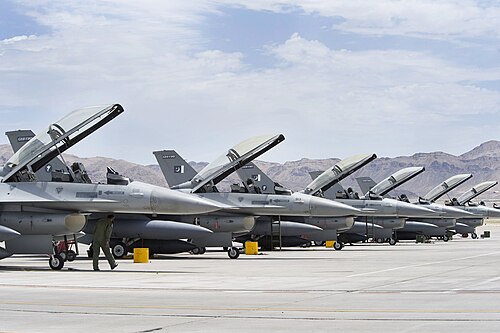
Lo and behold, you now have a platform that not only excels in air combat but it can also carry a variety of air-to-ground munitions and fight its way to the target and drop the load with unerring accuracy. It does not need to be protected by the legendary ‘Mustang’ escorts without which the US B-29s would have suffered very heavy casualties during their daylight forays into the German heartland during WW II. In effect, a true air-to-air platform automatically becomes a very effective strike aircraft. It achieves a swing role status in its true sense – the reverse, however, is not true. All fourth generation aircraft like the US F-22 and F-35, the French Rafael, the European Typhoon and the SU-30 series of Russia have adopted this philosophy. For the PAF, the F-16s enhanced its air combat capability besides adding a significant punch to its strike potential.
PAF in the First Decade of the 21st Century
The end of the 20th century and the beginning of the 21st century has witnessed a change in the threat dimension in the subcontinent and with it the dynamics of aerial warfare in the region has also altered. Veteran PAF combat pilots who had joined the service before the latter half of the 1960s had mastered the art of air combat by learning and specializing in high speed yoyos, low speed scissors, high and low speed barrel rolls and other air combat manoeuvres that were essential in close combat dogfights to obtain a position in the rear of the adversary from where the kill parameters of their aircraft gun/cannon and the first generation heat seeking air-to-air missiles could be achieved on the bandits. Good slow speed handling was considered a key factor during air combats of that era. Ground based radars were their only electronic eyes while the pilots relied on their keen eyesight to spot the bogies.
In the 1980s the induction of F-16s and all aspect heat seeking missiles brought about fresh air combat tactics and the concept of free and engaged fighters was born in the PAF. The more agile missiles permitted the achievement of kill parameters from higher angle offs and in some cases, even from a head on aspect. The virtue of excellence in slow speed handling got relegated to a large extent but overall, the changes were incremental and did not constitute a revolution in air combat tactics. By contrast, the PAF combat pilots of today operate under very different circumstances. BVR and even more capable and agile heat seeking all aspect air-to-air missiles, AEW&C platforms, air-to-air refuellers, GPS/INAS and other advancement in avionics have introduced air combat tactics vastly different from the ones their predecessors had employed. While individual brilliance, a keen eyesight and good aircraft handling were the keys to success in air combat in the 20th century, the combat crew of the 21st century rely on networking, greater team work and the ability to process and analyse the plethora of information being generated and displayed by their avionics systems. Being computer savvy has become an inescapable requirement for the current generation of air combat specialists of the PAF. Boldness, an aggressive frame of mind and professional mastery were essential traits of a fighter pilot then and it remains so in 2010 and beyond.
Current Challenges for the PAF
PAF since its inception in 1947 had been nurtured and configured to counter the Indian threat. Its doctrine, strategy and training were driven by an India-centric approach. Although during the 1980s, PAF was extensively employed operationally along its western border to counter and challenge the Soviet airspace violations but the focus on maintaining high preparedness and deterrence against the Indian threat was not lowered. The withdrawal of the Soviet forces from Afghanistan allowed the PAF to refocus all its attention towards the eastern threat.
A two-front threat scenario had always featured as a dangerous hypothesis for the PAF but in the 20th century, the threat visualisation was of a conventional nature from its two flanks, one emanating from India in the east and the other from Afghanistan in the west. Despite the preoccupation with the Soviet air threat in Afghanistan during the 1980s, a genuine two-front threat did not materialise. The instability in Pakistan’s Tribal Belts during US Operation Enduring Freedom in Afghanistan led to the deployment of the Pakistan Army in 2004 and it precipitated events that resulted in the rise of insurgency there. Since 2009, PAF has been extensively employed in counterinsurgency (COIN) operations in Swat and South Waziristan. With the Indian threat remaining unabated, PAF is now being confronted with a genuine albeit a different type of two front war scenario: an active one against the insurgents indulging in asymmetric warfare in the west and a latent conventional threat from the east where it cannot afford to lower its guards even temporarily. This is the current dilemma and challenge PAF is facing.
The nature of threat PAF faces from India in 2010 is different in scope and nature to what the service had to contend with in 2000. Similarly in the west the fear of a conventional threat has been relegated and instead, a fourth generation warfare (4GW) scenario has reared its ugly head. A realistic threat assessment from both the flanks would be necessary for formulation of the right strategies to deal with them.
Threat assessment
Up until the last decade of the 20th century, the Indian military threat was based on a full scale conventional war that would be spearheaded by a major land offensive by the Indian Army supported by the IAF and the Indian Navy (IN). In addition, IAF was expected to conduct operations against economic targets in Pakistan while the IN would attempt to enforce a naval quarantine or blockade. Pakistan’s undeclared policy of the ‘bomb in the basement’ since the latter half of the 1980s is believed to have been one of the factors that on a number of occasions prevented the eruption of the fourth India – Pakistan war.
In 1998, both India and Pakistan openly demonstrated their nuclear weapons capability and when the 2001 crisis erupted following the attack on the Indian parliament, the nuclear factor once again restrained the Indian leadership and an armed conflict was averted. Since then, India has been working, evaluating and implementing the Cold Start doctrine where they plan to launch a swift joint military campaign having limited objectives aiming to stay below the perceived nuclear threshold of Pakistan. By keeping the military objectives limited and placing the composite force (Battle Groups) close to the likely areas of employment the Indian military planners hope to drastically reduce the mobilisation period required for launching an invasion. The peace time locations of the current Indian Strike formations are well away from the border and their deployment for an offensive takes a long while providing Pakistan sufficient warning to mobilise their defensive effort. Cold Start doctrine would, in their opinion, remove this serious anomaly.
The numerous flaws in the concept, planning and execution of the doctrine notwithstanding, for the armed forces of Pakistan and for the PAF, suitable counter to any such eventuality has to be developed. Besides, while the Cold Start doctrine is being implemented, there is no reduction in the offensive elements of all the three military arms of India. It maintains the capability of launching a full scale conventional attack on Pakistan. The Armed Forces of Pakistan in which PAF is a key player, therefore, cannot afford to lower its deterrence against a fully fledged onslaught even as it prepares suitable responses to the Cold Start doctrine.
The threat from the west is not from a state but from non-state actors and is in the form of the Fourth Generation Warfare (4GW). What initially was restricted to Pashtuns from across the border in Afghanistan and locals from Pakistan’s tribal Belts, has now spread across the settled areas in Khyber Pukhtoonkhwa and the other three provinces. A number of splinter groups headed by Tehreek e Taliban Pakistan (TTP) and all adhering to the Al Qaeda and Taliban philosophy of establishing an Islamic Emirate in Afghanistan and Pakistan have resorted to armed insurgency and acts of terror across Pakistan. PAF is now involved in major counterinsurgency operations since 2009.
Air operations of the nature PAF is waging against the religious fanatics differ in a number of aspects as compared to a conventional war against another state. On the plus side first, against the insurgents and terror groups, PAF does not have to contest for gaining or maintaining air superiority – the command of the air is theirs by default because the insurgents have no, or at best rudimentary air power assets. The only threat to PAF platforms would be from small-arms fire, rocket launchers and perhaps a limited number of second generation shoulder-fired surface-to-air anti-aircraft missiles. These can be easily countered by staying above their limited ranges. Second, compared to a conventional war with another state, the tempo of operations would be much lower, involving only a portion of PAF’s total assets. Close support and interdiction missions will form the bulk of PAF’s air operations. And finally, in the context of PAF’s operations against the religious militants, it receives generous technical and logistics support from its allies in the western world who also feel threatened by the agenda of the extremists. Such a support is very unlikely if air operations are a result of a conflict between India and Pakistan.
On the negative side first, a 4GW adversary is a very slippery one; their foot soldiers reside and operate among the locals in small groups and wear no distinctive uniform. Their leaders too operate clandestinely and rely less on radio communication systems for command and control that can be detected and instead employ the slower but safer human couriers for the purpose. Their decentralized system does not require the sophisticated command and control apparatus of a conventional force. In effect, unlike a conventional force of a rival state, they are hard to detect and target. Second, the tempo of operations against the insurgents may be much slower but unlike wars in the subcontinent these can drag on for very long periods and on occasions even for a decade or longer. The cumulative effect of fatigue can sap the morale and will of the state.
Third, some degree of collateral damage of the enemy non-combatants in a state versus state conflict is acceptable as unintended consequences of war – against non-state actors, however, collateral damage can fatally compromise the mission objective as collateral damages in a home-grown insurgency will invariably result in the killing or destruction of property of the state’s own citizens. Since the centre of gravity of the insurgents lie in their ability to garner support of the locals, COIN operations by the state has to go at great lengths to ensure collateral damages are kept to a bare minimum so as not to lose the battle of hearts and minds of its own citizens to the rebels. This factor limits the use of force by the state and to an extent some of the inherent characteristics and strengths of air power are diluted.
Fourth, when nations are at war, public support is spontaneous. People will rally around the government and give their full approval for all offensive and defensive military actions. Maintenance of high motivation and morale at the initial stages and for as long as defeat does not appear inevitable is never an issue. It occurs automatically, especially if the nation has been aggressed upon. COIN operations against the religious extremists challenging the writ of the state and who happen to be the citizens of the country may not have full public support. The situation gets further complicated when in an Islamic state like Pakistan the insurgents’ stated objective is the implementation of their version of the Islamic Sharia. They draw their support from a segment of the conservative elements of the society. Even within the armed forces there may be a section that sympathise with their cause and do not wholeheartedly support the military operations. As the duration of operations prolong the difficulty in ensuring maintenance of motivation and morale becomes even more acute.
As reported by Reuters in Daily Times of 28 August 2010, the eastern and western threats are mutually exclusive, whose magnitude and type are quite different. The former is a conventional threat of a swift and dramatic attack if a terrorist outrage in India is determined by them to have been planned in Pakistan. The latter has an internal dimension, which is insidious and difficult to quantify. It is clear, serious and dangerous.
Response Options
This is a concept paper; hence the response options will be of a general nature and at the conceptual level. Since PAF has to simultaneously cater for two very different forms of threat, the response recommendations will be dealt with individually, with the inevitable link-ups, where applicable. An odd one may even appear suspiciously tactical in nature.