





(Land Corridor & Canal Options Linking the Persian Gulf to the Arabian Sea via Oman)
Introduction
The Strait of Hormuz represents one of the most critical maritime passages in the world. Situated between Iran to the north and Oman and the United Arab Emirates to the south, the narrow waterway connects the Persian Gulf with the Gulf of Oman and ultimately the Arabian Sea and the wider Indian Ocean.
At its narrowest point the strait is only about 33 kilometers wide, while the actual shipping lanes used by oil tankers are only a few kilometers across. Despite its relatively small geographic size, it serves as the primary maritime gateway for the export of energy resources from the Persian Gulf region to the rest of the world. In the contemporary global economy, where maritime transport accounts for more than 80 percent of international trade, the Strait of Hormuz occupies a uniquely critical position as the most important energy transit chokepoint on Earth.
The strategic significance of this passage stems not only from its geographic location but also from the extraordinary volume of energy commodities that pass through it each day. Any disruption in this narrow corridor has the potential to trigger immediate repercussions for global energy markets, international shipping, and the broader global economy.
Historical Development of the Strait of Hormuz as a Trade Route
a. Ancient and Medieval Maritime Trade
The importance of the Strait of Hormuz predates the modern oil economy by many centuries. During antiquity and the medieval period, the strait functioned as a crucial link between the civilizations of the Middle East, South Asia, East Africa, and the Mediterranean world.
Merchant vessels sailing between Mesopotamia, the Indian subcontinent, and the East African coast frequently passed through the strait as part of the broader Indian Ocean trading system. Goods transported through this maritime corridor included spices, textiles, pearls, precious metals, and ceramics.
During the medieval period, the Kingdom of Hormuz, located on Hormuz Island near the strait, emerged as a powerful trading center controlling commerce between Persia, Arabia, and India. The prosperity of this kingdom illustrates the long-standing economic importance of the maritime corridor.
b. Portuguese and European Maritime Control
The strategic importance of the strait became even more evident during the age of European maritime expansion. In the early sixteenth century, Afonso de Albuquerque captured the island of Hormuz in 1515, establishing Portuguese dominance over the strait and the surrounding maritime trade routes.
Control of the strait enabled Portugal to regulate the movement of goods between the Persian Gulf and the Indian Ocean, reinforcing its broader strategy of dominating global maritime trade routes during the Age of Exploration.
Portuguese control of Hormuz continued until the early seventeenth century, when Persian forces allied with the British East India Company expelled the Portuguese in 1622. Thereafter, the strait remained an important but relatively peaceful trade corridor linking Persian Gulf ports with global maritime commerce.
Emergence of the Strait as an Energy Chokepoint
Rise of the Oil Economy
The strategic importance of the Strait of Hormuz increased dramatically in the twentieth century with the discovery and large-scale exploitation of petroleum resources in the Persian Gulf region. Major oil reserves discovered in Saudi Arabia, Kuwait, Iraq, Qatar, and the United Arab Emirates transformed the Gulf into the world’s primary energy production hub.
As global demand for oil expanded after World War II, tanker shipping through the Strait of Hormuz increased exponentially. The waterway became the primary exit route for Gulf petroleum exports destined for Europe, Asia, and North America.
By the late twentieth century, the strait had effectively become the single most important artery for global oil transportation.
Trade Volume and Energy Transit through the Strait
The scale of energy transit through the Strait of Hormuz illustrates its unparalleled importance to the global economy.
According to international energy market data:
● Approximately 20–21 million barrels of crude oil and petroleum products pass through the strait each day. (en.maaal.com)
● This volume represents around 20 percent of total global oil consumption. (en.maaal.com)
● It accounts for about one quarter to one third of global seaborne oil trade. (Ballast Markets)
● It accounts for about one quarter to one third of global seaborne oil trade. (Ballast Markets)
● In financial terms, this energy flow represents more than $1 trillion annually in petroleum trade value. (Ballast Markets)
In addition to crude oil shipments, the Strait of Hormuz is also a critical transit route for natural gas exports:
● Approximately 20 percent of global liquefied natural gas (LNG) trade passes through the strait, largely originating from Qatar. (en.maaal.com)
The combination of crude oil, refined petroleum products, and LNG makes the strait the most economically valuable maritime trade corridor in the world.
Major Energy Exporting Countries Using the Strait
Several of the world’s largest oil-producing states rely heavily on the Strait of Hormuz for the export of their energy resources.
Major exporters using the route include
● Saudi Arabia
● Iraq
● Kuwait
● Qatar
● United Arab Emirates
●Iran
In 2024–2025 the approximate daily export flows through the strait were estimated as follows:
| Country | Approx Daily Flow (million barrels) |
| Saudi Arabia | 5.5 |
| Iraq | 3.7 |
| UAE | 2.9 |
| Kuwait | 2.1 |
| Iran | 1.8 |
| Qatar (condensate & LNG equivalent) | 1.5 |
These figures highlight the extraordinary dependence of Gulf oil exporters on a single maritime passage.
Some states possess limited alternative export routes through pipelines, but these alternatives remain insufficient to fully replace Hormuz shipping capacity.
For example:
● Saudi Arabia’s East-West Petroline pipeline to the Red Sea can transport about 2.6 million barrels per day, far below the kingdom’s total export capacity. (Ballast Markets)
Consequently, even partial disruption of the strait could severely restrict the ability of Gulf producers to export oil.
Major Importing Regions Dependent on the Strait
While Gulf States depend on the strait for exporting oil, many of the world’s largest economies depend on it for importing energy.
Approximately 84 percent of crude oil passing through the strait is destined for Asian markets. (en.maaal.com)
The primary importers include:
● China
● India
● Japan
● South Korea
Together these four Asian economies account for nearly 70 percent of total crude oil shipments passing through the strait. (en.maaal.com)
These countries rely heavily on Middle Eastern energy supplies to sustain industrial production, electricity generation, and transportation sectors.
Even the United States, despite increasing domestic production, continues to import a portion of Gulf crude through the strait. In 2024 the United States imported roughly 500,000 barrels per day from Persian Gulf states via this route. (en.maaal.com)
Financial and Economic Impact of the Strait
The economic value of energy trade passing through the Strait of Hormuz is immense.
● Assuming an average oil price of $80 per barrel, the daily oil flows of approximately 20 million barrels per day represent a daily trade value of $1.6 billion per day
● On an annual basis this equates to more than $580 billion in crude oil trade alone
When LNG exports and petroleum products are included, the total annual value of energy trade passing through the strait can exceed $1 trillion. (Ballast Markets)
Any disruption of this corridor therefore carries the potential to trigger significant economic consequences, including:
● sudden spikes in global oil prices
● increased transportation costs
● inflation in energy-dependent economies
● disruptions to industrial production and supply chains.
Historical experience demonstrates that even minor geopolitical tensions in the Gulf can cause immediate volatility in global energy markets.
Strategic Vulnerabilities and Security Risks
The Strait of Hormuz has long been considered one of the world’s most vulnerable maritime chokepoints due to its geographic constraints and proximity to regional geopolitical tensions.
Several factors contribute to this vulnerability.
a. Narrow navigation channels
The strait’s shipping lanes are extremely narrow, making tanker traffic vulnerable to:
● naval blockades
● sea mines
● missile attacks
● maritime accidents
b. Regional geopolitical tensions
The waterway lies adjacent to Iran, which has repeatedly threatened to close the strait during periods of political confrontation with Western powers.
c. Limited alternative routes
Although some pipelines bypass the strait, these routes can only handle 3.5–5.5 million barrels per day, far below the total volume normally transported through Hormuz. (rudawrc.net)
This means that the majority of Gulf energy exports remain dependent on the strait.
Potential Global Economic Consequences of Disruption
Any closure or severe disruption of the Strait of Hormuz would have immediate and far-reaching consequences. Energy analysts estimate that blocking the strait could remove 20 million barrels per day from global markets, representing nearly one-fifth of global oil supply. (en.maaal.com)
Such a disruption could trigger:
● oil prices exceeding $100–130 per barrel
● severe energy shortages in Asia
● economic slowdowns in major industrial economies
● instability in global financial markets
Furthermore, LNG markets would be particularly vulnerable because most LNG exports from Qatar rely entirely on this maritime route. (SpecialEurasia)
Countries dependent on LNG for electricity generation would face serious energy shortages if shipments were interrupted.
Detailed Timeline of Major Crises in the Strait of Hormuz (1980–2026)
The Strait of Hormuz has been a persistent flashpoint in international security for more than four decades. Although the strait has rarely been completely closed, geopolitical tensions, military confrontations, and maritime incidents have repeatedly threatened the security of global energy flows.
1. The Tanker War during the Iran–Iraq Conflict (1984–1988)
The first major crisis involving the Strait of Hormuz occurred during the Iran–Iraq War. By the mid-1980s, both Iran and Iraq began attacking oil tankers and commercial vessels transporting petroleum from Gulf States.
This phase of the war, commonly known as the “Tanker War,” resulted in:
● Over 450 commercial ships attacked in the Persian Gulf region.
● Numerous tankers damaged or sunk.
● Major disruptions to shipping insurance and freight markets. (WarCosts)
Because Kuwait’s oil exports were being targeted, the United States initiated Operation Earnest Will, escorting Kuwaiti tankers through the Strait of Hormuz under the American flag.
During this period several significant incidents occurred:
● The American frigate USS Stark was struck by an Iraqi missile in 1987, killing 37 sailors. (WarCosts)
● The U.S. warship USS Samuel B. Roberts hit an Iranian naval mine in 1988. (WarCosts)
In retaliation, the United States launched Operation Praying Mantis, destroying several Iranian naval vessels and offshore military platforms. It was the largest U.S. naval combat operation since World War II. Despite intense hostilities, the strait itself remained open, demonstrating the international community’s determination to maintain freedom of navigation.
2. Gulf War and Regional Security Crisis (1990–1991)
Another major threat to Gulf shipping occurred following the Iraqi invasion of Kuwait.
The conflict disrupted oil exports from both Kuwait and Iraq, removing more than 4 million barrels per day from global supply and causing oil prices to surge from approximately $17 to nearly $40 per barrel within months. (WarCosts)
During the conflict, coalition naval forces deployed heavily throughout the Persian Gulf to protect commercial shipping and ensure continued access to the Strait of Hormuz.
3. The 2008 U.S.–Iran Naval Confrontation
In January 2008 tensions escalated when Islamic Revolutionary Guard Corps (IRGC) speedboats approached three U.S. Navy warships transiting the strait.
Radio transmissions from Iranian boats reportedly warned: “You will explode in a few minutes.”
Although the confrontation did not escalate into direct combat, it demonstrated the fragile security environment in the narrow shipping lanes and highlighted the possibility that a miscalculation could trigger a wider military conflict. (WarCosts)
4. Sanctions Crisis and Closure Threats (2011–2012)
Tensions rose again when international sanctions were imposed on Iran over its nuclear program.
Iranian leaders publicly warned that the country could block the Strait of Hormuz if sanctions severely limited its oil exports.
Iran’s vice president at the time declared: “Not a drop of oil will pass through the Strait of Hormuz.”
In response, the United States Navy deployed additional aircraft carriers and naval forces to the region to ensure that the strait remained open for international shipping. (WarCosts)
5. The Persian Gulf Shipping Crisis (2019)
One of the most serious recent security crises occurred in 2019 during escalating tensions between Iran and the United States.
Several major incidents occurred:
● May 2019 sabotage attacks
Four commercial ships were damaged near the coast of the Fujairah in the Gulf of Oman in what was widely described as a sabotage attack. (Wikipedia)
● June 2019 tanker attacks
Two oil tankers were attacked while transiting near the Strait of Hormuz, damaging both vessels and injuring crew members. (Wikipedia)
● Drone shot down
Iran shot down a U.S. surveillance drone in the region, bringing the two countries close to open military confrontation. The incidents caused insurance premiums for shipping through the strait to surge dramatically and raised global oil prices.
6. Maritime Seizures and Regional Escalation (2021–2024)
Tensions in the strait continued in the early 2020s with multiple ship seizures and attacks attributed to Iranian forces.
A notable incident occurred in April 2024 when Iranian commandos seized the container ship MSC Aries, boarding it by helicopter and diverting it into Iranian waters. (Wikipedia)
Several other tankers and merchant vessels linked to Israeli or Western companies were also targeted in drone attacks and seizures in the wider Persian Gulf region. (Wikipedia)
These actions intensified concerns among shipping companies about the security of maritime transit through the strait.
7. The 2026 Strait of Hormuz Crisis
The most severe disruption in the history of the strait occurred in February 2026 following military strikes by the United States and Israel against Iranian military targets.
In response, Iran effectively declared the strait closed and began targeting commercial vessels attempting to transit the waterway. (Wikipedia)
Key developments included:
● Missile and drone attacks on merchant ships.
● Naval mine deployment in the shipping lanes.
● More than 150 ships stranded outside the strait. (Wikipedia)
Tanker traffic dropped dramatically, affecting approximately 20% of global oil supply and causing a sharp increase in oil prices worldwide. (Wikipedia)
Some estimates suggest the disruption represented the largest shock to the global energy market since the 1970s oil crisis. (Wikipedia)
Strategic Military Control of the Strait of Hormuz
Geographic Characteristics
The Strait of Hormuz is strategically significant because of its narrow geography. At its narrowest point it is approximately 21 nautical miles wide, with shipping lanes only a few kilometers across. (The Guardian)
The strait is bordered by:
● Iran to the north
● Oman and the United Arab Emirates to the south.
This geography allows coastal states—particularly Iran—to deploy missiles, naval mines, and small fast-attack boats capable of threatening commercial vessels.
Iranian Military Capabilities
Iran has developed a strategy designed specifically to control or disrupt traffic through the strait during wartime. Key elements of this strategy include:
● Naval mines
Iran possesses thousands of naval mines capable of blocking tanker traffic in narrow shipping lanes.
● Anti-ship missiles
Missile batteries positioned along Iran’s coastline can target ships transiting the strait.
● Fast attack craft
The Islamic Revolutionary Guard Corps Navy operates large numbers of small high-speed boats designed for “swarm attacks” against larger naval vessels.
● Drones and missile systems
Iran has increasingly relied on drone warfare and precision missile strikes against commercial shipping. (Barron’s)
These asymmetric capabilities are designed to compensate for Iran’s relatively smaller conventional navy.
United States and Allied Naval Presence
To counter potential threats, the United States maintains a significant naval presence in the Persian Gulf region.
The headquarters of the United States Fifth Fleet is located in Manama.
The fleet is responsible for securing maritime routes across the Persian Gulf, the Arabian Sea and the Red Sea.
Key assets deployed in the region typically include:
● Aircraft carrier strike groups
● Guided missile destroyers
● Mine-countermeasure vessels
● Maritime patrol aircraft
● Surveillance drones.
International coalitions have also been established to protect shipping in the region, including multinational maritime security initiatives designed to escort commercial vessels.
Chokepoint Control and Naval Strategy
Control of the Strait of Hormuz depends on three primary factors:
● Sea control
Naval forces must maintain the ability to operate freely in the strait while preventing hostile actors from disrupting shipping.
● Air superiority
Air power is critical for detecting mines, monitoring maritime traffic, and protecting shipping lanes.
● Mine-countermeasure operations
Naval mines represent one of the most significant threats to shipping. Clearing mines can take weeks or months, which means even a limited mining campaign could temporarily shut down global oil transit.
Strategic Implications
Because approximately one-fifth of global oil supply passes through the Strait of Hormuz, control of the waterway carries immense geopolitical importance.
Any conflict in the region has the potential to:
● disrupt global energy markets
● trigger oil price spikes
● threaten international shipping
● destabilize global financial systems.
Global Economic Impact Scenarios if the Strait of Hormuz is Closed
The Strait of Hormuz remains the most critical energy transit corridor in the world. Approximately 20–21 million barrels of crude oil per day, representing nearly 20 percent of global petroleum consumption, pass through this narrow waterway. In addition, about 20 percent of global liquefied natural gas (LNG) trade also transits the strait.
A temporary or prolonged closure of this maritime corridor would therefore have severe economic consequences for the global energy market. To understand the magnitude of the threat, analysts often examine possible disruption scenarios based on the duration of closure.
Scenario 1: 30-Day Closure
A closure lasting one month would already create significant disruption in global energy markets.
Immediate Effects
● Removal of approximately 600 million barrels of oil supply from global markets during the 30-day period.
● Rapid surge in crude oil prices potentially reaching $120–150 per barrel.
● Severe disruptions in LNG shipments, particularly from Qatar, the world’s leading LNG exporter.
Countries Most Affected
Major Asian economies would be the first to experience supply shortages, particularly:
● China
● India
● Japan
● South Korea
These countries collectively import more than two-thirds of the oil passing through the Strait.
Economic Impact
A one-month disruption could trigger:
● Significant increases in transportation costs.
● Rising electricity prices in energy-dependent economies.
● Temporary slowdown in industrial production.
Although global strategic petroleum reserves might partially offset supply losses, the psychological impact on markets could still drive severe price volatility.
Scenario 2: 60-Day Closure
A two-month disruption would produce much deeper economic consequences.
Oil Supply Shock
During a 60-day closure:
● Approximately 1.2 billion barrels of crude oil would be prevented from reaching global markets.
This would represent the largest supply shock since the oil crises of the 1970s.
Energy Price Effects
Crude oil prices could potentially rise to:
$150–200 per barrel
Natural gas prices in Asia and Europe would also increase sharply due to disruption of LNG exports from Qatar.
Industrial and Economic Consequences
A prolonged disruption could lead to:
● Global inflation spikes.
● Declining manufacturing output in Asia.
● Financial market instability.
Energy-dependent industries such as aviation, shipping, petrochemicals, and heavy manufacturing would experience major cost increases.
Scenario 3: 90-Day Closure
A three-month closure would likely trigger a severe global economic crisis.
Strategic Energy Emergency
In this scenario
● Nearly 2 billion barrels of oil supply would be removed from global markets.
Even if emergency reserves were released by major consuming countries, the supply gap would remain extremely large.
Global Oil Price Shock
Oil prices could potentially exceed:
$200 per barrel
Such price levels would likely cause:
● recession in many major economies
● global financial market volatility
● significant decline in economic growth.
Impact on Global Trade
Higher energy costs would affect nearly all sectors of the global economy, including:
● shipping
● aviation
● food production
● manufacturing
Developing economies heavily dependent on imported energy would be particularly vulnerable.
Feasibility Analysis of the Gulf–Oman Energy Corridor and Canal Alternative
Oman’s strategic geographical position overlooking the Arabian Sea and located close to major international shipping routes has increasingly positioned the country as an important maritime and logistics hub in the Middle East. Unlike several Gulf States whose ports lie inside the Strait of Hormuz, Oman’s ports open directly to the Indian Ocean, offering shipping lines immediate access to global maritime routes.
Recognizing this advantage, the Omani government has invested heavily in modern port infrastructure, logistics corridors, and industrial zones in order to diversify its economy away from dependence on oil revenues. Major ports such as Salalah, Sohar, and Duqm are undergoing large-scale expansion and modernization projects aimed at transforming Oman into a key regional center for trade, transshipment, and industrial production.
These initiatives are closely aligned with Oman Vision 2040, which prioritizes logistics, manufacturing, and global trade integration as major drivers of long-term economic growth.
Economic Diversification and Maritime Development
For decades, Oman’s economy relied heavily on hydrocarbon exports. However, fluctuating oil prices and the need for sustainable economic growth prompted the government to launch an ambitious diversification strategy.
As part of this policy shift, billions of dollars have been invested in port development, industrial zones, logistics infrastructure, and transportation networks. These investments aim to create an integrated maritime and logistics ecosystem capable of supporting regional trade flows and attracting foreign investment.
The development of the Port of Duqm is one of the most prominent examples of this strategy. Located outside the Strait of Hormuz on the Arabian Sea coast, Duqm is being developed as a major deep-water port and industrial city. It is designed to host petrochemical plants, manufacturing facilities, energy projects, and logistics services, thereby creating an alternative maritime gateway for regional trade.
Trade Agreements and International Partnerships
Oman has strengthened its international trade position through multiple bilateral and regional agreements. The country has signed free trade agreements with several major economies, including the United States, Singapore, and New Zealand. These agreements provide preferential market access, reduce tariffs, and encourage foreign investment in Oman’s logistics and industrial sectors. In addition, Oman remains an active member of the Gulf Cooperation Council (GCC), allowing it to benefit from regional economic integration and shared trade frameworks. Through these partnerships, Oman seeks to position its ports as gateways linking Gulf markets with Asia, Africa, and Europe.
Transformation of Logistics and Infrastructure
Oman’s logistics sector is undergoing rapid transformation through extensive infrastructure development. The government has prioritized the construction of modern highways, logistics parks, and future rail connections aimed at improving connectivity between ports and inland industrial zones.
Technology-driven supply chains, digital port management systems, and smart logistics solutions are also being introduced to improve efficiency and reduce shipping delays. These measures are intended to enhance Oman’s competitiveness against established regional logistics hubs.
The modernization of logistics infrastructure has significantly strengthened the role of Omani ports in supporting international trade and facilitating cargo movement across the Gulf region.
Role of Ports in Oman’s Economic Transformation
Oman currently operates seven major seaports which collectively handle approximately 77 percent of the country’s total trade volume. These ports form the backbone of Oman’s maritime economy and are central to its ambition of becoming a regional logistics hub.
Major Omani Ports
1. Port of Salalah
The Port of Salalah is Oman’s largest and most important transshipment hub. Strategically located near major East–West shipping routes, it serves as a major gateway for cargo moving between Asia, Europe, and Africa.
The port accommodates ultra-large container vessels and handles a wide range of cargo types. With an expanded container capacity of approximately 6.5 million TEUs, following a $300 million investment, Salalah ranks among the most efficient container ports globally.
In recent years, the port has handled more than 3.3 million TEUs annually, strengthening Oman’s position in global maritime trade.
2. Port of Sohar
The Port of Sohar serves as one of the region’s major industrial and logistics centers. It specializes in handling bulk cargo, petrochemicals, metals, and agricultural products. The port is integrated with a 4,500-hectare Industrial Free Zone, which hosts numerous international companies engaged in manufacturing and energy-related industries.
Recent operational data shows significant growth in activity at Sohar, including:
● 15% increase in container throughput
● 25% rise in roll-on/roll-off (Ro-Ro) cargo traffic
● 72% increase in bulk cargo volumes
These developments highlight Sohar’s growing role as a regional logistics hub.
3. Port of Duqm
The Port of Duqm represents one of the most ambitious maritime projects in the Gulf region. Designed as a deep-water port within a 2,000 square kilometer industrial zone, Duqm aims to become a center for heavy industry, energy production, and logistics. The port handles multiple cargo categories including breakbulk, dry bulk, liquid bulk, and project cargo.
Currently, Duqm is undergoing a $550 million expansion project, which includes the construction of new container terminals and industrial facilities. The port is also expected to play a significant role in emerging industries such as green hydrogen and green steel production.
Other Strategic Ports
In addition to the three major ports, Oman operates several smaller but strategically important ports:
● Port Sultan Qaboos – transitioning into a major cruise tourism terminal
● Port of Qalhat – Oman’s primary LNG export facility
● Port Suwaiq – serving as a commercial gateway for regional trade
● Port of Khasab – supporting trade and tourism in the Musandam Governorate
Together, these ports contribute to Oman’s maritime network and support regional connectivity.
Comparison with Major Gulf Ports
Despite rapid development, Omani ports still operate in a competitive environment dominated by several established regional ports.
Jebel Ali Port (UAE) Jebel Ali Port in Dubai is one of the world’s largest logistics hubs, handling approximately 15.5 million TEUs annually with a capacity of 19.4 million TEUs. Its advanced logistics infrastructure and global shipping connectivity make it the dominant maritime hub in the Gulf region.
Hamad Port (Qatar) Hamad Port is a modern facility designed to support Qatar’s trade and energy exports. It has a container handling capacity of approximately 7.5 million TEUs and plays a key role in Qatar’s import and export logistics.
Jeddah Islamic Port (Saudi Arabia) Jeddah Islamic Port serves as Saudi Arabia’s primary gateway for imports. It handles approximately 130 million tons of cargo annually and has a container capacity of around 8.8 million TEUs.
Potential of Omani Ports in Regional Trade
Oman’s ports possess several strategic advantages that could enable them to play a larger role in regional and international trade.
● Strategic Location
Unlike many Gulf ports that require ships to pass through the Strait of Hormuz, several Omani ports have direct access to the Arabian Sea. This provides shipping lines with a potentially safer and faster route for global trade.
● Growing Capacity
Oman’s ports are steadily expanding their capacity through major infrastructure projects. The expansion of Salalah and Duqm demonstrates the country’s long-term commitment to strengthening its maritime sector.
● Industrial Integration
The integration of ports with industrial zones, particularly in Sohar and Duqm, creates opportunities for manufacturing, petrochemical processing, and logistics services.
● Limitations and Challenges
Despite these advantages, replacing established regional ports such as Dubai’s Jebel Ali or Saudi Arabia’s Jeddah Islamic Port would be difficult in the short term.
● Several challenges remain:
Infrastructure Scale:
Major Gulf ports currently operate at a much larger scale, handling significantly higher cargo volumes.
● Logistics Connectivity:
Oman still needs stronger transport links connecting its ports with regional markets and inland trade corridors.
● Energy Export Capacity:
Although ports such as Sohar and Duqm handle oil and LPG cargo, matching the export capacity of Saudi Arabia or Qatar would require substantial additional investment.
● Shipping Network Integration:
Major global shipping companies have long-standing logistical arrangements with existing hubs such as Dubai.
Required Infrastructure Upgrades
To fully compete with regional maritime hubs, Oman would need to undertake several key infrastructure improvements:
● Expansion of port berths and cargo yards
● Acquisition of additional container handling equipment
● Strengthening inland logistics corridors
● Integration of advanced digital port management systems
● Development of rail connectivity with neighboring countries
Examples of ongoing investments include:
● Salalah Port expansion – approximately $300 million
● Duqm Port development – approximately $550 million
● Suwaiq Port upgrades – approximately $2.6 million
Strategic Importance for Gulf Trade
Oman’s ports could significantly influence regional trade dynamics by providing alternative maritime routes and additional logistics capacity.
Their location near major international shipping lanes enables them to serve as transshipment centers linking Gulf markets with Asia, Africa, and Europe.
In certain scenarios, particularly during geopolitical tensions affecting the Strait of Hormuz, Omani ports may also provide alternative access routes for regional trade and energy exports.
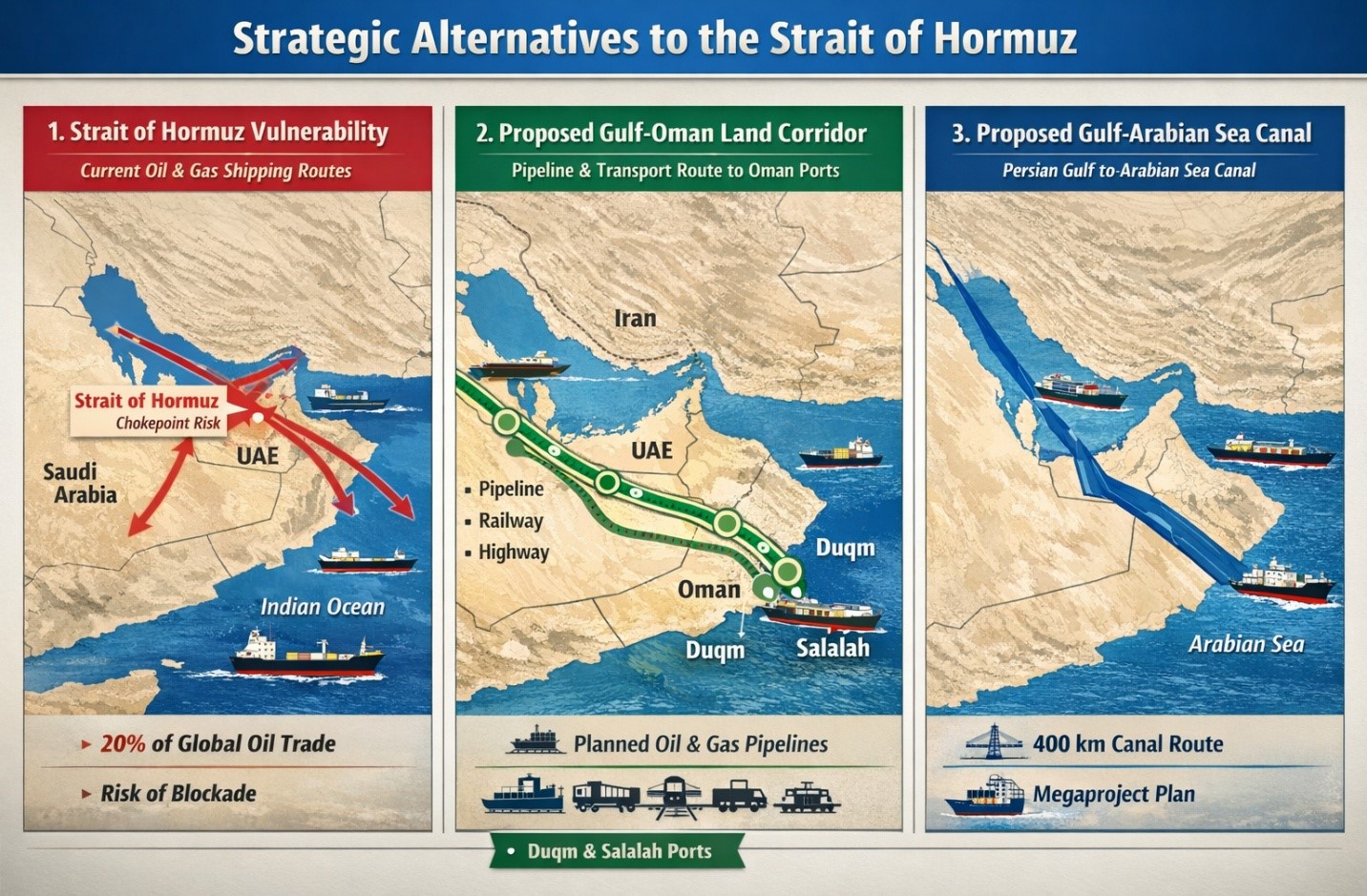
Given the vulnerability of the Strait of Hormuz, several strategic alternatives have been proposed to bypass the Strait entirely. Among these proposals, the most prominent include:
1. A Gulf–Oman land energy corridor consisting of pipelines and transport infrastructure.
2. A Persian Gulf–Arabian Sea canal connecting Gulf waters directly to the open ocean through Oman.
Option 1: Gulf–Oman Land Energy Corridor
The first and most practical option involves constructing an integrated energy corridor linking major Gulf oil fields to ports on the Oman coast.
Proposed Infrastructure
Key components could include:
● high-capacity crude oil pipelines
● natural gas pipelines
● freight rail networks
● highways and logistics hubs
● export terminals and storage facilities.
These pipelines could transport energy from:
● Saudi Arabia
● United Arab Emirates
● Kuwait
● Qatar
to deep-water ports on the Arabian Sea.
Key export terminals could include:
● Port of Duqm
● Port of Salalah
● Port of Sohar
Strategic Advantages
This approach offers several important benefits:
1. Complete bypass of the Strait of Hormuz.
2. Reduced vulnerability to maritime conflict.
3. Faster shipping routes to Asian markets.
4. Strengthening of Oman as a regional logistics hub.
Estimated Cost and Construction Time
The estimated cost of such a corridor could range between:
$80 billion – $120 billion
Construction time:
8–12 years
Compared to a canal project, this option is considered significantly more feasible.
Option 2: Persian Gulf–Arabian Sea Canal
A more ambitious proposal involves constructing a mega-canal linking the Persian Gulf directly to the Arabian Sea through Oman.
This concept is often compared with major global maritime canals such as:
● Suez Canal
● Panama Canal
Proposed Canal Characteristics
Possible dimensions could include:
Length: 400–700 kilometers
Depth: 25–30 meters
Width: 300 meters or more
Such dimensions would allow passage of large oil tankers and container vessels.
Engineering Challenge
However, several major obstacles exist:
1. Mountainous terrain in northern Oman.
2. Large-scale desert excavation.
3. Environmental risks and water management issues.
4. Extremely high financial cost.
5. Estimated Cost
6. Total construction cost could exceed:
7. $300 billion – $400 billion
8. Construction time could require 15–20 years.
Comparative Assessment
From a strategic and economic perspective, the pipeline-based land corridor appears significantly more practical
| Factor | Land Corridor | Canal Project |
| Cost | $80–120 billion | $300–400 billion |
| Construction time | 8–12 years | 15–20 years |
| Engineering complexity | Moderate | Extremely high |
| Security benefits | High | Very high |
Option3 (Most Realistic Hybrid Model)
Instead of a full canal, a pipeline + rail + port system would be far more practical.
Suggested model: Energy pipelines from:
● Saudi Arabia
● UAE
● Qatar
to Port of Duqm and Port of Salalah.
This system could export:
● crude oil
● LNG
● refined products
● petrochemicals
directly into the Arabian Sea shipping lanes.
Why Oman is Ideal for This Strategy
Advantages of Oman:
1. Located outside the Strait of Hormuz
2. Direct access to the Arabian Sea
3. Political neutrality in regional conflicts
4. Deep-water ports already under development
5. Large available coastal land for energy terminals
Key ports:
● Port of Duqm
● Port of Salalah
● Port of Sohar
Strategic Global Impact
If implemented, this system could: • Reduce global oil market vulnerability
● Protect Gulf exports during war
● Shift logistics power toward Oman
● Create a new global energy corridor
Similar in impact to:
● the Suez Canal
● or the Panama Canal
Strategic Policy Recommendations for Gulf States and Global Energy Security
The continued dependence of global energy markets on the Strait of Hormuz represents one of the most significant vulnerabilities in the contemporary international economic system.
Nearly one-fifth of the world’s oil supply and a substantial share of global liquefied natural gas exports pass through this narrow maritime corridor.
As geopolitical tensions in the Middle East persist and the strategic competition among regional and global powers intensifies, the risks associated with disruption of this critical chokepoint remain considerable.
To mitigate these vulnerabilities, both regional governments and the broader international community must adopt a combination of infrastructure development, maritime security cooperation, and strategic energy planning.
The following policy recommendations outline practical measures that could enhance global energy security and reduce dependence on a single maritime route.
1. Development of Alternative Energy Export Corridors
One of the most effective ways to reduce vulnerability to disruption in the Strait of Hormuz is the creation of alternative export routes that bypass the strait entirely.
Gulf States such as Saudi Arabia, United Arab Emirates, and Qatar should expand pipeline infrastructure connecting their oil and gas fields directly to ports located outside the Persian Gulf.
A particularly promising option involves developing a Gulf–Oman energy corridor, linking Gulf hydrocarbon resources with major ports on the Arabian Sea coast of Oman. Export terminals such as Port of Duqm and Port of Salalah are strategically located beyond the Strait of Hormuz and therefore offer secure access to international shipping routes.
Such infrastructure would significantly enhance the resilience of Gulf energy exports during periods of geopolitical instability.
2. Expansion of Strategic Petroleum Reserves
Major energy-importing economies must strengthen their strategic petroleum reserves in order to buffer potential supply disruptions originating from the Persian Gulf region.
Countries such as China, India, Japan, and South Korea depend heavily on oil transported through the Strait of Hormuz. Expanding national emergency reserves would enable these countries to maintain domestic energy stability in the event of temporary shipping disruptions.
In parallel, international coordination mechanisms among major consuming nations should be strengthened to allow rapid and coordinated release of strategic reserves during global energy crises.
3. Strengthening Multinational Maritime Security Cooperation
Ensuring the security of commercial shipping in the Persian Gulf requires sustained multinational naval cooperation.
The United States-led maritime security architecture in the region, supported by partners such as the North Atlantic Treaty Organization and other international maritime coalitions, has played a crucial role in protecting freedom of navigation.
Enhanced cooperation could include:
● joint naval patrols
● coordinated maritime surveillance
● intelligence sharing
● joint mine-countermeasure operations.
Such initiatives would reduce the risk of piracy, sabotage, and state-sponsored maritime disruption.
Diversification of Global Energy Supply Sources
Reducing reliance on a single geographic region for energy supplies is essential for long-term global economic stability.
Major importing countries should continue diversifying their energy sources by expanding supply partnerships with producers in:
● North America
● West Africa
● Central Asia.
In addition, investments in renewable energy, hydrogen fuel technologies, and alternative energy infrastructure can gradually reduce dependence on Middle Eastern hydrocarbons.
5. Diplomatic Engagement and Regional Stability
Long-term stability of the Persian Gulf region ultimately depends on diplomatic engagement and conflict prevention among regional actors.
Confidence-building measures between rival states—including maritime communication mechanisms, crisis-management hotlines, and multilateral dialogue forums—can reduce the likelihood of miscalculation or escalation in the Strait of Hormuz.
Regional diplomatic initiatives involving Iran, Saudi Arabia, and other Gulf states may contribute to lowering tensions and maintaining safe maritime navigation.
6. Development of Oman as a Global Logistics and Energy Hub
Given its strategic location outside the Strait of Hormuz, Oman possesses considerable potential to become a major logistics and energy export hub.
Large-scale investment in port infrastructure at Port of Duqm, Port of Salalah, and Port of Sohar could transform the country into a key node in global maritime trade networks.
By linking Gulf energy producers to these ports through pipelines, railways, and highways, Oman could serve as a secure alternative gateway connecting the Persian Gulf region with international markets across the Arabian Sea and the broader Indian Ocean.
Strategic Conclusion
The most feasible alternative to the Strait of Hormuz is not a canal but a Gulf–Oman energy corridor consisting of pipelines, highways, railways, and mega-export terminals at Duqm and Salalah.
Such a system could eventually carry 30–40% of Gulf energy exports, dramatically enhancing global energy security while transforming Oman into the primary logistics and export hub of the Arabian Sea region.
Conclusion
The Strait of Hormuz remains one of the most critical chokepoints in the global energy system, serving as the primary maritime gateway through which vast quantities of oil and liquefied natural gas from the Persian Gulf reach international markets. Despite its narrow geographical dimensions, the strait sustains the economic lifelines of both major energy exporters and importing economies, particularly in Asia. However, the heavy concentration of global energy flows through a single strategic corridor represents a significant vulnerability for the international economic system. Political tensions, military confrontation, or maritime incidents in this region could rapidly disrupt energy supplies and trigger global economic instability. In this context, the development of alternative export routes and diversified energy transportation infrastructure has become an increasingly important strategic priority. Among the potential options, the expansion of energy and logistics corridors linking Gulf producers with ports on Oman’s Arabian Sea coast offers a practical long-term solution for reducing dependence on the Strait of Hormuz. Oman’s sustained investment in maritime infrastructure—including the development of the ports of Salalah, Sohar, and Duqm—reflects a broader national vision to transform the country into a major regional logistics and trade hub under Vision 2040. While these ports are unlikely to immediately replace established regional hubs such as Jebel Ali or Jeddah Islamic Port, their strategic location outside the Strait of Hormuz, combined with modern infrastructure and expanding industrial zones, positions them as important complementary nodes in the evolving Gulf maritime network.
Over time, continued investment, technological modernization, and deeper regional economic integration will determine the extent to which Oman can strengthen its role in global energy transportation and emerge as a key pillar of regional trade resilience.