
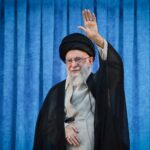
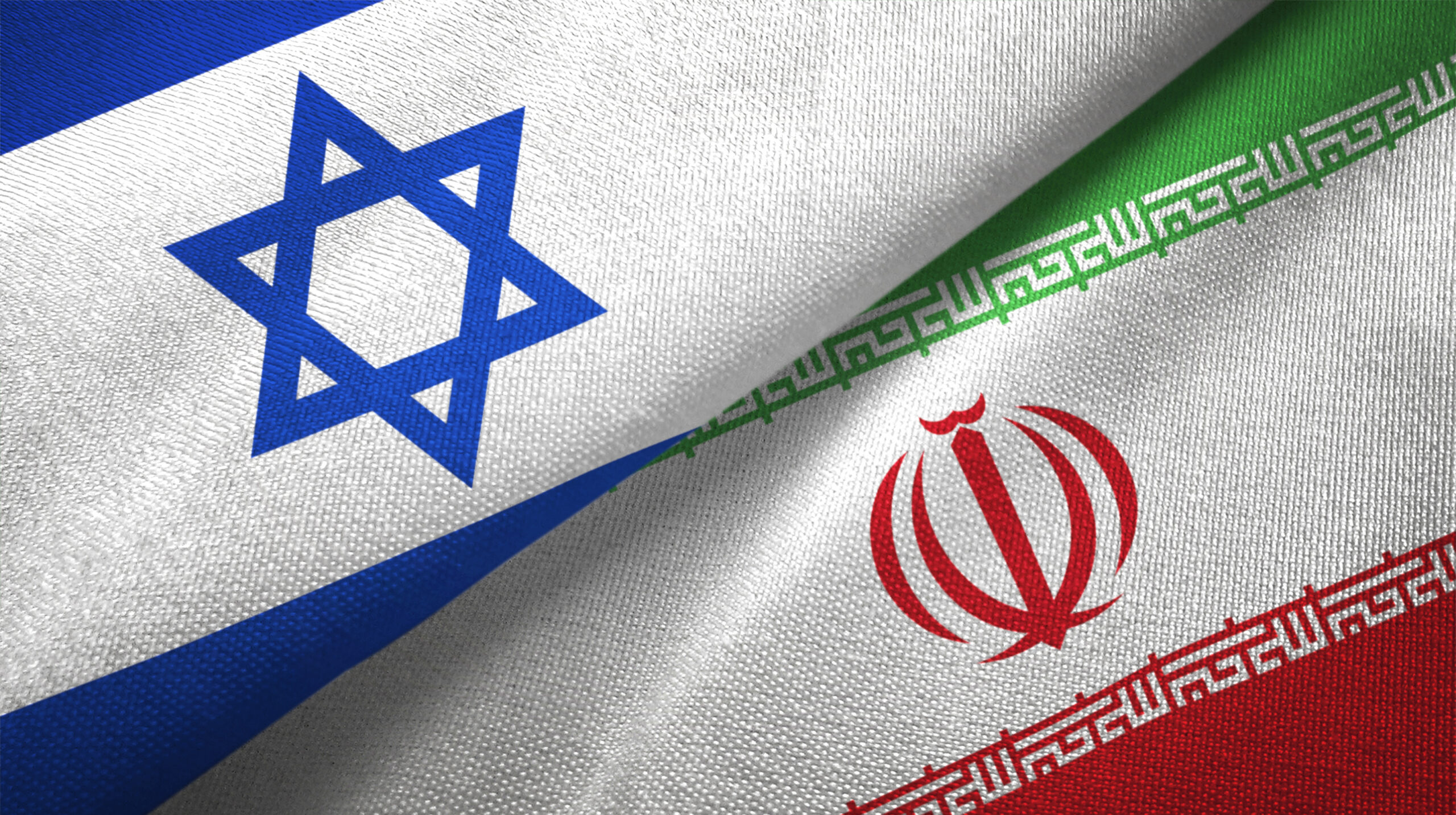
The conflict in the Middle East which has the potential of becoming a wider conflict involve more countries actively (US and Israel versus Iran) and passively (Gulf Countries and Saudi Arabia, Jordan, Lebanon and even Cyprus) has once again raised troubling questions about the future of humanity. The focus across the world inevitably turns toward peace, security, and the value of human life. While many innocents have already lost their lives, one remains hopeful that reason and sanity will ultimately prevail, towards a more peaceful future.
During global instability, the protection of diplomats, embassies, and international organizations becomes not only a legal obligation but also a moral and religious duty. Islamic teachings emphasize the sanctity of life and the responsibility to safeguard those who enter a Muslim land under protection. In classical Islamic jurisprudence, diplomats and foreign envoys are granted aman (guaranteed protection), meaning their lives, property, and dignity must be preserved even during periods of war. Security guards who stand at the front lines of this responsibility carry a noble duty, often risking their lives to protect others. Their role reflects Islamic values of hospitality, justice, and the fulfillment of trust (amanah), reminding us that safeguarding those in our protection is both a professional commitment and a religious obligation. It is therefore deeply reassuring and satisfying to witness the professionalism, morale, and technical competence of the SMS Guards protecting the US Consulate General, Karachi (since last 40 years almost). Their dedication to duty, discipline, and operational excellence ensures that international clients remain protected regardless of the political turbulence surrounding them. Their commitment reflects not only organizational strength but also the values of reliability and integrity.
A nation’s sovereignty ultimately rests not only on strong defense capabilities but also on sustained economic development and independence in decision-making. Active participation in international platforms is therefore essential to present a country’s perspective, attract investment, and strengthen global partnerships. Forums such as the World Economic Forum (WEF) provide an important space where nations engage in dialogue on economic cooperation, stability, and development.
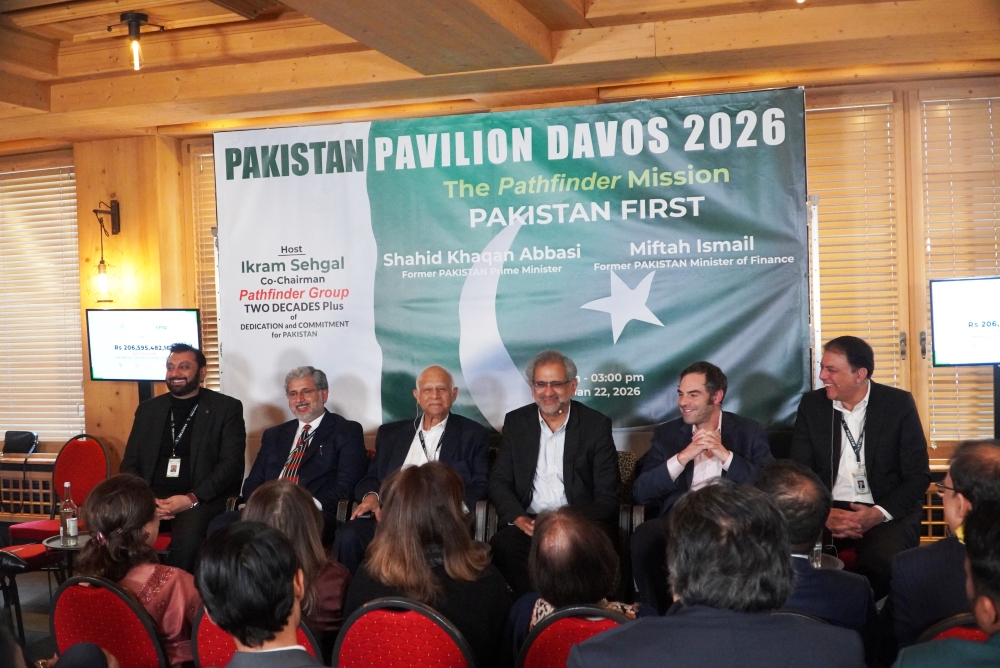
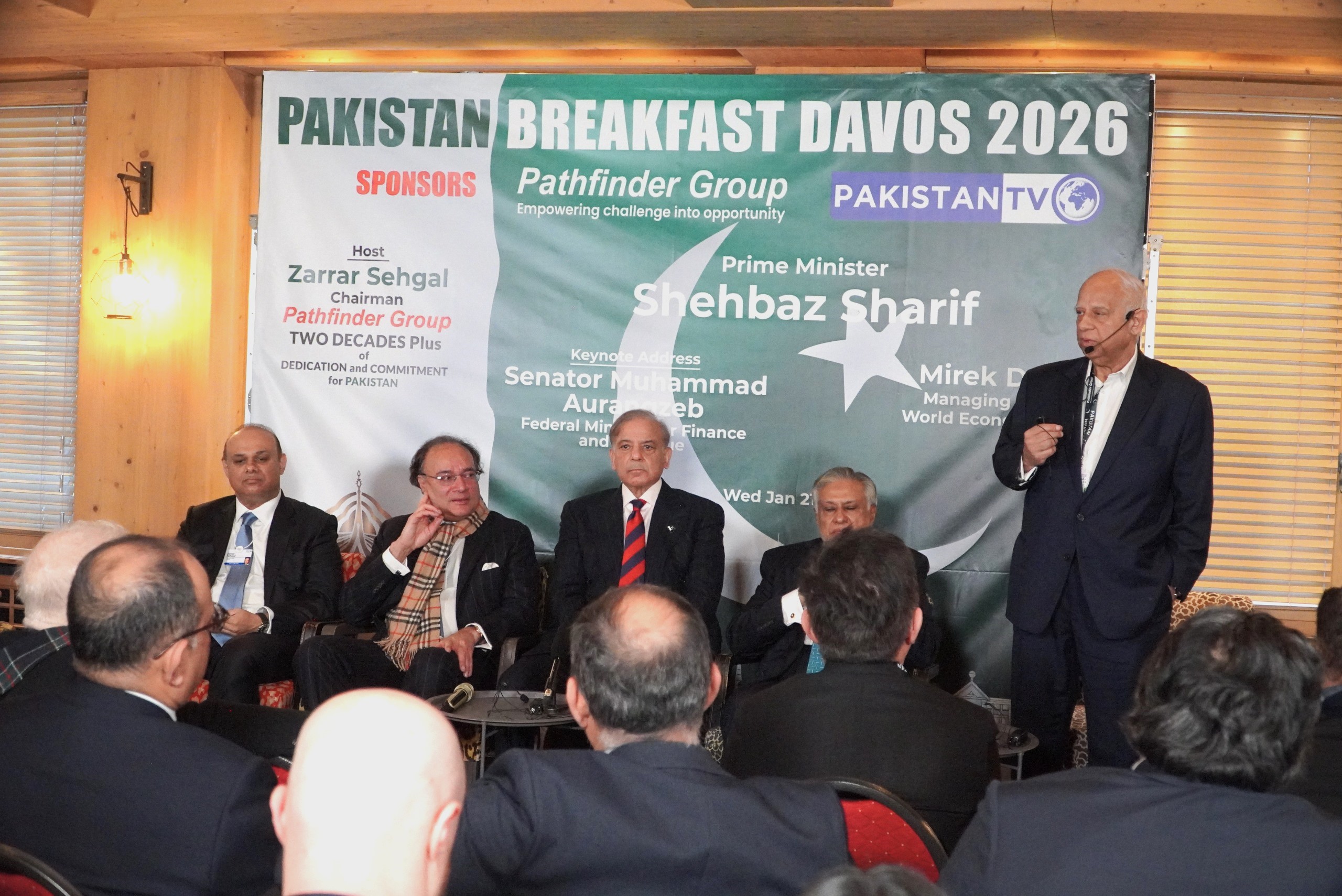
For more than three decades, the Pathfinder Group has proudly represented Pakistan at the World Economic Forum in Davos. Among the notable initiatives at the Pakistan Pavilion in Davos was the event “Investment in Pakistan,” which brought together policymakers, investors, and global stakeholders to explore opportunities for sustain- able growth and economic collaboration.
The Session was moderated by Muhammad Farid Alam, CEO of AKD Securities Limited, whose clarity of thought and grounded financial perspective set the tone for a substantive discussion. The panel included Sameer Chishty, Executive Chairman of Asia-Pak Investments; Michael Kugelman, Senior Fellow for South Asia at The Atlantic Council; Abu Bakar, former CEO of the Pakistan Software Export Board; and Dr Sania Nishtar, CEO of Gavi, the global vaccine alliance. Their contributions collectively provided a comprehensive
view of Pakistan’s investment landscape. For far too long, Pakistan has been described as a country of untapped potential. Resilience is not merely a descriptor; it is an intrinsic characteristic of the Pakistani people. The presence of distinguished speakers added depth and credibility to discussions on Pakistan’s economic future. Muhammad Farid Alam highlighted the importance of two-way investment flows, emphasizing that Pakistan must both attract foreign capital and expand its own enterprises globally. Sameer Chishty drew attention to a critical structural gap, the inability to scale innovation, underscoring the need to bridge the divide between capability and commercialization. Abu Bakar offered a forward-looking perspective, stressing that Pakistan’s future lies in a technology-driven economy, powered by its young and talented population. Complementing these insights, our own Dr Sania Nishtar noted the growing global recognition of Pakistan as an emerging investment destination, describing it as an underexplored opportunity.
The candid and constructive contributions underscored not rhetoric but realism about a shared understanding that macroeconomic stability, exchange rate predictability, and policy continuity are prerequisites for sustained investment, investor confidence cannot be built overnight; it is earned through discipline and consistency. Beyond economics, the conversation at the Pakistan Pavilion also reflected a broader shift towards innovation diplomacy. The inclusion of Pakistani Start Ups at Davos marked a significant milestone. For the first time, eight Start Ups, selected through a rigorous and merit-based process, were presented at the global stage. Pakistan does not lack talent; it lacks platforms. By taking these young entrepreneurs to Davos, we demonstrated that given the right opportunities, Pakistani youth can compete and succeed globally. The average age of these entrepreneurs, 23 to 24, speaks volumes about the potential of our younger generation.
This emphasis on youth and innovation resonated at the 17th Karachi Literature Festival. Having the privilege of engaging in a candid conversation with Dr Huma Baqai on “Evolving Power Dynamics in South Asia,” the discussion was not merely academic; it was deeply reflective of the changing geopolitical realities of our region. Dr Baqai aptly described the current global situation as a rupture, a breakdown of an old system without the emergence of a clearly defined new order. This uncertainty is particularly pronounced in South Asia, where traditional power structures are being challenged by new alignments and shifting priorities. I believe South Asia today cannot be understood through a narrow lens of conventional security. Security now encompasses economic strength, technological capability, and diplomatic engagement.
The battlefield has expanded, and so must our strategic thinking. A key question is whether Pakistan has a coherent strategy for the evolving landscape. While we are relatively stable, a long-term strategy is still in progress. Historically, Pakistan has reacted to crises instead of anticipating them, which is no longer sustainable. In an era of increasing strategic competition, proactive policy formulation is crucial.
The conversation also addressed regional dynamics, especially Pakistan’s relationship with Bangladesh. I repeated my connection for over 5 decades of simple but for pragmatic engagement by removing barriers like (1) visas and tariffs (2) Rupee-Taka and (3) fostering connectivity and people-to-people links. Regional integration in South Asia presents significant opportunities for economic and technological cooperation, despite existing geopolitical tensions. This can be possible alongwith India but if India remains recalcitrant, without India. One must therefore seriously, think about the AESSA (Association of Eastern States of South Asia) which I have been recommending since 1990 and which the outgoing leader of the recent Bangladesh Caretaker Regime, Senior Advisor Dr. Muhammad Yunus referred to in some detail in his farewell speech. Pakistan’s strategic location at the crossroads of South Asia, Central Asia, and the Middle East offers an advantage to South Asia (with or without India) that must be utilized through coherent policies and sustained engagement.
Another critical theme during the KLF discussion was the role of youth. With nearly 70 percent of Pakistan’s population comprising young people, the question is not whether youth matter; it is whether we are investing in them adequately. I believe that the future of Pakistan will be determined by how effectively we harness this demographic dividend. Investment in education, skills development, and innovation is not optional; it is imperative. As rightly pointed out, the software of the economy, human capital, requires far greater attention.
At Davos, the focus was on attracting investment and showcasing Pakistan’s economic potential. In contrast, KLF placed greater emphasis on understanding the broader geopolitical context that must be considered in order to realize this potential. Taken together, these engagements reflect a holistic narrative. Economic strength, technological innovation, and strategic foresight are not separate domains; they are interconnected. A nation that fails in one will struggle in others.
I believe that the time for incremental change has passed. What is required is a comprehensive approach, integrating economic reform, technological advancement, and strategic planning. The foundations have been laid. The question now is whether we have the resolve to build upon them. Engagement must be purposeful. Dialogue must translate into action. And above all, Pakistan must move from being a reactive state to a proactive one. Only then can we navigate the complexities of the evolving global and regional landscape.
Ikram Sehgal