
“
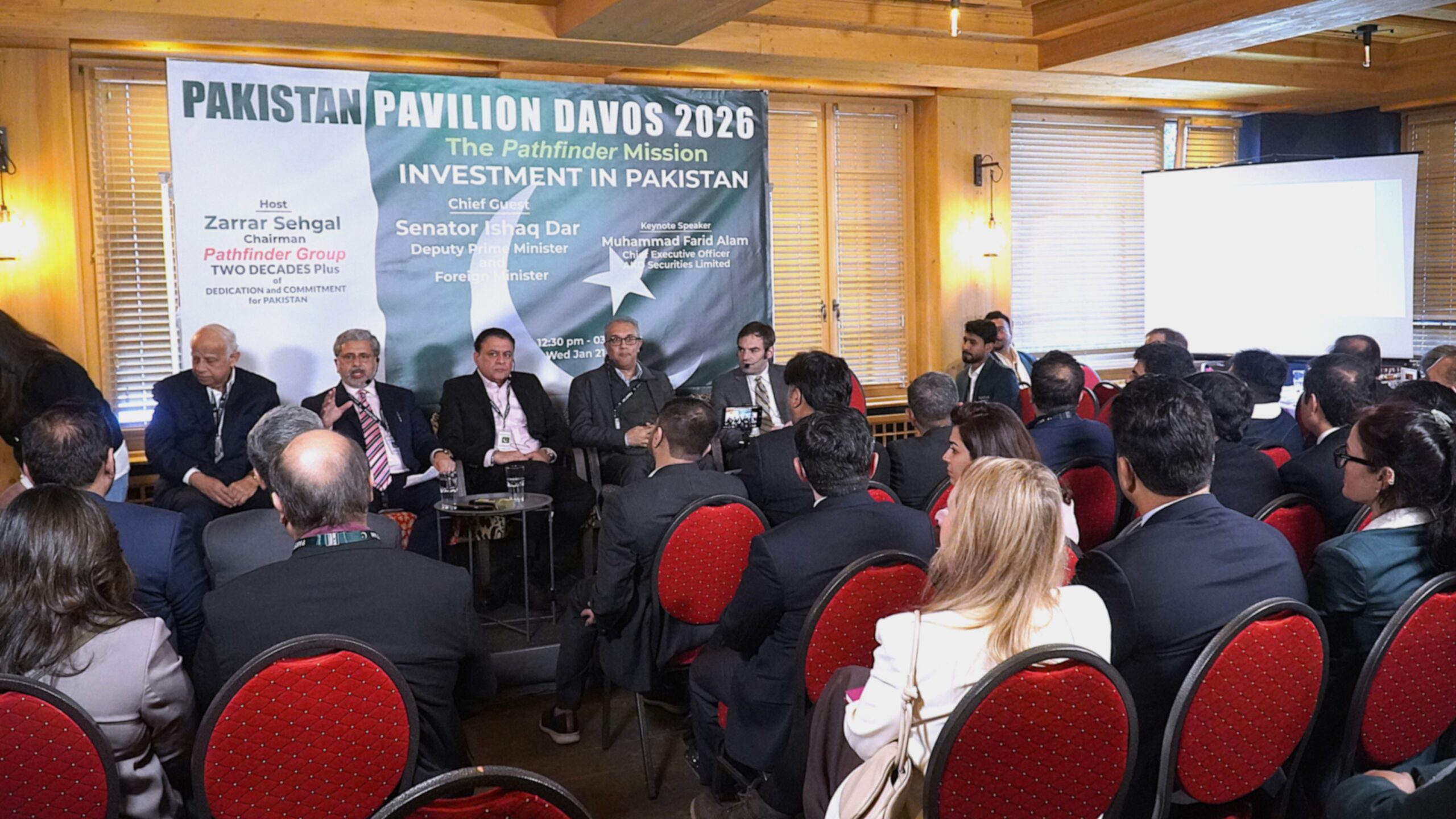
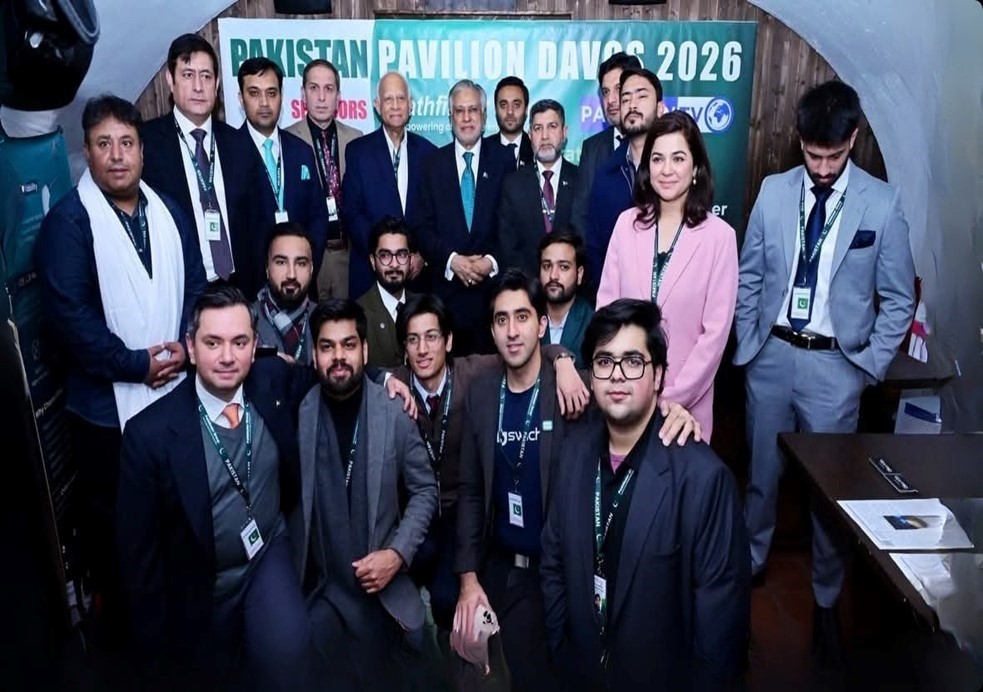
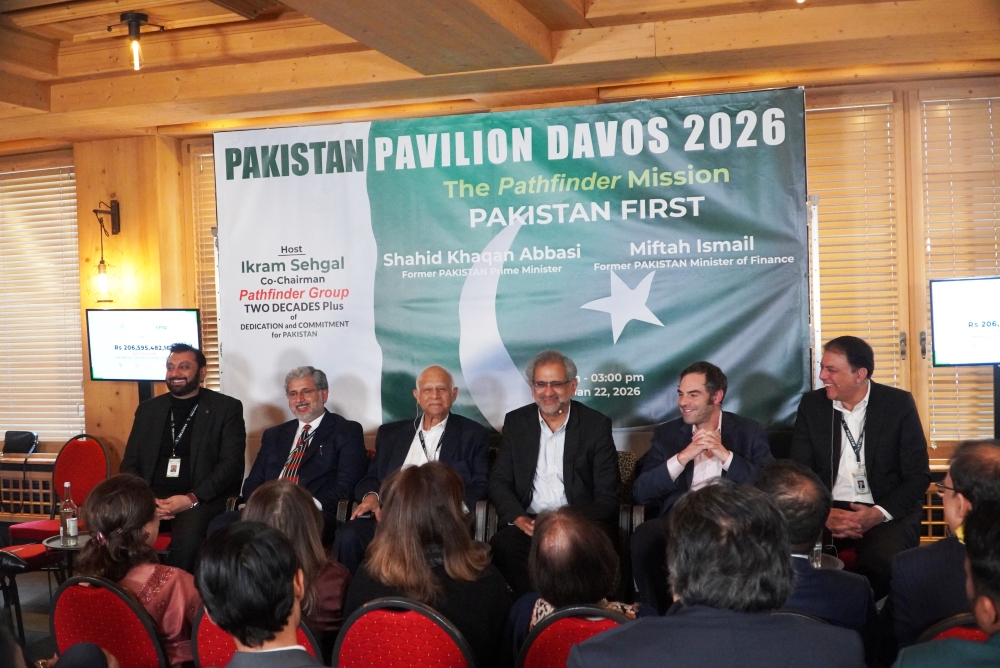
The Pathfinder Group hosted the “Pakistan First” session at the Pakistan Pavilion during the World Economic Forum (WEF) Annual Meeting in Davos, Switzerland on Thursday, January 22, 2026, from 12:30 p.m. to 3:00 p.m. at the Morosani Posthotel. The event brought together policymakers, economists, business leaders, and investment professionals to discuss Pakistan’s economic priorities and opportunities for investment.
Ikram Sehgal, Co-Chairman, Pathfinder Group (Host)
I welcome Shahid Khaqan Abbasi to the first Pakistan meeting forum. Let us begin with Michael.
Michael Kugelman, Senior Fellow for South Asia, The Atlantic Council
It has been a great few days. This is the second year in a row that I have been here, and I have to thank my dear friend Ikram for inviting me last year and again this year. It is always great to connect with old friends and to meet new ones.
So, the topic of this session is Pakistan First, and I have been trying to figure out exactly what that means. I am going to assume that it is not referring to America First or some play on that, so I will not go there, although I am happy to address any questions along those lines. Instead, I will give brief general comments on how I look at Pakistan today.
We started the other day by talking about why we have been drawn to Pakistan. I have been studying Pakistan for about twenty years, and one thing that has always drawn me to Pakistan is how it defies the odds. When you think it is going to collapse, it does not. When you think the economy is going to melt down, it does not. This has caused many people to talk about Pakistan as being resilient. But one thing I always add as a caveat when we talk about resilience is that resilience is a good thing, absolutely, and Pakistan is resilient but the problem is that resilience can also be problematic.
Why is that? Because if you are resilient, you are essentially focused on managing how things are. You deal with problems, you get by, you muddle through, whatever term you want to use. That allows you to address challenges in the current moment, but it does not put you in a position to think about how to move forward and how to address the deep-seated and entrenched challenges that caused you to need resilience in the first place.
I think that is why these types of conversations are important. We need to talk about what Pakistan can do and what it should do to move out of this situation. I do not want to use the term rut, but Pakistan has been experiencing many of the same challenges ever since independence, and I think that is quite clear.
Every government that comes into office in Pakistan says it will be the government that passes structural reforms and successfully concludes a reform agenda. The current government has the same claim. It is not easy to do. But I think the interesting discussion is about what Pakistan really needs to do to become a country with an economy that is stable, that can enjoy sustained growth, and that can become a true middle power or regional power, whatever term you want to use. Pakistan has been more active on the global stage over the last year, as we have already discussed. But my argument is that this could be short-lived, because Pakistan lacks the capacity to deliver economically on the global stage over the long term.
You can be a country without much military power and still be a significant global player if you have sustained economic clout, like Singapore or the UAE. But if you do not have long-term economic stability, it is very difficult to remain prominent on the global stage. I think this is where Pakistan is today. Hopefully, this tees up the discussion. Thank you.
Abu Bakar – Former CEO Pakistan Software Export Board
At the risk of repeating what we may have already said before yesterday, I will say it again. When we say Pakistan First, I would actually say Pakistan Now, because that is where the momentum is. The perception and acceptance of what is happening right now, especially over the last six months since the May incidents, show that the time is now for Pakistan. This is the biggest and best opportunity Pakistan has ever had. Today, you no longer have to shy away from saying that you have a business or an office in Pakistan. There is now an acceptability that did not exist before. I have lived in the United States for thirty-three years, and it has always been very difficult to go out and make big deals and say that we have an office in Pakistan. The immediate response would be hesitation, and then you would have to figure out how to create a front office somewhere else to mask that fact.
We have the talent, we have the scale, we have the capacity, but we did not have the acceptance globally. Now, those things are changing. As Michael very rightly said, this has a very short shelf life and if we do not execute this time, we are going to lose it again. We have done this before, so it is not something new, but this is the best opportunity we have ever had in our lifetime, at least in my experience.
Now we need to double down, especially entrepreneurs, founders, and businesspeople who are operating today. If you talk to business leaders who are operating on the global stage, they will tell you that this is the best time to go out and sell in Pakistan. I have travelled extensively over the last eleven to thirteen months. I was in Pakistan running the Pakistan Software Export Board, and I represented Pakistan on different fronts. I was there before May, and I was there after May, and trust me, it is a night-and-day difference.
People are engaging with you differently. People are taking you seriously. Even in the tech space, Pakistan is being viewed very differently. It is not just about defense. What we have shown is that we have the technical prowess and the capability to deliver. We have always said that we have great talent in Pakistan, and now we have demonstrated it. We have actually done it. I am very optimistic, especially about the younger generation. I would say to them that you will not get a better chance than this.
Usman Sheikh – CEO, OZI Technology Group
Thank you so much for the honor of sharing my views. I would like to share my story. Back in 2007, I was at the NADRA headquarters in Islamabad. At that time, I built a vision to go to China. China was still in a developing stage then, and none of the top ten global companies was Chinese. But I could see that China could become the next economic power. Over the next ten years, we saw that out of the top ten companies, five were Chinese. I worked there, I learned, and then I came back to Pakistan with the ambition to build a unicorn. But the change I wanted to bring came with a lot of discomfort, and that is what I want to explain with a simple example.
There is a small exercise we can do to understand what change really means. Please hold your hands together and twist them. Now change the position of your fingers and put the opposite thumb on top. You will feel like you are holding someone else’s hand. You feel that discomfort. That is what change feels like.
When I came back to Pakistan and started doing something for the country, there was no electricity, and there was terrorism in 2011. But I decided that I would build the ecosystem. I built the first million-dollar company, and then I started helping others. That ecosystem grew from one studio into two hundred studios across Pakistan. Today, Pakistan is among the top five in the global gaming economy competing on the global stage with Turkiye, Vietnam, China, and India.
This is what change really means. It means changing our ways. It means helping each other instead of pulling each other down. It means being supportive. When I met Ikram Sehgal, at a time when I had been feeling hopeless for the last four or five years, I felt that same energy again. Pakistan First is still his agenda. This is the same vision I carry. I truly believe that Pakistan’s time has arrived on the global stage. I welcome all of you to be part of this ecosystem, so that together we can play our economic role in the world, Insha’Allah.
Muhammad Farid Alam – CEO, AKD Securities Limited
The Pakistan story, in my view, is now beyond potential. It is about reforms, asset pricing, and execution. Sometimes we miss the execution part. Since I represent the capital markets, I would say that when markets go up, politicians often claim it as a reflection of national sentiment, almost like a national consumer confidence index.
The Pakistan stock market index reaching 89,000 speaks volumes about certain things that Pakistan has done right over the years. My statement today is that it is about time. Some of what has been said in English, I would like to express in Urdu, and then translate it for our foreign guests.
“Baa’t ab dosti ki nahin hosley ki he, Lazim nahin ke tu bhi mera ham khayal ho
Toota to hun magar abhi bikhra nahin Faraz, Merey badan pe jesey shikaston ka jaal ho”
Ahmad Faraz said that “even if I am wounded and covered in scars, I am still standing tall, and those scars are proof that I have endured”. This applies to Pakistan as well. Despite all the positives and negatives of the past, Pakistan is standing tall today.
Ikram Sehgal – Co-Chairman, Pathfinder Group (Host)
When I thought about who to call for this subject, Pakistan First, I thought of someone no better than Shahid Khaqan Abbasi, for many reasons. Of course, I must admit that I am prejudiced because of his father and his uncle. But the fact of the matter remains that when he was prime minister, things did happen. He did make changes.
One of the things his military secretary once told me was that he never leaves files on his desk overnight. Any files that were on his desk were completed the same day. As I thought about it, it seemed like this was a family tradition that likely traces back to his father, grandfather, and uncles. One thing has always been clear: he is honest and sincere about his commitment to Pakistan, and he continues to be so today. For me, there was no other choice when I wanted to conclude the final subject at Davos, Pakistan First. And no apologies to America First. We have no aspirations for anybody else’s territory. Our aspirations are for our own territory.
I think when both Abu Bakar and Farid alluded to the events of 9th May, and when everyone talked about it, it is evident that something truly significant happened on that day. In six hours, we inflicted not only a military setback but also a psychological defeat. Before that day, we used to constantly hear about drones attacking us, and one of the most prominent Indian anchors even went on television and said that Multan Port had been taken. You can imagine the level of misinformation that was circulating at that time. But the fact remains that within six hours, and I commend the army leadership for restraining themselves from doing much more in the interest of peace, the situation was brought under control. I believe it is better for a soldier, because a soldier is at his best when he fights a war to retain peace.
I dedicated several patriotic songs to the armed forces of Pakistan. I believe they have contributed in their own way. But theirs is not the only way. There is also a political way, an economic way, and all of these must come together. And with that, I hand over to you, Shahid.
Shahid Khaqan Abbasi – Former Prime Minister of Pakistan
Bismillahir Rahmanir Raheem. It is a pleasure to be here, invited by the Pathfinder Group and Ikram Sehgal. Over the years, I have been told that Ikram Sehgal is a brave man, but it takes even more courage to invite an opposition politician to speak. So, he is braver than I thought. Over the last few days, you must have heard a lot about the potential of Pakistan, and Pakistan indeed has immense potential. We have a huge market of around forty million people, mineral wealth, geography, and many other advantages on our side. We also have another form of potential, which is our youth. We are probably the only large country in the world where almost two-thirds of the population is young.
That is a major potential and an asset, but it can also become a huge liability if we do not address it. It is good to talk about these things and create the right optics, but ultimately, you have to deliver. What does Pakistan need today? Pakistan needs to go back to the basics and undertake massive reforms. What does a government do? At its core, a government’s bottom line is the economy. Jobs, taxes, and growth are what every government strives for. So, how do you achieve economic stability in Pakistan? How do you grow the economy? First and foremost, Pakistan must have the rule of law, political stability, and a clear and consistent policy structure. We need to understand that while Pakistan’s potential and will are there, they will remain uncapitalized unless we fix our own house. We need to fix our policy framework and our politics. That is essentially what is required.
There are no miraculous solutions. You need to work, make difficult decisions, and move forward. That is all that is needed. If you look at Pakistan from a business perspective, entry into business is relatively easy and often quite good. But what happens after that is not a great story, and anyone who runs a business in Pakistan understands this reality. I will leave you with a historical anecdote. There was a repressive dictator named Idi Amin in Uganda in the 1970s, and Uganda was part of the Commonwealth. Because of the repression, the Commonwealth sent an emissary to him and advised that there should be freedom of speech.
Idi Amin responded by saying, yes, I guarantee complete freedom of speech, but I do not guarantee freedom after speech. In many ways, the same applies to business in Pakistan. You can enter into business, but what happens after that is a different story altogether. That is why I strongly believe that every government must focus on making a real difference in what it does. The bottom line is that Pakistan needs massive reforms across the board today, and that is what we must work towards.
Muhammad Farid Alam – CEO, AKD Securities Limited
I will just take a minute, because figures normally do not lie. Sometimes we become sentimental about things, but I noted down a few points and scrolled through them because I will not have the time to explain each one in detail. However, if you really look at Pakistan’s reform agenda, you can see what is happening. I mentioned the required reforms, including gas and power sector reforms, privatization, and border controls. Look at what has changed in the foreign exchange market and how Pakistan has been able to control rupee parity. These are a few areas that we tried to tabulate. Remittance inflows are extremely important and have been crucial in whatever stability we have been able to achieve.
Another very important development is the improvement in cross-currency swaps, specifically the Credit Default Swaps (CDS). The CDS, which was around 124 percent or 1240 basis points, has come down by about 98 percent. CDS exists over two, five, and six-year tenures. I have tabulated these figures to show you the foreign exchange reserves and the current level of exchange reserves. Although external debt still stands at around 80 billion dollars, we have already paid about 25 billion. Even so, 80 billion is not something that is completely out of reach or unmanageable for us. Digitalization is another key area. EMI licensing, Raast, and other initiatives mean that Pakistan is moving towards branchless banking and digital banking.
This is a very positive development, and organizations like VRG are doing their best to educate the lower segments of society and bring them up to the same level as other countries. Over the last three years, taxation reforms have enabled Pakistan to increase revenue from 7 trillion to 13 trillion. The target is even higher and could reach 15 or 16 trillion next year. In less than three years, we have almost doubled revenue. One major improvement compared to earlier years is that some asset classes and sources of income were effectively untaxed. People living lavish lifestyles could claim agricultural income or other exempt sources and avoid paying taxes. That is no longer the case. Almost every asset class is now taxed. While agricultural income still contributes minimally in revenue terms, people can no longer completely escape taxation.
Privatization is another very important chapter in Pakistan’s history. The way PIA was privatized and strategically structured shows that the government was not focused on foreign or local exchange gains. The objective was to get the airline operational again and make it viable. The bidders were required to inject money and follow the structure and plan that was laid out. We also have ML1, which is moving forward. Finally, the agricultural sector is critical. Agricultural exports are extremely important for farmers and for Pakistan as a whole.
Ikram Sehgal – Co-Chairman, Pathfinder Group (Host)
Well, I think we have almost come to the end of our speaking sessions. Shahid Khaqan Abbasi spoke about my bravery in inviting an opposition politician. Let me say this. When he was Prime Minister, Bilawal was sitting in the front row. Shahid Khaqan Abbasi stepped down to the front row and met him. If you remember Bilawal at that time, I mention this to make a point. When we step outside Pakistan, we are one; the only objective is the representation of Pakistan. I do not think in terms of political parties. I only think of Pakistan. I believe that all political parties have a right to exist, and all are Pakistanis. They may oppose each other as much as they like within the country, but when we step outside the country, we represent one Pakistan. That is why we say Pakistan First, and then all petty problems later. I must tell you that it has been a long journey for Pakistan, and Pakistan has turned a corner. The 9th of May was a profound turning point. You cannot deny that what happened in six hours was significant. It woke up many people, particularly among our shocked friends, and so were our enemies. But that shock was necessary to wake us up to our own potential.
Mr Abbasi rightly spoke about our youth. We have to invest in our youth, because our future lies with them. Thank you, Shahid, for being here. We truly admire the potential that Pakistan has, and we want that potential to be developed in a way that ensures a bright future for our country, not just a mirage, which is how it may seem to many of us at the moment. Thank you very much.
This article has been contributed by Ms. Aniza Imtiaz.