



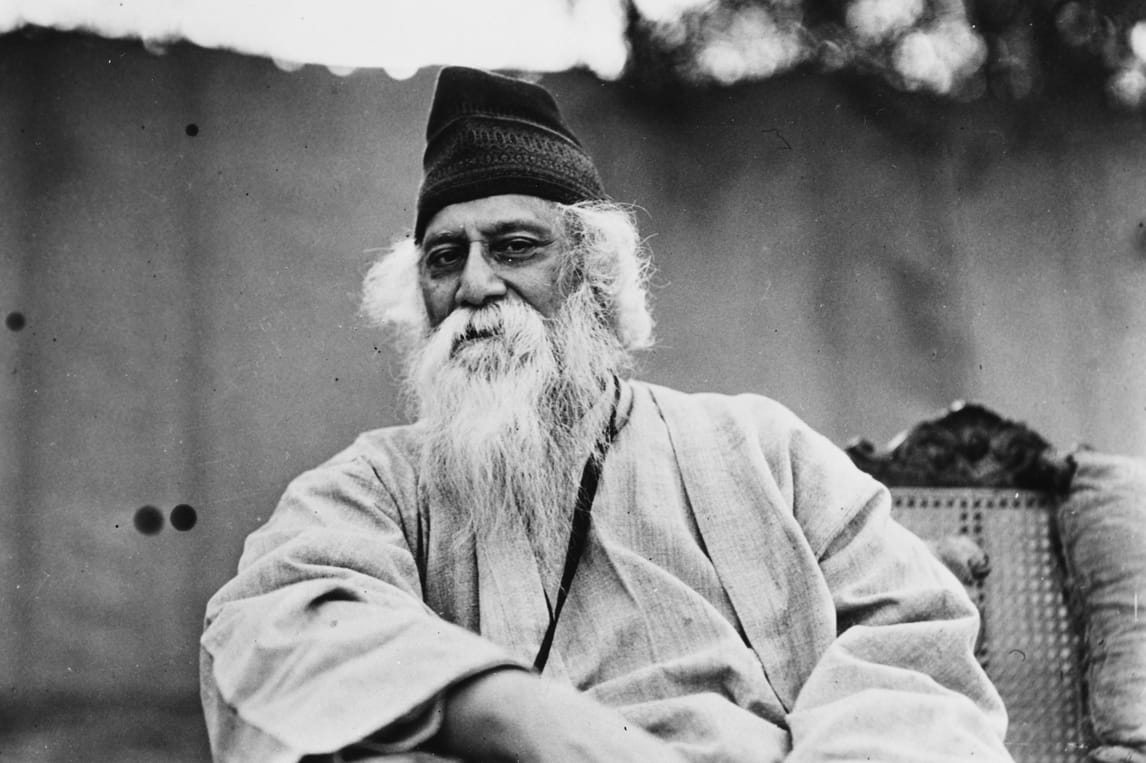
Rabindranath Tagore, the legendary Bengali Nobel laureate poet, said: “You can’t cross the sea merely by standing and staring at the water.” The Bengali nation has time and again proved that they are resilient and possess the due courage to take a dip in the oceans, when required.
From A.K Fazlul Haq to Hussain Shaheed Suharwardy; and from Mujibur Rahman’s Six-Points to the July Charter of 2026, the Bengalis have stood fast, striving earnestly for civil supremacy and rule of law. Not many were sure of a de jure change in a country ruled by iron-fist Sheikh Hasina Wajid of the Awami League for the last 15 years until Abu Sayed, a student at Begum Rokeya University in Rangpur, emerged as a symbol of defiance. His spreading of arms before paramilitary personnel made many feel the heat, as he was inviting trouble at the cost of his life. He paid his share duly in the national resistance uprising as the July 2024 Bangladesh quota reform movement was spreading all over.
Sayed was shot dead, and since then-on there was no looking back. A subsequent violent crackdown turned the tables and the state had to bite the dust before people’s power! Students and Gen-Z led from the front. The National Citizen Party, formed by the youth who toppled Hasina, made a spontaneous political impression too by winning five seats in the parliament. A trend that will long be cherished in other developing countries against state’s highhandedness.
A peerless and apolitical revolution led Hasina to flee for life, creating a vacuum that saw Bangladesh’s first-ever interim government come into power. Another Nobel Laureate and economist par-excellence Dr Muhammad Yunus did justice with his stature and call for duty in national interests. He held the reign of power for more than a year-and-half, and worked on genuine state-centric reforms by putting his head down. He refrained from taking political sides, and empowered national institutions to go by the book. Some of the steps that an exceptionally well-learned technocrat cabinet of Dr Yunus took were empowering the National Human Rights Commission to investigate law-enforcement personnel; removing restrictions that shielded security forces as sacrosanct; limiting the role of armed forces as Border Protection Force; jotting down necessary constitutional amends in electoral system, police, judiciary, and anti-corruption. That will long be remembered as a preamble of political-correction known as “July Charter”. The Bangladesh’s National Party’s return to power after a long hiatus was inevitable. This time around the geopolitical sequence is quite different, and the BNP in collusion with Jamaat-e-Islami is better poised to usher in political stability, an aspect missing in periodic governance postures of Hasina Wajid and Khaleda Zia respectively.
The BNP’s one-point political agenda is to prosecute Sheikh Hasina, and her henchmen who went over the brink. There is a wider national consensus on it, though. That desire, however, must stop short of measures that usually go on to exterminate political dissent, and outlaw Awami League as a party. This is where political maturity and sagacity is desired by making pluralism be the part and parcel of Bangladesh’s adult franchise dispensation.
The rise to power of Tarique Rahman, the scion of Khaleda and Gen. Zia-ur-Rehman, was apparently irresistible under conventional dynastic politics. He returned from self-exile after 20 years, as his mother went through trial and tribulation of prison sentences, as well as ‘boycott politics’ that kept her in oblivion. Rahman, thus, has a responsibility to shoulder and the least that is desired from him is to recollect the synergies of an enterprising nation and take it to new heights. Restoring trust in electoral politics and national institutions is sine qua non for the Bengali society. Likewise, the BNP’s slogan of ‘Bangladesh before all’ necessitates walking the talk.
Bangladesh, nonetheless, has changed for good. Its foreign and economic relations have passed the benchmark tests of nationalism. Dhaka is reorienting its foreign policy, and wants to shun the stigma of being an allied-ally of India at the cost of nursing animosity with other South Asian neighbours. The leap forward towards Pakistan under the Yunus administration was a jiff of fresh air, and is reaping dividends.
The resumption of flights between Dhaka and Karachi is an epoch-making moment, and will surely stir geo-economics. The good thing is that the conventional frost in relationship has taken a backseat since the ouster of Awami League. The volume of trade has increased by 20% compared to last year, and is touching the threshold of $1billion.
The nod from both the governments to grant visa-free entry to holders of diplomatic and official passports; coupled with an easing of visa regime for commoners is most welcome. Moreover, renewed understanding in the arenas of higher education, nanotechnology, and Artificial Intelligence, apart from rubbing shoulders between the chambers’ of commerce, are laudable efforts.
Academicians and intelligentsia must rise to the occasion and fill the void of historic mistrust by sharing notes in all humility. They should agree to disagree, and move forward. It’s time to come out of the quagmire of truncation.
Dhaka is in need of once again leading from the front in terms of recasting regional cooperation. The defunct SAARC must be revived. President Gen Ziaur Rehman’s brainchild of SAARC can be re-invented by his son, the new Prime Minister of Bangladesh. A new nomenclature can be inserted to address India’s concerns as well as reservations of smaller states.
A viable suggestion is inclusion of China in the South Asian league, as aptly suggested by Mushahid Hussain Syed in his articulation of plausible regional compatibility. That is essential to pick the threads of regionalism for the collective good of the poverty-stricken region.
Dhaka’s recent advancement towards Beijing has opened new vistas of power balancing. China has become one of the biggest investors in Bangladesh, especially in infrastructure, logistics and water dams. Beijing has pledged over $24 billion to buoy Bangladesh’s industrial sector. The trade imbalance, however, is worth addressing as in December 2025, Bangladesh exports were $148million and imports stood at $2.18 billion.
Last but not least is the emerging troika of understanding between Islamabad, Dhaka and Beijing, fomenting a new power dynamic as New Delhi’s pendulum goes the United States way.
The BNP’s wish-list is to have a balanced and even-handed approach with India, and is a welcome thinking. Rahman will have to make strides in addressing sticky issues such as concerns of Hindus in Bangladesh, a large exodus of Muslims inside West Bengal and Assam, as well as the water disputes. Both the countries share almost 54 rivers, and India has control over the 43 reservoirs. Sharing the Teesta River’s water has remained a recurrent challenge, particularly during the dry season (December-May). Originating in Sikkim, the river is crucial for irrigation in Bangladesh, but construction of upstream dams have opened a Pandora’s Box, leading to bad blood. How aptly Rahman intervenes and takes a call is worth watching.
It would be a great intellectual injustice if any discussion on Pakistan-Bangladesh relations omits the grievances and plight of Biharis. To Quote Dr Rakshinda Perveen, an adored writer and activist, “…1971 was not simple. It was traumatic for Bengalis in general and for pro-Pakistan Bengalis in particular. It was far more traumatic for non-Bengalis, especially Biharis, who faced reprisals, targeted killings and displacement in the aftermath of this blood-soaked liberation war. Some Bengalis had believed in a united Pakistan. Many who associated with Jamaat-e-Islami Bangladesh later faced political trials and social marginalisation during Sheikh Hasina’s tenure, yet they remained within Bangladesh’s citizenship framework. The Urdu-speaking Biharis, by contrast, became the most prolonged human residue of the rupture.” It is rightly argued that with bilateral relations improving, it’s time to get introspective on the Bihari count.
The gangrene of separation owes more than an apology. It warrants rescue and relief for approximately 324,000 Urdu-speaking Biharis who continue to live in densely-populated settlements across Bangladesh.
Pakistan and Bangladesh are both in it, and have a historical baggage to address in good faith. Dr Perveen is on the mark, as she says, “History does not disappear because it is inconvenient.” These children of lesser gods in Bangladesh must be attended to in all humility. That would be a win-win proposition on the path of burying the hatchet of dismemberment, and getting along in an era of interdependence.