





Session 1
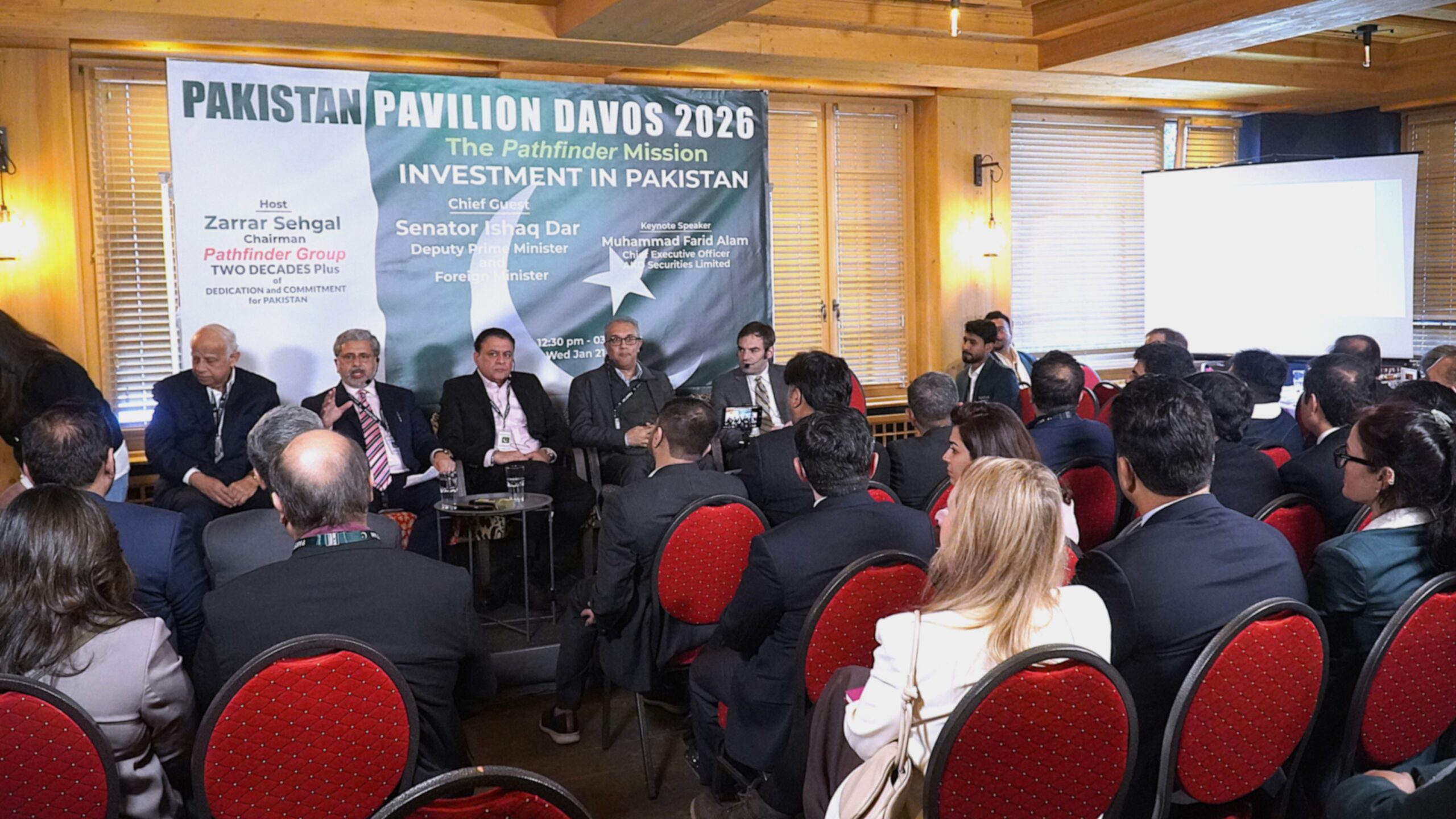
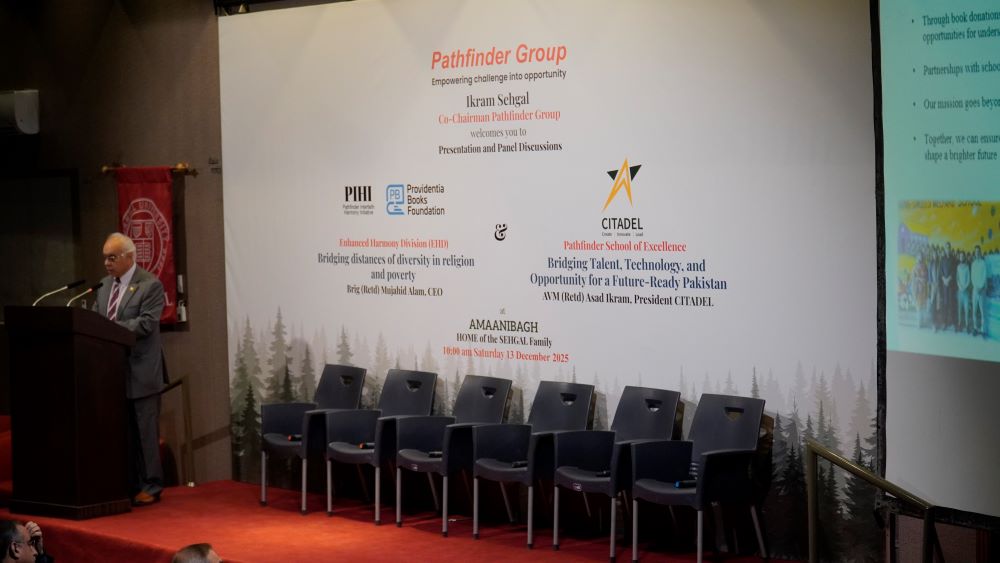
The Pathfinder Group Enhanced Harmony Division (EHD) organized a thought-provoking presentation and a high-level panel discussion titled “Bridging Distances of Diversity in Religion and
Poverty” and “Bridging Talent, Technology, and Opportunity for a Future-Ready Pakistan” on
Saturday, December 13, 2025, at AmaaniBagh Angoori, Islamabad. The event brought together
senior professionals from policy and academia, students from different universities in Islamabad,
and the private sector to discuss Pakistan’s social cohesion challenges and its innovation and
opportunity gaps.
Sehrish Mustafa (Host):
Bismillah ir-Rahman nir-Rahim. Good morning and welcome to AmmaniBagh. Today, we gather for an important discussion focused on the youth of Pakistan. This event is organised by the Pathfinder Group, which operates on a simple yet powerful philosophy: transforming challenges into opportunities. The theme for our discussion is “Bridging” – bridging distances in religion and poverty, and bridging talent, technology, and opportunity for a future-ready Pakistan. These are interconnected conversations – they represent two sides of the same national journey. A nation that aspires to innovate must first learn to be inclusive. A nation that seeks progress through technology must also promote harmony. Additionally, a nation rich in talent must create space for every community, every mind, and every voice to rise. To officially start today’s proceedings and share the vision guiding Pathfinder’s innovation-led initiatives, I would like to invite Brigadier (Retd) SSG Kiani, Director of Special Projects at the Pathfinder Group, to deliver the welcome remarks.
Brigadier (Retd) SSG Kiani:
Bismillah ir-Rahman ir-Rahim. Distinguished guests, respected speakers, members of the Pathfinder Group family, representatives of the industry, civil society, and the media: Assalam-o-Alaikum, and a very warm welcome to all of you. It is a privilege to host you today at this important gathering, where ideas, responsibility, and national purpose intersect. Leadership at the Pathfinder Group creates a platform that unites security, development, innovation, and social harmony into a single national vision. Today’s discussion is anchored in powerful and interconnected national realities: faith and poverty, talent and opportunity, security and inclusion. These are not abstract concepts; they define the pressures and possibilities shaping Pakistan’s future, where challenges extend beyond conventional threats. The real struggles of our time manifest in economic inequality, social polarisation, digital transformation, and ideological fragmentation. A nation’s strength can no longer be measured by arms alone; it is assessed by cohesion, opportunity, trust in institutions, and the dignity of its people.
Poverty breeds desperation, and when coupled with social and religious divides, it becomes fertile ground for instability. When large segments of the population feel excluded from economic participation, education, and social mobility, the foundations of national stability weaken. We have observed that faith, when guided by wisdom, has always been one of Pakistan’s greatest unifying forces. All religions, at their core, teach compassion, justice, dignity, and responsibility. When these principles are translated into action through education, welfare, ethical leadership, and inclusive development, they become powerful instruments of national strength. In this context, the work of the Providentia Books Foundation, the Pathfinder Interfaith Harmony Initiative, and the Kashmala Family Welfare Centre is significant. These are not isolated welfare initiatives; they are pillars of long-term national resilience. Every child educated, every marginalised family empowered, and every community reconciled delivers a strong blow against instability and extremism.
In our second session today, we will have a panel discussion on innovation, technology, and opportunity, which is equally important. Pakistan suffers not from a lack of talent but from a disconnect: a disconnect between talent and opportunity, education and industry, ideas and execution, and ambition and access to capital, mentorship, and global markets. This disconnect signifies not just an economic failure; it poses a strategic vulnerability for a nation that cannot absorb its young talent into productive systems. It breeds frustration, brain drain, and social unrest. This is where the Pathfinder School of Excellence, CITADEL, plays a transformative role. CITADEL bridges the gap between students, startups, industry, investors, and global platforms like the World Economic Forum in Davos. CITADEL is turning potential into performance. It is cultivating not just entrepreneurs, but national assets. Innovation today is not a luxury; it is the backbone of economic sovereignty, technological independence, and future competitiveness.
What gives me confidence is that today’s gathering unites all the right forces: faith-based social development, technological entrepreneurship, academic leadership, welfare institutions, and national security thinking under one platform. This convergence is rare and powerful. It demonstrates an understanding that Pakistan’s future cannot be secured through fragmented efforts. It requires the integration of values with vision, compassion with strategy, and talent with opportunity. Before I conclude, I would like to commend everyone who has worked tirelessly to make this event possible. I also recognise the leadership of the Pathfinder Group for acknowledging that national security, social harmony, innovation, and economic inclusion are not separate conversations but a united mission. If we succeed in bridging divides, whether of religion, poverty, education, or opportunity, we will not only strengthen Pakistan’s economy but also fortify its very foundations as a stable, confident, and forward-looking nation. On this note, I once again welcome all of you and look forward to a meaningful discourse, practical recommendations, and collective resolve.
Sehrish Mustafa (Host):
Ladies and gentlemen, as part of the Corporate Social Responsibility (CSR) portfolio of the Pathfinder Group, we take pride in initiatives that extend beyond business. These efforts aim to strengthen communities, foster understanding, and build a better society. One of our flagship initiatives is the Enhanced Harmony Division, which includes the Providentia Books Foundation, the Pathfinder Interfaith Harmony Initiative, and the Kashmala Family Welfare Centre in Pabbi. Together, these programs promote interfaith harmony, mutual respect, and unity by collaborating with community partners to reduce poverty and encourage coexistence among people of different religions. To discuss this important work further, I would like to invite Brig (Retd) Mujahid Alam, Chief Executive Officer of the Enhanced Harmony Division, to the podium.
Brigadier (Retd) Mujahid Alam, CEO Enhanced Harmony Division (EHD):
In the name of Allah, the Most Gracious, the Most Merciful. Throughout history, we are reminded that the true meaning of life is not found in the wealth we accumulate or the titles we earn, but rather in the quiet legacy of goodness we leave behind. Occasionally, a leader emerges whose vision extends far beyond boardrooms and balance sheets, a leader whose heart beats for the people, for dignity, and for humanity itself. Today, as we discuss the CSR journey of the Pathfinder Group, we honour the compassion and moral courage of one man: Ikram Sehgal, Co-Chairman of the Pathfinder Group. His vision has not only shaped organisations; it has touched lives, opened doors, and offered hope where it was fading. His leadership serves as a reminder that true greatness is not measured by profit or power, but by the quiet miracles we create for others.
The CSR initiatives of the Pathfinder Group stand as a testament to the belief that human beings exist not merely to succeed, but to serve. This belief emphasises that a life well-lived elevates others, and that service is not just an obligation, it is the highest expression of human purpose. The Enhanced Harmony Division (EHD) of the Pathfinder Group is a purposeful manifestation of the humanitarian vision of Ikram Sehgal and the Sehgal family. At the core of EHD’s creation lies the belief that society thrives when its most vulnerable members are supported. Built on the principles of compassion, service, and social responsibility, the Division serves as a structured platform to uplift those who are underprivileged, underserved, and overlooked. EHD encompasses three transformative initiatives, each addressing a different aspect of societal well-being:
1. Providentia Books Foundation (PBF):
Nurturing minds and igniting curiosity, advancing literacy, educational access, and a culture of learning.
2. The Pathfinder Interfaith Harmony Initiative (PIFHI):
Building bridges of understanding, tolerance, and peace, and promoting dialogue and peaceful coexistence among diverse faith communities.
3. Kashmala Family Welfare Centre (KFWC):
Standing as a sanctuary of care for families facing hardship, offering them dignity, support, and the warmth of human kindness. It provides women, families, and local communities with welfare, skills development, and empowerment services.
Together, these initiatives create a unified ecosystem of hope and opportunity, aimed at strengthening communities through education, harmony, and welfare. They are not merely structures or programs; they embody a worldview that sees humanity as interconnected. In this view, uplifting one another is not an act of charity but an act of justice, and compassion is regarded as a form of wisdom. This perspective illustrates that a single committed individual can initiate a ripple effect of progress that impacts countless lives.
The vision of the Enhanced Harmony Division is to establish an empowered, harmonious, and educated society in which every individual, regardless of their background, has the opportunity to thrive with dignity and purpose. Our mission is to serve humanity by expanding access to education, fostering interfaith understanding, and providing holistic welfare services, ensuring that the most vulnerable communities receive the support and opportunities they deserve. I will now briefly explain each of the Pathfinder initiatives.
Providentia Books Foundation
It was founded by Amaani Sehgal, the granddaughter of Ikram Sehgal, who is currently studying for her degree at Cornell University in the USA. At just 13 years old, Amaani began teaching at TCF schools in Karachi and Islamabad. She quickly recognised that children from impoverished households have limited access to academic books and other reading materials compared to their more financially stable peers. Her vision is to create a platform for community participation and empowerment, reflecting her commitment to promoting literacy and fostering a culture of lifelong learning.
The Foundation is a registered non-profit organisation dedicated to nurturing a love for reading and learning among children in need. We connect generous individual donors and institutions with spare books, school supplies, and educational furniture to NGOs, community schools, and out-of-school children who require these resources. Currently, the Foundation operates in five major cities across Pakistan: Lahore, Karachi, Islamabad, Peshawar, and Multan. This Foundation aims to ensure that children from underprivileged communities have free access to books and essential educational materials, helping them overcome resource gaps and providing them with equal opportunities to learn and excel.
Our vision is to create a future where every child, regardless of their socio-economic background, can discover the joy of reading, explore knowledge freely, and reach their full academic potential through accessible learning resources.
Key Objectives:
(1) To encourage reading habits among children with limited access to books.
(2) Partner with schools and NGOs to set up reading corners and mobile libraries.
(3) Promote sustainability by reusing books and reducing waste.
(4) Connect donors with recipients through a simple, scalable platform and
(5) Mobilise communities with book drives and volunteering.
We have a dedicated team for Providentia Books in all the major cities. They are truly doing wonderful work.
Our operational model consists of two distinct roles:
As a Collector: We identify schools, arrange meetings, sign MoUs (Memorandum of Understanding), place donation boxes, collect books, and sort them out.
As a Donor: We identify NGOs and communities, arrange meetings, visit schools, sign MoUs, and donate the books.
We have a large number of collaborations with different schools, NGOs, and communities. A large network has been developed, which we continue to expand as we proceed. This includes partnerships with various NGOs and publishers.
Activities and Impact
A brief look at our activities shows the tangible impact of our work:
Metric Achievement
Total MoUs Signed Over 80
With NGOs 30
With Schools 50
Library Corners Established 27
Interactive Sessions Held 12 (Story reading and other activities)
Total Books Received 71,712
Total Books Donated: 68,823
School Furniture Donated 125 items
We are deeply grateful to our numerous partners and all the schools with which we have signed Memorandums of Understanding (MoUs). We strongly encourage student volunteerism, and many students actively collaborate with us. Students who donate books and other useful items are rewarded with certificates, Providentia souvenirs, and caps.
Key Objectives:
(1) Free School Libraries: We are working to establish free school libraries in many underserved community schools. Many government schools, for example, lack any concept of libraries, so we strive to create these resources for them.
(2) Student Volunteer Program: We are committed to working closely with our existing student volunteer program and expanding its reach.
(3) Outreach Program—Education for All: We are trying to expand this outreach with a focus on free digital education to serve all those who are financially unstable.
We organise various events and seminars in collaboration with our partners and universities. We have held awareness seminars where students, think tanks, leaders, policymakers, and philanthropists come together to share their insights and perspectives on education and other social issues.
Additionally, we arrange art and book reading sessions with underprivileged schools and NGOs to bring joy to children’s lives. We have found that these art classes and reading sessions are greatly enjoyed by young students, which is very important for their development. The Foundation is dedicated to bridging educational gaps across Pakistan. Through book donations, the establishment of library corners, and various learning activities, we are creating equal opportunities for underserved children. By partnering with schools, NGOs, and local communities, we can reach more learners every day.
Our mission extends beyond providing books; we aim to inspire curiosity, build confidence, and promote lifelong learning. Together, we can ensure that every child has access to knowledge and the opportunity to shape a brighter future.
Pathfinder Interfaith Harmony Initiative (PIFHI)
The Pathfinder Group has a legacy of national service that spans over 30 years. Each Sunday, it secures the safety of more than 100 Christian churches, demonstrating its commitment to interfaith respect and protection.
To further this mission, the Interfaith Harmony Initiative was established to promote empathy, peaceful coexistence, and mutual respect among all faiths. This initiative provides a structured platform for dialogue and collaboration, with the goal of building a more peaceful and inclusive society.
Vision: To foster mutual respect, peaceful coexistence, and collaborative action among the religious and spiritual communities of Pakistan.
Mission: To promote dialogue and understanding for collaborative community engagement among faith groups in Pakistan through education and leadership.
Elena Sehgal, the Founder of PIFHI
The founder of this initiative is a young girl named Elena Sehgal, the granddaughter of Co-Chairman Ikram Sehgal. She is currently studying at the Brearley School in New York. Elena has been actively promoting interfaith harmony alongside her Jewish and Christian friends. While in high school, she regularly visits orphanages and nursing homes to help those in need, often accompanied by her friends. Inspired by her passion, this wonderful initiative is now being carried forward in Pakistan by her grandfather, ensuring that our message of unity and compassion continues to grow. This demonstrates that even in your early teens, you can ignite a spark that leads to many positive developments in your own life and the lives of others.
Key Objectives:
Dialogue and Understanding: To facilitate respectful interfaith understanding through dialogue forums.
Youth Engagement: To promote interfaith harmony among youth through leadership programs and joint activities.
Community Projects: Launch cooperative service projects involving members from different faiths.
Counter Extremism: Collaborate with scholars and institutions to counter hate speech, intolerance, and extremism.
Training and Capacity Building: Conduct workshops for teachers, clerics, youth leaders, and community influencers.
Core Activities:
(1) An annual Interfaith Peace Forum.
(2) School and university outreach programs.
(3) Faith and Leadership Fellowship for youth.
(4) Joint service projects in education, health, environment, and disaster relief.
(5) Publication of interfaith success stories.
We are collaborating with faith-based organisations, educational institutions, NGOs, government departments, and international networks.
Recent Events and Outreach Two key events were organised to bring together members from the Hindu, Sikh, Jewish, Parsi, Christian, and Muslim communities:
(1) Introductory Curtain Raiser: Held on 2nd August 2025 at AmaaniBagh, chaired by Elena Sehgal. The session introduced the initiative’s objectives and promoted interfaith dialogue.
(2) Advisory Council Initial Meeting: Took place on 13th September 2025, again here at AmaaniBagh, focusing on council formation, future strategies, and interfaith collaboration. Members from all different communities (Hindu, Sikh, Jewish, Parsi, Christian, and Muslim) participated.
We have also engaged in several outreach programs across the country:
(1) I addressed the A-Level students at Roots Millennium School.
(2) I held a session for the under-training Foreign Service Officers at the Foreign Service Academy in Islamabad.
(3) I visited the Naval Cadet College in Ormara and spoke to over 600 boys and the staff there.
(4) A lecture on character building and interfaith harmony was delivered at PNS Qasim in Karachi.
(5) Only last month, I had an interactive session and an address at the APS College for Girls in Chaklala, Rawalpindi.
(6) I also had a very interesting interactive session with the students of the IR department at Quaid-i Azam University.
(7) We intend to continue with such participation.
Direct Community Support
The PIFHI team members are actively working for the betterment of the minority communities.
(1) The Pathfinder Group and PIFHI gave free medicines to the Sikh flood victims of 2025 in Peshawar.
(2) The Providentia Book Foundation teams have signed agreements with several Christian community schools across different cities and have donated books to help establish their libraries.
Future Steps: Some of our future steps include strengthening partnerships with communities and local leaders.
(1) Expand outreach to ensure wider participation and impact, especially to the younger generation.
(2) Introduce new programs that promote dialogue, learning, and inclusion.
(3) Empower youth and women as ambassadors of peace and unity.
(4) Use data, feedback, and community insights to improve future initiatives and continue building a society rooted in respect, tolerance, and shared humanity.
(5) We have very good representation from across all faiths: Jewish, Hindu, Sikh, Christian, Parsi, and of course, Muslim. These are all very active and distinguished people in their own fields, and we look forward to their advice and collaboration.
Kashmala Family Welfare Center
This centre is a flagship project of the Pathfinder Group, established in 2022. It is located in the peaceful yet underserved village of Choki Mumraiz in Pabbi, Khyber Pakhtunkhwa. The centre is named in honour of Kashmala Sehgal, the daughter-in-law of the Co-Chairman of the Pathfinder Group. It provides women and girls from the village and surrounding areas with a safe space to acquire new skills, receive medical assistance, and engage with one another.
Why Does the Centre Matter?
The centre serves as a beacon of hope for the women and girls in the village, who are often confined to their homes. They have limited access to healthcare in the area, and social restrictions significantly impede their skill development. In many ways, the center is like an oasis for the females of this community.
Facilities and Staff:
The centre is supervised and operated by Zakiya Khan, and we are privileged and very happy to have her among us today. She is sitting here, accompanied by her young daughter, Ansa, who is studying Dentistry in college. Ansa is very active; she is studying dentistry and greatly helps her mother and the centre in all its activities. We are thankful to both of you, Zakiya and Ansa.
The centre operates from a dedicated, three-story building. Eight different units operate with a staff of 10 people, including a lady doctor, a dentist, an ultrasound technician, an Aalima (female religious scholar) for the Madrasa, a crochet trainer, a stitching trainer, a basket-making trainer, a beautician, and two helpers. It is serving approximately 20,000 beneficiaries from over 30,000 people in the village and the neighbouring area.
Welfare and Medical Services
(1) Poor patients receive free basic medicines after check-ups.
(2) On average, 20 to 30 children and women seek assistance daily.
(3) Medicines are provided to those in need throughout the month.
(4) We have a 24/7 ambulance service available.
(5) The centre helps with referrals to welfare and government hospitals.
(6) The dental unit operates three days a week.
The dental unit operates beyond its initial capacity, as it now has two dentists on staff. It provides free check-ups and basic treatments, equipped with essential dental tools and medications, focusing specifically on women and children. Despite being a small unit, it has a significant impact on the community.
The ultrasound unit serves approximately 15 to 20 patients daily, offering maternal and general diagnostic services. This helps save the community travel costs and ensures the timely detection of health issues. The unit is equipped with a reliable ultrasound machine, and a skilled technician is always available to perform scans with care and professionalism.
Skill Development Programs:
(1) Sewing and Stitching Program:
Started in 2022.
• Enrollment: 50 students in morning and evening batches, taught by two teachers.
• Outcome: Six months of training, after which graduates begin earning immediately from the skills they have learned. Eight women are now running their own home businesses in the village.
(2) Crochet and Warm Clothing Sales
• Students learn crochet alongside stitching.
• They produce sweaters and warm clothing for children, and the items are sold in the market for income generation.
(3) Madrasa Classes
• Offers Quran and Islamic teaching courses.
• Enrollment: 10 to 15 girls attend daily. The classes are free and accessible to all families there, taught by a learned Alima (female religious scholar) with dedication and care.
(4) Basket Making Program
This is a very interesting and useful program.
• women are provided raw materials at home, enabling income generation without leaving their households.
• Each woman makes around 10 baskets per day, contributing significantly to household income.
• A portion of their earnings is donated to buy free medicines for patients at the center.
• The program is led by a highly experienced basket-weaving instructor with more than 30 years of experience.
• The baskets are widely used in fruit and vegetable markets, flour and rice mills, and for domestic and commercial use. Those of you who are not from KP (Khyber Pakhtunkhwa) may not be very well aware of how useful basket making is in that society, which is why this program has been started.
• Every year before Ramadan, they also produce several baskets of dates (khajoor) that are then distributed by the Pathfinder Group to various beneficiaries.
(5) Beautician Training
• Young girls and women are given practical training in makeup and hair styling.
• Four of the young women who got trained there have opened up their own salons in the village itself and are running them very successfully.
• Bridal makeup is very affordable, costing only Rs. 5,000. Many young women and girls sitting here would know how much it costs elsewhere.
• Certificates are given to those who complete the training.
Affordable Shopping Initiative
This initiative was launched by Zakiya Khan. A small shop has been opened in the centre that offers makeup, clothing, shoes, and daily-use items at very affordable prices, lower than market rates. This enables women in the area to avoid the need to travel all the way to Peshawar or to the main market. Additionally, instalment-based purchasing is available.
A summary report detailing the significant progress made by the Kashmala Family Welfare Centre from August 2022 to November 2025 demonstrates a tangible impact. There are also some ambitious plans for the centre, led by Zakiya Khan:
• A small loan program for women entrepreneurs.
• Expansion of sugar and pregnancy testing services.
• Establishment of a fully stocked pharmacy (improving on the current small medicine dispensary).
• A kitchen and garden training program for the women and girls.
• A women’s gym and a small park for the children.
If these plans materialise, God willing, they will significantly enhance the welfare services for girls and women in that area. This was a brief overview of the three unique and impactful initiatives taken by the Pathfinder Group and its Co-Chairman, Ikram Sehgal.
I am truly pleased to see so many young students, both girls and boys, from the universities here today. Dear students, I want to speak to you briefly. At this stage of your lives, you possess an extraordinary power: the ability to dedicate your time, talent, energy, and heart to something greater than yourselves. The Pathfinder Group’s initiatives – the Providentia Book Foundation and the Interfaith Harmony Initiative – are founded on the belief that young people can change the direction of a community and even the destiny of a nation.
• Providentia Books needs your passion to light the spark of learning in children who only need a helping hand.
• Interfaith Harmony needs your voices, your empathy, and your courage to build bridges in a society that deeply needs understanding and unity.
| Service/Area Achievement | (August 2022- November 2025) |
| Total Patients Served | 25,533 |
| Basket Making | Active income generation |
| Stitching/Crochet | Skills learned, home businesses started |
| Makeup/Salon Training | Four women opened their own salons |
| Ambulance/Emergency Referrals | 583 |
| Medical Services | Free checks, pregnancy tests, sugar tests, ultrasound, and dental services are provided |
I invite you to join us, volunteer, and participate by bringing your ideas, idealism, and humanity. The future will be shaped by those who act, not by those who stand by. Your contribution may seem small, but for someone out there, it could mean the world. We will welcome you with open arms. Let us build something meaningful together. I am confident that many of you here will decide to join us as volunteers and lend your support. In conclusion, I want to emphasise that these projects are not just corporate social responsibility activities; they reflect a leader’s soul. They illustrate what happens when one person believes deeply that every life matters and every child deserves opportunities. When leadership is guided by conscience, it becomes a force that reshapes society. Likewise, when vision is rooted in empathy, it becomes a light that continues to shine long after the individual has stepped aside. Mr Ikram Sehgal’s leadership reminds us that true greatness comes from quietly, consistently, and lovingly lifting others. Thank you for your attention. We now have time for an interactive session, as scheduled in the program. If anyone has a point, suggestion, or question, please feel free to ask.
Q&A Session
Question:
Assalam-o-Alaikum, Sir. My name is Bakht Muhammad, and I am from the International Islamic University (IIUI). I have a question regarding the organisations you mentioned, such as Roots Millennium, which is already well-established and offers various educational opportunities. I would like to know why, if your focus is on these elite institutions, we are not allocating time and resources to areas where people are underprivileged, where students may not even have slippers to wear to school. You also mentioned organisations like Roots Millennium, which cater to an elite class. If your mission is indeed vast, it would be important to include support for those in need as well.
Brigadier (Retd) Mujahid Alam:
This is a very relevant and important question. I want to clarify that, regarding the collaborations we mentioned, we are not donating anything to those schools. When referring to collaborations, I meant that we are only collecting books, furniture items, and school uniforms from them. All the donations I mentioned, over 68,000 books, 125 furniture items, and more, have been given to villages, rural areas, and underprivileged schools. Not a single book or item has gone to the elite schools, as you might think. I hope this clarifies everything.
Question:
Sir, my question is, as you mentioned, that women in these areas are being skilled and treated, but what about men? Many men are doing labour work in those areas, so I believe they need more skills training instead of women’s, so they can work better because men are the providers.
Brigadier (Retd) Mujahid Alam:
I am very happy that a young woman is also concerned about the men; that’s a very positive thing. Of course, the men in that society also need support. However, you would agree that in that environment, 90% of women are not even allowed to leave their homes or communities. In societies like this, particularly in underprivileged areas of Pakistan, women and girls deserve much more. This does not mean we should ignore the men; perhaps we need to establish welfare centres for them as well. However, our focus is on empowering women and girls as a priority.
Question:
Sir, as you mentioned, women need priority for an easier life. If a husband earns well, his wife can enjoy more peace of mind. I’m not suggesting that only men should earn. If a woman is earning significantly more than her husband, he might struggle with feelings of inadequacy, which can be a common mindset among men. Therefore, I believe we need to focus on both men and women, as both play essential roles in this dynamic.
Brigadier (Retd) Mujahid Alam:
You are absolutely right, and I truly appreciate your insight. However, it’s important to acknowledge that the earnings of a woman whose husband is struggling can be very limited. You would agree that when women are mentally happy and physically fit, they are better equipped to take care of their husbands, sons, and other family members. While we have limited resources at the moment, perhaps we can explore this further in the future.
Question:
My name is Salah ud Din, and I am from Balochistan. I have a suggestion: we need to implement initiatives in Balochistan to address the alarming dropout rates among students. Currently, 30% of children leave school after primary education, 50% after matriculation, and 80% after FSC. I believe it is essential to start these initiatives, along with health initiatives, in Balochistan.
Brigadier (Retd) Mujahid Alam:
You are right; we initially focused on larger cities where collecting donations is easier. However, I completely agree that Balochistan is a deprived province in terms of education and health. We have already discussed this with the Co-Chairman, and, God willing, we may begin to expand our reach to Balochistan. We will certainly make efforts to broaden our impact in the region.
Question:
Sir, my name is Mustansar. I am from the International Islamic University (IIUI), Islamabad. Sir, we have witnessed all these initiatives taken by the Pathfinder Group, and they mainly address educational purposes and health services. We also see that most of our youth are addicted to drugs. So, is there any initiative that the Pathfinder Group would take to address all these issues related to drugs?
Brigadier (Retd) Mujahid Alam:
You have brought up a very important point, and this is a serious issue, especially among the youth. At this time, we do not want to expand our efforts too much. Our primary focus remains on education, health, and welfare. Once we have consolidated these efforts, we may consider addressing that aspect as well.
Question:
Assalam-o-Alaikum, as a representative of a centre for young researchers, we appreciate the initiatives of the Pathfinder Group. It is our wish to collaborate with the Pathfinder Group as volunteers in a research context.
Brigadier (Retd) Mujahid Alam:
That sounds great! If any of you would like to reach out to us, please feel free to contact me to get my number. You are always welcome to visit our Blue Area office, and we would be very happy to meet with you.
Question:
Sir, the skills we have discussed so far are primarily domestic skills, which are typically taught to women. However, we should also focus on technical skills. Skills do not depend solely on degrees; if we invest 1 to 1.5 years in technical or IT skills, we can better match global standards and rankings. Many people register with NGOs, and these organisations approach a wide range of individuals. By adopting this approach, we can make significant progress.
Brigadier (Retd) Mujahid Alam:
That’s a great point. We are already considering this. Basic computer skills and spoken English are very important. We have previously conducted spoken English classes for our guards in major cities, organised by the Pathfinder Group, to enhance their English skills. At the Kashmala Family Welfare Centre, we may introduce similar courses, such as computer training. It is essential to do so.
Question:
Assalam-o-Alaikum, Sir. My name is Vikkesh Kumar, and I am from the Centre of Excellence in Gender Studies at Quaid-e-Azam University. First of all, I would like to express my gratitude to the Pathfinder Group for their invaluable work in society. I have a question: why, despite the presence of numerous organisations working throughout the country, do we see so few impactful actions taking place? I am from District Ghotki, and after arriving in Islamabad, I discovered that there are organisations focused on helping women, children, and marginalised groups. However, during my time there, I did not notice any organisation effectively engaging in real work on the ground. How can we address these challenges? As someone who is committed to supporting marginalised communities, I would appreciate your advice on how I can uplift these groups. Additionally, how can we ensure that our efforts lead to real action within communities, rather than just remaining visible on screens?
Brigadier (Retd) Mujahid Alam:
Your point is very valid. We are already focused on education, interfaith harmony, and welfare activities for marginalised communities. Our initiatives, such as the book donation drive and library corners, specifically target rural areas and underprivileged communities to provide free education. We aim to reach those who are marginalised and underserved. Please feel free to reach out to us; we would be more than happy to further expand and improve this system.
Question:
Sir, my name is Zarnain Raza. I am currently pursuing my M.Phil. degree from Quaid-i-Azam University, Islamabad. I have a question regarding technology integration. We observe that technology is integrated into many aspects of life; however, in developing countries, particularly among the elite in Pakistan, access to technology is limited. In contrast, marginalised groups often lack this access. This issue was not addressed in the presentation.
Brigadier (Retd) Mujahid Alam:
You are right. The technology-focused presentation is coming up next in the second session, where you will be able to ask these things. But we are already looking into and focusing on that disparity.
Question:
Assalam-o-Alaikum, Sir. First of all, thank you so much for your insightful presentation. It was very helpful in understanding the work you are doing, especially for women. As a woman, I truly appreciate the initiative you are taking to support women. I have a question regarding the book donation initiative. I think it’s fantastic, and I would like to know how we can enhance it. In this era of globalisation, how can we raise awareness among young minds, particularly in rural areas, about the importance of reading books? I am from rural Sindh, where many students who are passionate about reading struggle to continue their education due to various challenges. Additionally, how can we utilise social media and other platforms to promote the value of reading?
Brigadier (Retd) Mujahid Alam:
This topic is very close to my heart. I have been a passionate book lover and reader my entire life. I was privileged to serve as Principal of Lawrence College for over 11 years, where I observed a troubling decline in the culture of reading due to the influence of social media. To me, this is truly tragic. I come from the old school of thought: books belong in libraries, and both English and Urdu books should be made available to everyone. Our goal is to establish libraries and promote reading.
I kindly request that you consider becoming a volunteer. Please help spread the word at your university and among your classmates. Share this message with your family and friends as well. We have a website and are active on all social media platforms. I believe, as a fellow book lover, you likely have many books you could share. We welcome your donations. Please consider bringing any books you can spare. We would also appreciate your ideas and support. Join us as a volunteer.
Question:
Assalam-o-Alaikum, Sir. My name is Muhammad Yahya, and I am a student of BS Bioinformatics at NUST. First of all, I want to express my appreciation for all the initiatives that the Pathfinder Group is undertaking. I would like to suggest another initiative: providing awareness about family planning to impoverished communities. This is an important issue, as many impoverished families have large family structures and limited resources to support their children, which can lead to child labour and other negative consequences. By raising awareness about family planning, we can help these families better manage their family sizes, ultimately contributing to the improvement of society as a whole. Thank you for considering my suggestion.
Brigadier (Retd) Mujahid Alam:
Thank you for raising such an important point. Family planning and population growth are critical issues at the national level, especially considering that our population growth rate is one of the highest in the world. However, this topic can be quite sensitive, particularly among scholars. We aim to avoid making the Family Welfare Centre a controversial subject that attracts criticism. Nonetheless, we will certainly take this issue into account. I am also pleased to see the large number of questions and ideas you have shared. Please remember that you are not robots; you are thoughtful individuals. Always feel free to express your ideas and share your thoughts without hesitation.
Question:
Sir, my name is Muhammad Saad, and I am a student at NUML. First of all, I want to commend you on your clear explanations. Regarding the Kashmala Family Welfare Centre and its projects, how many other locations where these projects ongoing?
Brigadier (Retd) Mujahid Alam:
For the time being, the project is located in Pabbi Choki Mumraiz, which is a large village. This is part of the vision of Co-Chairman Ikram Sehgal. There is also a centre under construction in Bhakkar, South Punjab. Although we cannot reach every area, the reason for selecting Bhakkar is that South Punjab is also very underprivileged, so we are trying to expand our reach there as well. Thank you very much once again, everyone.
Sehrish Mustafa:
Sir. It was a wonderful presentation, and I appreciate the interactive session; it was truly great to engage with all of you. I am grateful for your questions and suggestions. I would like to emphasise that the Enhanced Harmony Division reminds us that true prosperity is incomplete if it does not uplift the most vulnerable among us. We are already working in the most underprivileged areas and have specifically selected those locations which truly need support that may not be widely recognised. You may not have heard of Pabbi, which is situated in Khyber Pakhtunkhwa (KPK). If you Google it, you’ll find that it is indeed an underprivileged area. Thank you for your valuable suggestions.
Now, I would like to invite a remarkable individual who has been instrumental in these initiatives and is with us today. He is a visionary leader and a true patriot behind these efforts. Please join me in welcoming the Co-Chairman of the Pathfinder Group, Ikram Sehgal.
Ikram Sehgal, Co-Chairman Pathfinder Group:
Bismillahir-Rahman-nir-Rahim. I was supposed to talk at the end of this session, but so many questions were raised that I thought I should take a different approach to this subject and share some thoughts with you.
I will start with the Kashmala Family Welfare Centre and how it came about. The Centre is an amalgamation of different elements. Zakiya, who is here with us today, used to work earlier in the organisation, but after marriage, she became a homemaker. She started this initiative from a single room in her house to address the many ailments that women in her village suffered from, ranging from headaches to digestive issues. She would allocate something out of her own resources every month to obtain general medications, as the women often lacked the resources to address these issues. She discussed this with her sister, who is still an employee of the organisation, and they both came to my office to discuss the prospect of a financial donation, specifically for medicine. When I asked her what budget she had in mind, she said that if she could get medicine worth 20,000 to 25,000 per month, it would help her achieve her goal. That story begins with that small room in her house and the conversation we subsequently had, leading to about a 25,000 per month donation. A few months later, she visited me and said that external contractors were economically exploiting the women in the village. They would give the material for basket making and pay the women only 12 rupees per basket, which would then be sold outside for 100 rupees. I asked her how I could help solve this issue. She said if I could arrange the material for the first set of baskets, she would use its proceeds to buy future material. With that material, she started paying the women 30 rupees per basket. I hope I am not mistaken, but almost a thousand women now make these baskets, and their earnings per basket have tripled from 12 rupees to almost 35-40 rupees.
On another subsequent visit, she asked me if I could help arrange 10 sewing machines. Fast forward to today, and they now have almost 100 sewing machines. In one of our subsequent conversations, she mentioned that the women are often not able to go to a doctor outside their home, and ignoring dental health can lead to many more diseases. Since they cannot go to a male dentist, she asked if we could help set up a dental health unit. She mentioned that someone had tried to do this in Mardan, KPK, but the equipment, worth almost Rs 2-3 million, was lying unused. That person was willing to sell it for a discounted price of almost Rs 700,000. I agreed to help with obtaining it. She started a dental health unit there with that equipment, hiring various dentists, and was even joined by her own daughter, a dental student, in this endeavour. Similarly, in another follow-up meeting, she said that often during a medical emergency involving pregnancy or a cardiac issue, it is not possible to find an ambulance to transport the patient. We went ahead and turned one of our old vehicles into an equipped ambulance with a driver. This is how we later stumbled into arranging an ultrasound equipment as well. I am sharing this with you to show how it all started from just one room. Zakiya, I am very proud of you for having achieved so much. This is doable.
This story identifies how resource mobilisation can be made possible even without taking any help from the government. We need to identify areas that require similar resource mobilisation efforts. You asked about our effort surrounding book donations and why we go to Roots Millennium. Earlier, there were donation boxes in these schools. Now, the students themselves have taken the initiative to gather books from their neighbourhoods to increase the volume and quality of donated books, choosing to become our volunteers. I would like to say that you, too, can become our volunteers in this mission. When those books reach us, we sift through them and arrange them before donating them to libraries in a lot of schools across the country.
I am sharing this to identify areas where we can work and what we can achieve once we put our minds to it. This aligns with the basic teaching of Islam, encouraging us to help those around us who are in need by marshalling the resources at our disposal. If we are willing to put our minds to it and make a sincere effort, we can achieve a lot. Imagine with me how much more we can achieve if we stay the course. Just like Zakiya, we have some more employees, two of whom are sitting here today: one hails from Bhakkar in Punjab and the other from Abbottabad in KPK. The first lady from Bhakkar mentioned that the women in her village are very good at embroidery work and are facing similar exploitation issues.
The second lady from Abbottabad also identified a similar situation. I would like to acknowledge them by identifying the positive contributions they have made to their areas. I am doing this because I am very proud of my employees. Someone in the audience asked about what we have been doing for the welfare of men in far-flung areas. Here is one example: Some of the poorer women from these areas identified how the men in their families often do not have warm clothes and are exposed to the harsh weather when they work outside in demanding fields like construction coordinated with these communities in Pabbi to arrange 50 jackets from our warehouse stock. A few days ago, Zakiya mentioned they were also in need of footwear, so we similarly donated existing boots from our warehouse to create a safer working environment for them.
Through these directed actions, like recycling old products, you can still achieve a lot. This is the main essence of resource mobilisation: to identify how existing resources can be best utilised for problems that are going unaddressed, provided you are willing to make an honest effort. Apart from all the technical conversations, I would like to share something different but equally important.
Are you aware that about 4-5 years ago, 80% of Pakistan’s adult population did not have a bank account? This was due to the red tape involving various forms and documents that they were unable to read or understand. Do you know how this problem was addressed? The World Bank has a very good scheme focusing on financial inclusion through women’s empowerment, as they identified that only 18 out of 100 women had a bank account.
We participated in it through VRG, headed by Salman, who is here with us today. VRG, where the average age is 28, created the Asaan Mobile Account (AMA). He won the competition involving the financial inclusion scheme by the State Bank and the World Bank. We were able to open 13.5 million accounts for people who previously did not have bank accounts, and out of that, 38% are women. My point is, you can do things, and Inshallah, we will achieve many more things like this. I want you to pause and reflect that our people, especially our youth, have been able to create things that did not exist anywhere else in the world. We are working with almost 16 banks for agent interoperability. You can go to any bank branch to cash in and cash out, irrespective of who you bank with and where. For example, if you bank with UBL, you can go to Habib Bank for your transactions. Similarly, 70,000 EasyPaisa agents can now do this for you, and you will see hundreds of examples of actions that may seem small but have made a very large and meaningful difference:
Riders for companies like Foodpanda were often victims of police corruption or gunpoint robberies because they had to carry cash to receive payments or give change. Now, these riders can take payments via EasyPaisa. Any cash payments they receive, they are able to submit into their account from the nearest EasyPaisa shop, rather than risking travelling with that money. This solved a small but pertinent problem affecting many honest workers. If you are willing to make a meaningful change, you can achieve a lot with small, well-thought-out actions. This is what you must aim for.
I would also like to highlight how our company contributes towards ensuring free education for the children of the staff working as guards in our security company by sending them to prestigious institutions like Jajja Cadet College. Someone here also talked about Balochistan; you will be pleased to know that the best students in Jajja Cadet College are from Gwadar, Balochistan, and they are the children of one of our guards. I am always proud that a son of our guard has even made it to Harvard University. All that I ask from you is your help to make this country a great country.
Lastly, the Asaan Mobile Account (AMA) that I just spoke about was recognised by the World Economic Forum (WEF), and we were appreciated for our contribution. You will hear more about it during the upcoming second session by Air Vice Marshal Asad Ikram and Air Commodore Farhan and Imran Jattala, detailing many things we are working on and how we are trying to take our start-ups to various parts of the world. I frankly ask you, we are willing to listen to any idea you may have, whether an idea is big or small. If we can participate in its implementation, we would like to do everything that we can.
Similarly, we do not want to limit our efforts to just the places I mentioned, Bhakkar, Abbottabad, or Pabbi. I would like to hear from you about other places where you think our presence would amount to making a meaningful contribution in the lives of local communities. The least we can do is try, and we promise you always.
Sehrish Mustafa:
Thank you very much, Sir. This reminds us that innovation is not only about products or systems, but also about people. We aspire to create a Pakistan where every community feels seen, heard, and respected.
Session 2
Sehrish Mustafa (Host):
Today’s panel discussion is on Pakistan’s Innovation Paradox: Talent-Rich, Opportunity-Poor, Bridging Talent, Technology and Opportunity for a Future-Ready Pakistan. We aim to bridge talent, technology, and opportunity for a future-ready Pakistan. To set the stage for our panel discussion on building a future-ready Pakistan, I am pleased to introduce you to AVM (Retd) Asad Ikram. He’s President CITADEL. He’s not just a leader within the aerospace and aviation community; he’s an institution builder, instrumental in establishing pivotal organizations that drive our nation’s technological advancement.
AVM (Retd) Asad Ikram has been instrumental in establishing key organizations, including the Navigation Systems Department at the Advanced Engineering Research Organization, the Telecom and Marketing Department at LT Engineering Limited, and the Aviation Research Innovation and Development Organization at the Pakistan Aeronautical Complex. For his meritorious services over the years, he is a recipient of the Sitara-i-Imtiaz and Tamgha-e-Imtiaz. Please join me in giving a warm welcome to a true architect of progress, AVM (Retd) Asad Ikram.
AVM Asad Ikram, President CITADEL:
Tell me, how many people in this room have studied physics, at least in class five? You must have studied it. So, you studied gravity, you studied friction. And there was always a pet question. What if there were no gravity? Then what would happen? What if there were no friction? Do you remember? There was always a question, right? And it was not that difficult; it was very easy. If there were no friction, what would happen?
You would not even be able to walk.
So, I asked AI yesterday, and it made two images for me of a world with no gravity, where everything is flying off, and where there is no friction. What I want to talk about today is whether we can imagine a world without innovation. Just think about it. If humans were not given this capability to innovate, then what would happen to us? Would we be sitting here like this? We would be in the Stone Age. Yes, I am also afraid of the Stone Age, because I do not know how we would survive in the Stone Age. After all, we would not even be able to carve a stone and make something out of it. Would humankind have evolved into communities? Probably not. So, that is how important innovation is. The point here is that technology can take you somewhere, but not everywhere. Technology will not always be right. It is the people behind the technology that matter. The mindset, the thought process, and that is what humans have.
This also reminds me of something. When my son was young, I asked him a question, and he would go and check with ChatGPT and then give me an answer. And I was like, you cannot keep trusting ChatGPT all the time. Then one day, he comes to me and says, Baba, you were right; I cannot trust ChatGPT. I asked how you found out. How did you realize this today? He said, I was playing a game, and I was at a certain level, so I asked it how long it would take to get to the next level. It said half an hour. So, I thought, okay, there is still time, let me start the next level. But then it took me three hours. And I asked the same thing on Google, and Google told me the right time. I was happy that he realized you cannot just blindly trust ChatGPT or any other AI engine, for that matter.
Now that we understand that innovation is important for progress, what is it that can make a nation innovative? There are a lot of books on this. You can listen to a lot of people, watch YouTube videos, and normally, this is what you will get – World-class education, investment in research and development labs; Business environment where you can manage rewards and risks, where if you make a mistake, it is not like your property will be taken over by a bank; Strong infrastructure, a culture that celebrates creativity; Smart and stable governance; Public-private collaborations, et cetera. The list can go on.
Often, especially the young people sitting in the front, you must have heard of the Triple Helix: government, academia, and industry. But what I have understood in my life is that these three alone cannot do it all. You need a lot more. You need financial institutions, legal entities, entrepreneurs, and much more. You need society at large. And the most important thing is the mindset. A nation’s mindset should be geared towards progress and innovation. The required competencies and character qualities should be there to make a difference. We can all make a difference, but for that, we need to collaborate.
We have to start training ourselves to feel happy when someone else succeeds. That is important because until that happens, we cannot make progress. We have to change this. Maybe our generation was not that good at it, but I believe you have a great chance to do that.
This also reminds me of an interview we once conducted. A person had applied for a job. He was asked what he was doing, and he said he had a company. I said, you have a company? What do you do? He explained. I asked about his earnings. He told me the amount. I said, “What we will pay you is not even half of what you already earn. So why do you want a job?” He replied, “Sir, my father wants me to take a job”. I said, “Tell me the truth. Why do you want a job?” He said, “Sir, I need a job to get married. That is why I need a job.”
So, you see, this lad has a nice company running and is making good money, but there is societal pressure that he must have a job to even get married. What we need is a whole-of-nation approach, each one of us. We cannot leave it to just the government, or the universities, or the industry. Everyone matters. We are all important if we want to innovate and if we want to take Pakistan forward.
Now, for this, what we did was that the Pathfinder Group itself, being very progressive, decided to focus our energies. Remember, we are a private organization. We do not have the sort of funds that the government might have. So, what we looked at was the crisis of unemployed graduates, around 31 per cent. Now, that includes all of you who are studying at good universities. And then we need around 2.5 million new jobs to be created every year.
Now remember, the government cannot do that. No government in the world does that. This is done by industry, agriculture, and services. We cannot ask the government to just create jobs for us. How can it do that, and why would it do that? The government does not have to run factories or farms. And then we have a short window left, up to 2040. After 2040, our population will start declining. It will start ageing. The next generation will be in decline. All of you, if you are still young today, will move on, and you will be part of that older segment later on.
We thought we needed to do was to work on graduate employability, job creation, and wealth creation. We intentionally wrote wealth here. Because we have to create wealth, and we have to feel good about it. We need to work hard and earn more money, so that all of us become wealthier and Pakistan becomes a wealthy nation. Women empowerment is also extremely important for this. What we have within CITADEL are three core areas that we are working on.
Number one is what we call the Career Jumpstart Institute. Here, we plan to work on emerging technologies and train people in these areas, along with soft skills. Soft skills are extremely important for the industry. These are skills all of us need. And this directly leads to graduate employability these days. Then there is the Escape Velocity Accelerator. This focuses on startup companies, so that we can connect them to places where they can work together and grow. They can get funding, mentorship, and support to succeed, create more jobs, and generate more wealth.
Similarly, the next area is Strategic Innovation Consulting. This focuses on companies that are already operating in Pakistan, helping them increase efficiency through better technology adoption. This leads to more sustainable economic growth. Another thing we always say is this. Do not look at Pakistan as your only market. Look at the world as your market. The entire globe is your market.
What we did was that we decided to run a national challenge to select top startups to represent Pakistan’s innovation potential at Davos, Switzerland, during the World Economic Forum meeting in January 2026. It was an uphill task because we started around September this year. We defined clear selection criteria and identified priority sectors. We focused on companies that had already demonstrated growth potential.
We sent out the call for applications in September and received around 200 applications. From those, based on a defined criterion, we selected 40 startups. In the first round of pitching, we shortlisted 20 teams. Then, in this very hall, on 25th October 2025, we conducted the final round and selected the top seven startups. We also had the Swiss Ambassador with us that day, who appreciated the conduct of the entire challenge. At the moment, these startups are being prepared to go to Davos next month to represent Pakistan and gain global traction. We had judges from the industry who supported us in both rounds, and we are very thankful to all of them for their time and contribution. Right now, we are running a global readiness training program, conducting focused sessions in different areas so that these startups are fully prepared to pitch effectively in Davos in January.
Another important announcement I would like to make is that next year, in April, we will be taking another seven startups to the World Economic Forum in Jeddah. Please spread the word. Let your friends know. Anyone working in startups or technology areas should apply. The call for applications is planned to be sent out in January. The first round is scheduled for 3rd February, the final round for 26th February 2026, and then from 22nd to 23rd April 2026, Inshallah, we will be in Jeddah.
If we talk about our evolving ecosystem, we have P@SHA as one of our first partners, wonderful people to work with. We also have IBA, CyberEd, GoTelecom, SmartForum, NED, and NUST. This ecosystem is growing every day. All of you are welcome. Any organization that is passionate about Pakistan is most welcome to join us. We have to do this together. It is about building the future together. It is not about predicting the future, because no one can ever predict it. But you can work together, hand in hand, and build it for yourself. One last thought I would like to share is a verse by Allama Iqbal:
“Jahan e Taza Ki Afkar e Taza Se Hai Namood
Ke Sang o Khisht Se Hote Nahin Jahan Paida”
Mindset, creativity, and new ideas are what drive progress. Do not get distracted by impressive buildings in any country or by organizations with large physical infrastructure. If you go to Islamabad, you will find many empty buildings, ghost buildings, in both the government and private sectors. What truly matters are ideas and the effort to work on them. We will now move to a panel discussion. But before I leave, I want to say one thing. Innovation is not just about technology. Innovation also exists in processes, in governance, in teaching, and in learning. Innovation is everywhere. When you hear the word innovation, do not think it is only about technology or STEM. It applies to everything we do.
Sehrish Mustafa:
We move forward to our panel discussion. It will be moderated by Air Cdre (Retd) Farhan Ahmed, Director CITADEL. He has 32 years of distinguished service in the Pakistan Air Force and has been at the forefront of shaping the country’s aerospace vision. Alongside this, he is also the Managing Partner of Innovator Garage International, where he provides strategic leadership in innovation, resource development, and project management. For his incredible services, the government of Pakistan has awarded him with Sitara-i-Imtiaz (M) and Tamgha-e-Imtiaz (M). Please join me in welcoming Air Cdre (Retd) Farhan Ahmed.
I would now like to invite our panelists. First, we have Dr Adil Naseer. He is the CEO of the All Pakistan Geoscientists Association at the Prime Minister’s Office, Islamabad, and the Chairman of the National Center for Excellence on Energy and Climate, a unique public-private initiative between APGA and the Government of Pakistan. He also serves as the Petroleum Chief of the Pakistan Geo-scientists Council and chairs the boards of multiple companies across the energy supply chain and life sciences sectors.
Next, we have Imran Jattala. He is an Advisor at CITADEL and the founder of the National Incubation Center for Aerospace Technologies. He is a prominent figure in the global innovation landscape and is widely recognized for his pioneering work in establishing the first aerospace and deep tech incubation center in South Asia and the Middle East.
Next, we have Fajer Rabia Pasha. She is the Chief Operating Officer at the Dr. Sadiq Foundation and previously served as the Executive Director of the Pakistan Alliance for Girls’ Education. In that role, she led the organization’s growth into a nationally recognized platform for advancing girls’ education and gender equality. Her work focuses on building cross-sector partnerships, influencing education reforms, and amplifying marginalized voices at the policy level.
Next, we have our second female panelist, Lamia Khan. She is the Founder and Chief Executive Officer of G.O.A.T and G.O.A.T Solutions, where she leads growth-driven initiatives in sales, marketing, and brand development to help individuals and businesses maximize their potential. Alongside her leadership role, she also contributes as a certified life coach, supporting personal and professional development through a people-centered and results-oriented approach.
Finally, we have Usman Shaikh. He is the Founder and Chief Executive Officer of OZI Group, leading diversified ventures across electric vehicles and energy, Pakistan’s largest mobile apps and games publishing platform, IT services, and skill development institutes. He is also the co-founder of Jolta Electric and Jolta Batteries, working to advance Pakistan’s electric vehicle ecosystem and address environmental challenges. Through innovative business models, he has empowered entrepreneurs, created large-scale employment, strengthened skills development, and made significant contributions to Pakistan’s digital and green economy.
Air Commodore (Retd) Farhan Ahmed, Director CITADEL (Moderator):
Assalamu Alaykum, everyone, and a very good afternoon. To begin with, I thank you all for joining us today and welcome you on behalf of the Co-Chairman, Pathfinder Group, and President, CITADEL.
It is a great day for all of us to come together, not only to celebrate the culture of innovation in Pakistan, but also to highlight and diagnose some of the challenges we face today. The topic for today’s panel discussion is the Pakistan Innovation Paradox, which essentially asks why we are where we are at this moment in time. We are a society that is rich in talent but poor in opportunity.
Today, we all know that Pakistan is blessed with one of the youngest populations in the world. This blessing is with us right now. We have a 15-year window available to us to act, or risk being left behind. As I mentioned earlier, this window will not remain open forever. And this time, the option of lagging is simply not available to us.
Even though our universities, startup communities, civil society, and government institutions are all striving to do something in the field of innovation, and even though our universities and institutions are full of bright, hardworking, and highly driven professionals, too many ideas never move beyond the whiteboard. Too many graduates, 31 percent to be precise, struggle to find even meaningful employment. And too much talent is lost to migration or disillusionment.
We also know that when young people lack access to finance, mentoring, and enabling policies, their ambitions often remain unrealized, even when they possess strong skills and education. Our challenge today is not a shortage of talent, but a shortage of pathways. And that is exactly what we at CITADEL are trying to create. One milestone that you have just witnessed being established is our effort to take the best Startups to the World Economic Forum (WEF), presenting Pakistan’s talent on a global stage where it truly matters.
Today, we have brought together leaders from health, technology, girls’ education, energy, and climate. Each of them, in their own way, is working to convert potential into real-world impact. The goal of today’s panel discussion is very simple. It is to diagnose why we remain talent-rich but opportunity-poor. In the second half of the discussion, we will try to explore and identify some practical steps needed to bridge talent, technology, and opportunity, and to truly future-proof our country.
To begin, I would like to start the discussion with Ms Fajer. You have spent years working to expand girls’ education in underserved and marginalized areas, places that require urgent attention from all of us. How does the exclusion of girls and women from quality education and meaningful work contribute to Pakistan’s opportunity-poor reality? And what are some of the less obvious ways in which this exclusion holds back overall innovation?
Fajer Rabia Pasha, COO Dr Sadiq Foundation:
In the name of God, the Most Gracious, and the Most Merciful. When we talk about opportunity, our data shows that if we are able to overcome gender disparity in Pakistan, the country’s GDP could increase by up to 60 percent. That is what we are losing right now when we talk about women and girls who have never been to school. This represents a massive unrealized innovation and an enormous contribution that we are unable to bring forward for Pakistan’s development. There are many challenges linked to this.
One thing I would like to say is that Pakistan has often been portrayed as a country that does not want to educate girls, and I strongly disagree with that. I have worked across the country, in around 62 districts, specifically in the field of girls’ education. I have worked in Balochistan, in some of the most conservative communities, and there has not been a single instance where we have faced resistance. Everywhere we go, whether it is KP, Gilgit Baltistan, Kashmir, or any other region, we have been warmly welcomed. In fact, communities themselves have contributed resources and support. So the real challenge is not resistance, but lack of access to education for our girls.
Under Article 25A of the Constitution of Pakistan, education is the responsibility of the government. Many organizations are doing excellent work, but it is still not enough to address the scale of the problem. Pakistan has one of the highest numbers of out-of-school children in the world. Around 26.2 million children who should be in school are not attending. The majority of them are girls. When we look at the data, we see that enrollment rates are low, and even when girls do enroll, many drop out before completing primary education. Around 85 percent of girls drop out during primary school and never continue into middle school.
So the girls sitting here today in universities are the fortunate ones who have made it. Meanwhile, millions and millions of girls, not thousands but millions, have no opportunity at all. We also know that ours is a patriarchal society. There is a common saying that if a boy does not get an education, he will still go out and find a way to learn something. For a girl, education is often the only doorway to opportunity.
I truly believe that unless we focus on education, unless we invest in it, and unless we invest as a nation, we will not be able to overcome these challenges. There are many factors involved, but education is the foundation and the starting point when we talk about economic growth, development, and addressing broader social issues.
Early child marriages are still very common in Pakistan. These are controversial topics that we often avoid discussing, but they are realities. In many rural areas, girls are married at the age of 14. That is the reality. Can you imagine being married at the age of 14? A 14-year-old girl is married, and no one asks about her dreams, her aspirations, or what she wants to become. She is pushed into marriage because families, driven by poverty, see a girl as a burden and try to transfer that burden to another family. Poverty is a massive problem in Pakistan, and it impacts girls the most. That is why I strongly believe in girls’ education and girls’ empowerment, alongside the empowerment of their mothers. These must go hand in hand. There are many things that we can do, and many things that can be done, that can truly help Pakistan grow, InshAllah.
Air Commodore (Retd) Farhan Ahmed, Director CITADEL (Moderator):
Well, when we talk about education and pathways for youth, especially for girls, we naturally move toward the creation of opportunities. And once we start talking about creating opportunities, this is where Usman comes in. You have developed companies in mobile applications, gaming, and clean technology. You have trained and supported countless startups and scaled them to a level where they are now making a global impact. From your perspective, how do you identify the key structural reforms that are needed, or the structural impediments that currently exist, for young entrepreneurs to enter global markets and make a competitive impact?
Usman Shaikh, Founder and CEO of OZI Group:
Thank you so much. First of all, I would like to congratulate AVM Asad Ikram for putting this together, as well as Farhan and the entire team. It has been a truly wonderful gathering. We began with a thought and ended with a verse, and that reminded me of a verse as well. I would like to start with that, because my journey has been accompanied by this poem. And for all of you listening here today, especially the youth, who in the next ten years will become something significant, this is for you:
“Jo yaqeen ki raah par chal pade, unhe manzilon ne panah di
Jinhe waswaso ne dara diya, wo qadam qadam pe behek gaye.”
Translation: Those who walked the path of certainty, the destination sheltered them. Those who were frightened by the whispers of doubt lost their way at every step.
So, you have to be sure and clear, without confusion, about what you want to do in your life. Otherwise, when you remain confused, whether you want to do this or not, whether you want to take a job or start a business, that confusion takes you nowhere. If you decide to do a job, you can still aim to become the CEO of a large corporation. In a professional career, you have to set your path clearly.
The real question is, what is the future ready for Pakistan, and for us? It is about leaders who can think 20 years ahead, and about youth who can become economic weapons for the country. For that, you must keep your mind clear. If you want to do a job, then your mindset should be that one day you will become the CEO of Amazon or the CEO of Google. Or you will climb the ladder in companies like P & G, one of the best organizations, or attach yourself to a startup and grow with it to a strong position. And if you want to move into entrepreneurship, you can start with a job, learn from the environment, and after three to four years, start your own startup.
What I see are three major structural challenges.
The first is fear, the fear factor driven by society and mindset. No one mentors you, no one backs you, and everyone seems to pull your leg. I have experienced this myself. And this does not happen only at the start. Initially, your family discourages you. When you overcome that, your friends warn you not to fail. When you overcome that, there are still people trying to pull you down. At every stage, you have to keep moving forward, accept the challenge, and climb the next ladder. For that, you must free your mind. Do not be afraid of failure. If I am standing here today, I am standing with around twenty failures, out of which only three turned into successes. A person achieves success by making difficult decisions. And when you take difficult decisions, failures are inevitable. But those failures give you learning. So this fear is the number one structural challenge.
The second challenge is our lack of a product mindset. We are a service-oriented nation. Very few people dare to think in terms of building products. We do not prepare ourselves to build million-dollar products. We never truly take that idea and start working on it. This is because of limited access to capital, lack of mentorship, and the absence of people who push you forward. So this is the second challenge.
The third challenge is the lack of exposure to globally competitive products. We do not understand what global outcomes look like. What are their key performance indicators? What are their benchmarks? Without this exposure, we cannot build competitive products. If we are able to address these three structural challenges, our youth can achieve wonders.
I want to say something directly to the youth present here today. You simply have to push yourself. We have become comfortable with the current system and its infrastructure. Over the last 30 to 40 years, we have focused only on short-term success. We build a good road or a bypass, and we feel satisfied. And trust me, our leaders are also satisfied as long as the youth remain satisfied with this. Because when mindsets change, it challenges leadership. But we do not want leaders who fear change. We want leaders who can change the nation. And whatever needs to happen to those who can change the nation must happen with all of us as well. So, we must remain conscious of this reality. These, in my view, are the core structural problems
Air Commodore (Retd) Farhan Ahmed, Director CITADEL (Moderator):
Thank you very much, Usman. And since everyone is sharing verses, I was also reminded of one, in the same context:
“Tere darya mein toofan kyun nahin hai
Khudi teri Musalman kyun nahin hai
Abas hai shikwa e taqdeer e Yazdan
Tu khud taqdeer e Yazdan kyun nahin hai?”
Translation: Why is there no storm in your sea? Why are you not true to oneself and to God? Complaining about God’s decree is meaningless. Why are you not becoming your own destiny?
As we are discussing youth, youth mindset, and the role of mindset in building a culture of innovation, and in taking Pakistan’s youth and innovation onto the global stage, I would like to ask you, Ms Lamia. Working closely with youth and young professionals, where do you see the biggest mindset or skill gaps that prevent talented individuals from converting potential into real opportunities? Is it confidence, access to networks, practical skills, financial constraints, or the prevailing environment? Or is there something else that you believe plays an equally important role?
Lamia Khan, Founder & CEO, G.O.A.T & G.O.A.T Solutions:
Assalamu Alaikum, everyone. All the points that you mentioned are valid. However, I believe the biggest gap I see is at the moment when young people transition from education into the real world. That transition is where all these skills, and even more, are required. Unfortunately, those skills are not developed. This happens because young people spend years of their lives sitting at desks for six to eight hours every day, overloaded with information. That information helps them pass exams, but it does not prepare them for the realities of the real world.
So I think that point of transition is the biggest gap. What happens after that is that pressure begins to build. They start looking for quick fixes and quick results. They go into survival mode and just want immediate outcomes. As a result, their decision-making suffers, and they get trapped in a vicious cycle, sometimes for many years. I believe most young people struggle with this phase because they feel directionless. They feel lost when they step into the real world. That is where I see the biggest gap.
Air Commodore (Retd) Farhan Ahmed, Director CITADEL (Moderator):
By being directionless, I believe they simply do not know which path to choose. They need a bit of mentorship, some handholding, and someone to point them in the right direction. Beyond that, the resolve is already there. The hard work is there as well. I am very sure that our youth are not afraid of hard work.
Now, coming to you, Dr Adil Naseer. When we talk about geoscience, energy, and climate, these are probably among the most discussed subjects today, yet they are also among the least acted upon. I fully acknowledge that Pakistan has strong technical expertise in these fields. Yet, we continue to import solutions and underutilize our local knowledge. What is it that prevents our scientific and engineering talent from feeding directly into commercially viable and climate-resilient projects?
Dr Adil Naseer, CEO APGA:
Bismillah irrahma-nir-rahim. Good afternoon, ladies and gentlemen, and thank you very much to the Pathfinder Group for the invitation. I believe that trying and failing is far better than not trying at all, especially under the circumstances in which Pakistan is suffering today. Pakistan needs to be put back on track in terms of socioeconomic development and internal peace. We have a very strong scientific community within Pakistan, but the reality is that we have become habitual in misusing our resources.
Pakistan’s geographic location, from north to south, is extremely important, and we face multiple challenges across the country. Through the Prime Minister’s Office, last year we signed an important letter of intent, and we are currently working on climate change, earthquake seismology, and other disasters such as floods. So the potential is clearly there. We are already engaging youth within the scientific community. Recently, we have developed approximately 58 academic chapters across Pakistani universities nationwide. Within these chapters, we have established research cells, and those research cells are actively working within the scientific community. The potential in Pakistan is very much present.
Climate change is one of the most critical issues facing Pakistan today. At present, almost every institution has a climate cell. However, the key gap we have identified is the lack of inter-coordination among institutions. When there is no coordination, many efforts are lost and significant gaps emerge. The minerals sector, especially in Pakistan, is another very large area of opportunity. In regions such as Gilgit Baltistan and Balochistan, exploration is currently underway, and multiple national and multinational companies are operating in Pakistan.
The main challenges at this time are security concerns and gaps arising from government policies. If the policies developed by the Government of Pakistan are improved even slightly, investment is ready to come into the country, and youth engagement will also increase. At present, across multiple universities, around 9000 youth members are actively associated with our community. In addition, approximately 500 heads of professional institutions are aligned with us and working together at this stage.
With sustainable policies, along with proper monitoring and control systems, Pakistan can earn billions of dollars through its natural resources. Pakistan has vast gold reserves. In the oil and gas sector, OGDCL is Pakistan’s largest exploration institution and is a top-tier organization. Similarly, multinational companies are eager to enter Pakistan.
Along the Iranian border, we possess multiple natural resources. However, due to policy limitations, progress has been affected. If we want youth to become actively engaged, then sustainable policies, along with monitoring and control mechanisms, must be introduced, which we are currently working toward. Through youth skills development programs, we can move Pakistan firmly toward long-term development.
Air Commodore (Retd) Farhan Ahmed, Director CITADEL (Moderator):
Youth development and past progress are the highlights here. And when we talk about youth development, youth progress, entrepreneurial culture, and the passion for entrepreneurship, there is only one name that comes to mind: it’s you, Imran. You are a great, great proponent of entrepreneurship. Whenever you meet someone, even a passerby, you ask, “Why are you doing a job? You must start your own startup.” That is the passion this gentleman carries. You have been involved with the startup culture for years, training and scaling multiple startups. So, Imran, you have worked on fostering a startup mindset, understanding the importance of building a strong team, and identifying the need for policy corrections. How do academic policy and industry collaborate effectively, and what results can they achieve when connected with the startup ecosystem?
Analyzing all of this, please shed light on the subject: do we truly have the talent? If we do – which I firmly believe we do – what are the impediments that prevent this talent from translating into tangible, real-world results?
Imran Jattala, Advisor CITADEL:
Thank you very much for this elaborate introduction. First of all, my religious belief is that Pakistan is full of talent. If anyone tries to convince you that you cannot do something, just do not listen to that person. One of my professors used to say – and I fully subscribe to this philosophy – that if you look at the entire region of Pakistan, from north to south, it is a mix of blood from different cultures. If I ask you, what is a Pakistani face? What would you define as a Pakistani face? Let us start from Gilgit, Islamabad, KP, Punjab, Sindh, Balochistan, it is diverse. What is the skin color of Pakistanis? It is equally diverse, close to Chinese in Gilgit, close to the Middle East or Africa down in Gwadar, and everywhere in between. We have it all. We have diversity, probably making us the most diverse nation with one of the oldest civilizations.
The skill and talent are definitely there. There is no doubt about that. The gap lies in systematic support, and that has been missing. Job creation and wealth creation are state functions, government responsibilities. Unfortunately, these have not been adequately addressed for the last four to five decades.
There is an economist, Dr Atif, who recently wrote a column stating that if Pakistan grows at 5% annually for the next 50 years, it could become one of the top ten economies in the world. If we had maintained that growth rate over the last 25 years, we would still be among the top 25 economies. This is not rocket science. It is very achievable, and it starts with youth. Every year, we add roughly 4 million young people to the workforce. If we can add 1 million productive youth – productive meaning they enter a job, earn income, be it self-employment, freelancing, or traditional employment – it makes a significant impact.
Even at a basic income level of $2,000 annually per person, 1 million productive youth would generate approximately $2 billion. Multiply that by four or five, and the economic activity generated reaches $10 billion. This is the potential that exists within our youth.
Let us talk about some pathways. All of you, young people, please Google Usman Shaikh, Usman of Shaikh OZI Group. He is one of the leading figures in Pakistan’s gaming and animation industry, with an annual turnover of over $30 million. He started from nothing and built this in the last 10–15 years right here in Pakistan. We have amazing examples like him. Get inspired by Usman Shaikh.
The gaming and animation industry is a high-value skill. There are three to four other high-value skills as well: AI, gaming and animation, and chip design. These are high-value skills, and I want to emphasize this: target these high-value skills and aim to be the best. If you want to be an employee, be the best employee. If you want to be an employer, be the best entrepreneur.
Air Commodore (Retd) Farhan Ahmed, Director CITADEL (Moderator):
Well, as you mentioned, the animation guru, I like to call him the entrepreneur guru, because of knowing where he started and where he has reached today. From your perspective, Usman, looking back on your journey, from starting on very small ground, scaling it up, and bringing people along, how do you see the path forward? We understand that talent exists, but opportunities and pathways are limited. These pathways need to be created, and there are different ways to do that.
So, from the experience, background, and lens that you have, what do you see as the top priorities or practical steps that the government, industry, academia, and the community must undertake? How can we take this youth or raw talent and transform it into a tangible economic impact, and in doing so, advance this country?
Usman Shaikh, Founder and CEO of OZI Group:
If I start with my story, the answer will come through it, and then I will explain the three points. I started from a very humble background, working from a garage office. What this means is that I spent every single penny on work that produces results, not on infrastructure or anything fancy. Even a garage office meant that I had to manage with whatever I could. I even borrowed systems from my friends, and I leveraged every opportunity. I knew someone who had a good gaming laptop, so I asked him to lend it to me for three months.
The problem I have seen over the last seven or eight years is that many co-working spaces, NICs, and STAPs have been built. A lot of money has been spent on buildings and fancy infrastructure instead of investing in brains and talent, even if the funds were intended for the right purpose. That has been the biggest challenge.
The government funds institutions, seminars, and innovation, but rarely for creating commercially viable products. These are the ground realities. When I was in China, I worked there for two years, learned chemistry, and realized I could contribute to society. That motivated me to come back and encourage others. I made my first million-dollar company in 2013. I reached out to all my friends and wrote on Facebook that if anyone wanted to build a million-dollar company, I could help them. In this way, I was able to build 30 companies, each capable of reaching a million-dollar benchmark, and at the same time, I could scale my individual company to a ten-dollar benchmark.
Like one candle igniting another, knowledge grows when shared. If our lamp is lit, and someone comes to you seeking light, you just need to give them an opportunity. But we often hold back, thinking we have some secret sauce. The world is sharing knowledge, on YouTube, on forums, and sharing knowledge only increases it; hoarding it reduces growth. Our environment often stops us from doing this. I wanted to be that bridge, to be a role model for my nation, and to create several role models in the industry.
You must have heard of Pasha’s Vice-Chairman, Raheel Iqbal. He was the first person I picked from NETSOL. I told him to join, and we started modestly. Today, he runs one of the largest gaming companies. This shows that you must sacrifice to create leaders, and eventually, you become a leader yourself. You have to lead and follow at the same time— learn from someone and then pass it on. These are basic philosophies and attributes that we often neglect. All of you can do it. I started with a garage office and five people; now, we have 1,000 employees across Lahore, Karachi, Islamabad, and even smaller cities. This spreads the message, builds an ecosystem, and allows us to compete globally with countries like Vietnam and Turkey.
The first problem is that we don’t invest in the right areas. Student projects are rarely commercially viable because there are no milestones or KPIs. We need to fund with measurable outcomes. Secondly, we must eliminate fear. Thirdly, we must share knowledge. If we engage the ecosystem and show people that it can be done, others will follow. You must be the first drop of rain. Too often, we complain, “Why me?” You must decide, “I will do it,” and people will follow, and together, we will grow. China taught me this: push each other, and the nation grows collectively. Alhamdulillah, today we are competing nationwide. A practical example: when we started, nobody knew Android. I trained fresh graduates and interns on Android, and we built small, commercially viable apps. Through iteration, improvement, and market feedback, they became industry leaders. Similarly, when the EV industry started, nobody knew how to make batteries, electric bikes, or motors. I hired people, trained them, and today they serve across the EV industry.
Your job is to take raw talent, nurture it, and make it useful for the community. If you focus on benefiting your community, you will benefit in return. Often, we think that helping others will cause us a loss, but that’s wrong. In negotiation, there is the concept of a win-win situation. Empower others, and they will empower you.
Air Commodore (Retd) Farhan Ahmed, Director CITADEL (Moderator):
Perfectly stated. That means collaborate, collaborate, and collaborate. That is the way to progress. Cooperate, help each other, that’s yet another way to move forward. Well, with this, I turn to you, Ms Lamia, because this touches on mindset and some of the psychological factors that come into play. You work at the intersection of personal development and business strategy. From your perspective, what specific programs or platforms, whether coaching, incubators, or digital communities, would you like to see established to equip thousands of young Pakistanis each year with the mindset, network, and personal branding required to create and seize opportunities?
Lamia Khan, Founder & CEO, G.O.A.T & G.O.A.T Solutions:
Basically, we have to prepare the youth for the real world. The most crucial aspect of this preparation is soft skills. I don’t call them soft skills; I call them survival skills, because in today’s world, they are essential for survival. You cannot be successful in any career or relationship if you don’t develop these skills. And by the way, I am not the only one saying this; McKinsey’s reports highlight the same, and the research and reports of the World Economic Forum confirm it as well.
So, I believe all our programs should be focused on this. In fact, the World Economic Forum (WEF) and McKinsey have identified a list of 10-15 soft skills that are critical for the next 15-20 years. These include foresight, critical thinking, problem-solving, analytical reasoning, leadership, and several others related to these areas. If we design our programs around these skills and focus on developing the youth into individuals capable of creating significant impact, Pakistan can truly become future-ready.
Air Commodore (Retd) Farhan Ahmed, Director CITADEL (Moderator):
Well said. As a matter of fact, I also agree with the point that, according to one of the reports the institution she referred to, technical skills alone account for only about 30% of what is required to be employable or successful in a company. The remaining 70% is soft skills, and that is where most people fall short. This is precisely why every program that CITADEL is running, and will run, ensures that the technical skills we teach are always accompanied by a substantial focus on soft skills.
Similarly, coming back to you, Ms Fajer, if we truly want to be future-ready, and it is now or never, what should be the top priorities to ensure that girls not only attend school but also successfully transition into leadership and entrepreneurship? Because we all understand that unless the approach is fully inclusive, progress will be limited. What proven models, whether community-based, policy-driven, or tech-enabled, could be scaled rapidly to achieve this goal?
Fajer Rabia Pasha, COO, Dr Sadiq Foundation:
I’ll come straight to a model. I’ve been working with women and girls in the UK and Pakistan. I started my first social enterprise in the UK when I was 18. I began it because I felt that Muslim women there were culturally restricted. They were not allowed to go out, to work, or to pursue education. Because of that, I started an online learning initiative, which grew rapidly. Looking back now, I can see how the system supported me. I started something, and the system enabled me to grow and create a significant impact. My organization became known as the largest organization in the UK working with women from minority communities, helping bring them into entrepreneurship and employment.
One of the most important programs we ran was our personal development program. No one was allowed to enter a business or even go for an interview until they had completed a fully structured program covering personal development, soft skills, interview skills, teamwork, conflict resolution, and confidence building. In Pakistan, there are two programs that I particularly liked, which I built myself. One program model, which I truly believe can accelerate change for women and girls in Pakistan, involved running a program for three years where we set up schools for girls. In the afternoon, their mothers would come. First, the mothers participated in literacy programs, learning English and math. Then we worked on their entrepreneurship skills.
This program had two main purposes. The first was for girls to attend school and receive an education, because in many communities, girls are at constant risk of dropping out, a major challenge in Pakistan. But what we found was that by engaging mothers, our awareness-raising efforts scaled significantly, because the mothers were consistently involved. They also improved their own learning skills. By the end of the program, 80% of the mothers became financially independent, and the girls’ dropout rate dropped to zero. The mothers also understood the importance of education, not just academically but also for financial independence. They began advocating for their daughters, especially when they were being pushed into early marriages.
What I emphasize everywhere is that we need to think very holistically. Pakistan faces the same problem. Whether we look at policy, implementation, resources, or development, there is a huge disconnect between entities. Ministries like IT and Education do not communicate effectively. I don’t see a comprehensive plan for inclusive economic development. To address this, we need strategies that target everyone at the community level. Awareness-raising should include both boys and girls. Skills development should be inclusive. Would you imagine that in a population of 250 million, last year, only 453,000 young people participated in technical and vocational programs, of which only about 150,000 were girls?
We must approach this holistically. With the rise of the internet and AI, we need to ensure our girls are safe. We also need to consider global trends, as more countries are banning internet and digital spaces in schools. Meanwhile, we are still primarily focused on teaching children basic skills. As a nation, we tend to chase trends without strategic planning. There is no long-term vision. Pakistan needs short-term, mid-term, and long-term plans for investment in education and skills. Consider this figure: 78% of the population suffers from learning poverty, meaning they cannot read, write, or even write their own names.
This shows how far behind we are. Community-based models are effective, but they require holistic planning. Sending a girl to school is not enough. It does not address the broader challenges she faces. We need an approach that includes soft skills, parental engagement, and skill-building opportunities that allow girls to grow fully. I see many programs focused on teaching girls skills they can use from home. But why should they be restricted? Shouldn’t they be allowed to go out and pursue their ambitions freely? Models and organizations exist, and many programs have been piloted in Pakistan. We know which approaches deliver the best results and have potential for scaling. That is what we need to focus on.
Air Commodore (Retd) Farhan Ahmed, Director CITADEL (Moderator):
We started this discussion with a whole-of-nation approach, and this is also where we are concluding. Nevertheless, before we conclude, I would like to request that you, Dr Adil Naseer, wrap up the session holistically, in a way that helps us understand that a piecemeal approach probably will not work. How does everything connect? How does each entity connect with the whole? And what is the main purpose? If no connection, that’s why we are where we are.
So the question is: what needs to be done to ensure that the objectives remain linked to each entity, and that every action we take feeds into the main objective?
Dr Adil Naseer, CEO APGA
Last year, we established the National Center for Excellence on Energy and Climate, which was the result of a 12-year struggle. During this time, we identified gaps in various industries, especially in Pakistan’s E&P sector, and examined the gaps in the climate sector. We also explored how the textile industry could connect with these sectors, considering the high levels of corruption in Pakistan.
If you look at any industry, opportunities are often wasted due to the exchange of money. Many industries, particularly in Karachi, Lahore, and Faisalabad, face significant restrictions. We worked on addressing these issues. I will not go into the highlights here, but I will conclude with our main proposal: the National Center for Excellence on Energy and Climate. A bill for this center is currently under process and is awaiting approval by the Senate. Through this center, we aim to regulate industries so that no practices damage the country’s economy.
With even a small focus, our industries have the potential to generate significant revenue. Pakistan has immense potential. Allah has blessed us with natural resources, and our geographic location is both crucial and strategically important. With the right rules and policies, our country could rapidly gain recognition among developed nations. If we compare with neighboring countries – India, China, or Bangladesh – we see that while their industries are growing, Pakistan’s industries are in decline. Many industrial areas have been converted into housing societies, even though this growth is partly artificial.
If cities like Faisalabad, Lahore, and Karachi embrace industrial development, and if we successfully implement the National Center for Excellence on Energy and Climate as proposed, I believe Pakistan’s economy can improve significantly. Moreover, we will be able to engage the youth, which we talk about repeatedly. This engagement will be a driving force for national development in Pakistan.
Air Commodore (Retd) Farhan Ahmed, Director CITADEL (Moderator):
That is very well said. Just before we close, I would like to request that Usman share his final thoughts. But the message so far, gentlemen, is clear: collaborate, cooperate, and do not fear failure. Every stumble, every fall you experience is actually meant to move you forward. It is meant to make you stronger.
Nothing is small; everything is significant. A small step you take is actually a step forward toward the destination you are pursuing. Never consider anyone or anything insignificant, and do not be afraid that you have to do something grand right away. Start with small actions, and they will grow naturally over time. So, Usman, with that in mind, let us hear your concluding thoughts for the young people.
Usman Shaikh, Founder and CEO of OZI Group:
You talked about collaboration. I want to add something to it: ‘Share, Inspire, and Facilitate.’ This is a very powerful combination. Just like Pakistan decided to become an atomic power back in the day, our government and our Army made that decision, and we achieved it.
The second goal should be economic power. That would be the best outcome. We should have a 20-year roadmap aiming to be among the top five economies in the world. As a nation, we must do whatever it takes to get there. We cannot be directionless. We need to focus on the main objective and find ways to achieve it.
Until and unless we have a clear direction and until we are focused on a single vision and purpose for the entire nation, where every person contributes, we cannot progress. Perhaps the Prime Minister could declare an emergency: that we must become an economic power within 15 years, and that this is our direction. Everyone should contribute to it. The difference between good and great organizations is vision. In great organizations, every employee knows the vision. NASA is a great example. If you ask the janitor at NASA what he is doing, he will say,
“I am working on a mission to put a man on the moon.”
He does not say, “I just do janitorial work here.”
We must be equally clear about how each of us contributes to Pakistan’s vision of becoming an economic power.
Air Commodore (Retd) Farhan Ahmed, Director CITADEL (Moderator):
Thank you very much to the panelists for being part of this discussion, and thank you to each one of you, especially the youth, for participating and contributing to this effort.
Sehrish Mustafa:
I believe that every idea matters, and we should support each other in bringing these ideas to life. It does not matter whose idea it is. That, I think, is the consensus from everyone here, and this is the way forward. Progress begins when we choose to bridge the distances between communities’ perspectives and possibilities. I hope that, both at the micro level, in our homes, schools, and workplaces, and at the macro level, in our institutions and national discourse, we continue to reduce divides, embrace diversity with respect, and strengthen interfaith harmony across society.
To conclude today’s event, it is my great honor to invite the Co-chairman of Pathfinder Group, a visionary leader and patriot whose commitment to Pakistan’s progress continues to inspire generations. He is a distinguished businessman, as well as a prolific writer and commentator, contributing regularly to both national and international media. He has also served on various esteemed platforms, including the World Economic Forum Global Agenda Council on Counterterrorism and the EastWest Institute. His steadfast dedication to national security, economic progress, and the promotion of Pakistan’s positive image on the global stage continues to make us proud. Ladies and gentlemen, please join me in welcoming the Co-chairman of Pathfinder Group, Ikram Sehgal, to the stage.
Ikram Sehgal, Co-Chairman Pathfinder Group:
Bismillah irrahma-nir-rahim. Today has been a very special day, and I would like to share something because, for me, it is truly special. So many people with so many ideas have gathered together in one room, particularly the youth, and that makes a great difference. It is a special day for me.
Fifty-four years ago, on 13 December 1971, I received a battlefield promotion to the rank of Major in the Cholistan Desert. I was just thinking this morning that I am truly lucky and blessed. Two of my best friends died 54 years ago. On 6 December 1971, a senior to me, my distant cousin Sabir Kamal, died in East Pakistan. He was awarded the Sitara-e-Jurat. He actually received two Sitara-e-Jurat that same year: the first on 8 April 1971, and the second posthumously on 6 December 1971. Another of my best friends, General Raheel Sharif’s elder brother Shabbir Sharif, was awarded the Nishan-e-Haider. He died on 8 December 1971. It is truly the blessing of God that I am standing here, speaking to all of you. And let me tell you, you are blessed because of the education you have received. As Army personnel, our education was mostly limited to the Pakistan Military Academy, where we could only earn a graduate degree. Everything else we learned, we learned on the job.
First of all, let me thank Brigadier Mujahid Alam, CEO of the Enhanced Harmony Division of the Pathfinder Group, for bringing the division to the level it has reached today and for guiding it forward. Brigadier Mujahid is one of the finest officers of the Pakistan Army, and he and I go back a long way. My sister, who is no longer with us, was two years younger than me, and he was her classmate in the same Convent School that we all attended together. I think we were about ten years old at that time. Of course, Brigadier Mujahid has taken forward all three of our initiatives, which he presented separately here today.
But there is another initiative I want to mention, called Elena Care, named after my granddaughter Elena. Through Elena Care, we look after all our employees and provide the full gamut of their medical services. Beyond that, if an employee dies on the job, his widow receives six months of full salary and twelve months of half salary. She also receives a pension, but not immediately. We delay giving the pension or insurance straight away because, unfortunately, vultures from all over the world often try to take advantage. Our goal is to help her settle into life. We give six months of full salary and twelve months of half salary before providing insurance. I am proud to say that if an employee dies in the line of duty, whether due to terrorist activity, bank robberies, or other incidents, the widow receives the same support. She receives six months of full salary and half salary until her youngest child reaches eighteen years of age. I truly believe there is nothing like this anywhere else in the world.
I am blessed with tremendous employees, and we do everything for their betterment. Believe me, everything that has been achieved has been the result of the people, the team that is present here today. When the World Economic Forum told me that our company is superior to others, I was surprised. I asked, “How come, with so many companies?” They replied, “We saw one of your CEOs putting up the backdrops with their own hands in Davos.” One of those CEOs, Salman, is already here today. He helped set up the backdrops himself when we took our people to WEF Davos. I am proud to say that this year, we are taking thirty of our employees to WEF Davos. And let me tell you, among them is even our tea boy. What I am trying to say is that things can be done. The things that the panelists have mentioned today – collaborate, cooperate, and share – are wonderful principles. If you follow them, you will make an impact. The impact is yours to create, for you to come together and make things happen.
I think I am probably the oldest person in this room. I am in my eighties. But looking at you, I feel young in spirit, because yes, there is a future for Pakistan. Never think that you are second to anyone. I had a friend from India at the WEF, the founder of the Hindustan Institute of Technology & Science. I asked him to help me establish such an institute in Pakistan, but he never replied. We were (still are) good friends, I asked him, just around the turn of the century, why he was not helping. He said, “Your youth is far better than our youth. You will be far ahead of us, far ahead of us.” And today, I tell you, Pakistan is going to make things happen because you, the youth, are going to make it happen, not us. I thank you all for being here. I thank my staff for doing a wonderful job. Each one of them has contributed significantly. I would also like to acknowledge my good friend who flew in from Washington. He drove all the way from Lahore this morning with his brother to be with us, and he will drive back as well. Thank you for being here. So, thank you, everybody, for being present. We look forward to doing many great things with you. And most importantly, we wanted you to feel this, the spirit of what we are.