
Barbara Tuchman, an American historian of repute (1912 – 1989), congruously said, “War is the unfolding of miscalculations.” That proves true as strife-torn Afghanistan musters the courage to take on a neighbouring nuclear power, Pakistan, with the sixth largest army in the world. The genesis of its going over the brink are shrouded in mystery but an unbiased analysis suggests that either it is playing to the gallery by appeasing either a new-found nexus with Delhi, or trying to bolster its image at home by rubbing shoulders with destructive non-state actors for reasons of political exigency.
Pakistan’s western frontiers, nevertheless, have never been serene and friendly. Irritations have spilled across them for decades. Islamabad’s desire to enjoy the ‘strategic depth’ of Afghanistan, as it confronts a perpetual confrontation on its eastern borders, has led it to indulge in maneuvering for attaining a subservient political order in Kabul. That policy, however, has never come full circle, and rather led it into a vicious circle of meddling in the landlocked and strife-torn Southwest Asian nation, ending up in appeasing the United States and taking on the ire of the then Soviet Union.
Fast forward, the terrain remains hostile and despite the fact that the Taliban militia, nursed and bred by Islamabad, are in power; the country’s geopolitical chemistry is anti-Pakistan. Notwithstanding the benevolence and compassion that Pakistan bestowed on a war-torn neighbour and for its millions of refugees for decades by hosting them at the peril of ruining its own social mosaic, Afghans nurse vendetta against Pakistan. That ingrained feeling unfortunately has got an impetus these days, as Pakistan’s ‘hurried’ policy to shunt out Afghan refugees has backfired. Apparently, an element of disrespect and haste in showing them the door has crippled decades of hospitality.
Pakistan has a dire situation now on its western borders as an undeclared war of attrition is underway. October 2025 saw a new hype in diplomatic wrangling as Kabul decided to take the New Delhi route. India was quick to embrace the Taliban 2.0 after having nursed severe grievances with it for years. The quid pro quo struck between Afghan Foreign Minister Amir Khan Muttaqi and his Indian counterpart Dr S. Jaishankar will see full-fledged diplomatic relations restored, and a possible de jure recognition of the regime in Kabul. Apparently that deal influenced Kabul to exhibit some bravado on its frontiers with Pakistan as it opted for brinkmanship and took to unprovoked shelling on several Pakistani check-posts on the night of October 11/12.
That was a misadventure, per se. The ensuing outcome was toiling for Kabul, as reportedly more than 200 Taliban-affiliated terrorists were exterminated in clashes. Pakistani security forces went on to ‘capture’ 21 hostile positions on the Afghan side of the border for a while, leading to destruction of a number of terrorist training camps. This new episode in military escalation between the two countries is quite unfortunate, and has come to derail all kinds of confidence-building measures undertaken between the two countries since August 2021. Moreover, they have clashed on the heels of growing dissenting notes from both the governments as they refuse to see the evolving security paradigm from the same prism.
Pakistan has some serious reservations with Afghanistan, and they are ordained. The demand is to act against unscrupulous elements, especially the Tehrik-e-Taliban Pakistan (TTP) terrorists holed on Afghan soil. They are scot-free and have bled Pakistan at their time of choosing. The Afghan Taliban by looking the other way round have failed to honour the Doha 2020 Accord, as well as commitments to regional states to flush out terror remnants. Thus, the denial from a spokesperson of the Afghan government that “no terror camps” are inside his country is a great disservice, and utter dishonesty in the realms of bilateralism with Pakistan.
Let us evaluate the simmering policy differences on Afghanistan and tackling terrorism by Pakistan. At the official level, Islamabad now believes that taking on the hostile regime is the way to go. Politicians in the ruling clique such as the Defence Minister, Advisors to the PM, and a host of movers-and-shakers have called for hot-pursuits, and to nail down the terror elements. The security forces are already in synchronized military operations in the restive provinces of Khyber-Pakhtunkhwa and Balochistan. The Director General ISPR says that 14,535 intelligence-based operations (IBOs) were conducted in KP during the year 2024, resulting in the killing of 769 terrorists. With the situation getting worse since September this year, 10,115 IBOs led to the extermination of 917 terrorists. The losses on the civilian and military side are enormously devastating.
That policy of taking on the terrorists, however, has not bred results as peace remains a far cry. This aspect was questioned on the floor of K-P Assembly by Chief Minister Sohail Khan Afridi, challenging the rationale behind military operations, and calling for a regime of negotiations with stakeholders. Thus, there are dissenting voices on the military strategy at home and for Afghanistan. A sizable number of people believe that confrontation is not the way forward with the restive neighbouring state. Likewise, they beg to differ with security forces’ operations underway in the former tribal areas of Pakistan and in Balochistan.
The PTI and its incarcerated former Prime Minister Imran Khan call for a policy of restraint, and to talk it out with the stakeholders in the areas under revulsion. The misnomer is that such a demand is deciphered as ‘engaging with terrorists’. It goes without saying that bringing on board the tribesmen leadership through Jirgas is the way to go, and history is witness that military option has never succeeded in this part of the world. Pakistan too in yesteryears had been ardent supporters of ‘talking it out’ with the tribals, and the enormous influence that the powerful military establishment exercised over ‘jihadis’ and several non-state actors was a case in point. As Pakistan’s Afghan policy comes under scrutiny, it’s time for an open-ended debate keeping in view national and the people’s interests, alike. The perceptional clash on policy is now no secret, as the local inhabitants open-endedly differ over military operations.
Maulana Fazlur Rehman, chief of JUI-F, is on record stating that “making war with Afghanistan is a myopic approach”, and has offered his services to broker a thaw with Taliban authorities. At a recent press conference, the veteran politician remarked, “…in case of a war with Afghanistan, not the entire Pakistan populace will be supporting the government”. That is a stunning message, calling for some instant introspection and auto-correction in policy parameters.
To quote famed American journalist, Maureen Brigid Dowd, “Afghanistan is more than the ‘graveyard of empires.’ It’s the mother of vicious circles.” She is right. History reminds us that three Great Powers – the (colonial) United Kingdom, the Soviet Union and the United States, have bitten dust in the rugged mountains of Afghanistan, and had to decamp it in utter embarrassment. It is only through an articulate dialogue that the Afghans could be engaged in statecraft. Thus, voices that call for restraint and parlays must be taken on board, as it would be unwise to throw open a new front of warpath, and especially one that could be in cahoots with India.
Pakistan’s security concerns call for a thaw on the western front, so that all synergies are focused on the eastern border from where the county had been in a four-day duel in May this year. Reports of Pakistan flying sorties inside Kabul on October 8/9 night to target TTP leader Noor Wali Mehsud, and subsequent air ventures inside Afghanistan are disturbing. Afghan authorities would be well-advised to seek reconciliation and desist from violating Geneva Conventions on warfare, and also to investigate the factors and elements that went over the brink to attack simultaneously on several check-posts and mistreating Pakistani soldiers. The aftermath of recognition in the region is worth-evaluating. Russia has de jure recognised the Taliban government, and a similar high-profile diplomatic presence of China in Kabul gives it a win-win equation. More to come will be in the form of Delhi not only recognising the regime, but also entering into accords that come to undermine Pakistan’s interests in the fragile and volatile region. President Trump’s desire to retake the Bagram Airbase puts Afghanistan in the spotlight of global security calculus, and Pakistan cannot afford to sit on the fences by endangering its interests in the strife-torn country.
A new strategy in the making as Islamabad has categorically posted a policy shift on Afghanistan. It no longer calls it a friendly-neighbouring state and all overtures of brotherhood and cordiality, it seems, have come to naught. Officially the government in Kabul is being pronounced as ‘regime’ and fire-spitting statements against it from the intelligentsia and political circles is making reconciliation a horrendous task.
The intensity of otherness is at par with India and that of Bangladesh (in the yesteryears), opening a window of anguish from Afghanistan.
Pakistan’s flexing of muscles for a long-drawn confrontation with Taliban, and offending the sentiments of local tribes through a military campaign, at a time when an onslaught from India is a possibility is unwise to say the least.
Anand Gopal, a reputed scholar and one who serves as a commissioner on the Afghanistan War Commission in Washington, remarks that “never short of guns and guerrillas, Afghanistan has proven fertile ground for a host of insurgent groups in addition to the Taliban.”
Thus, taking on physically the Taliban 2.0 by challenging their writ is tantamount to inviting unbridled trouble across the porous borders from non-state actors, including the ISIK, Al Qaeda, TTP and likes.
Security analysts say that Pakistan’s options are limited, and the preferable course may be to rely on coercive measures, and at the same time kick-start a dialogue process.
Tapping soft elements who have a constituency on both sides of the divide can be a good start, and religio-political figures from Pakistan have immense potential to strike a deal. The offer from jailed PTI founder, Imran Khan, to do the needful with Afghan authorities if released on parole is worth considering in wider national interests.
Pakistan already lacks a favourable public opinion in Afghanistan, and the sitting dispensation has burned its fingers, especially after the forced refugee repatriation episode.
The Way forward: Pakistan and Afghanistan must strike congeniality and agree to resolve all of their differences through a composite dialogue. Kabul must be encouraged by regional states and the United States to act against non-state actors, and a broader counter-terrorism strategy is indispensable.
Pakistan too, at home front, should take the tribal elders on board for ushering in a negotiated strategy to deal with tricky issues of dealing with militants, disarming them and rehabilitating displaced families, along with a new social contract for empowering the locals in K-P and Balochistan.
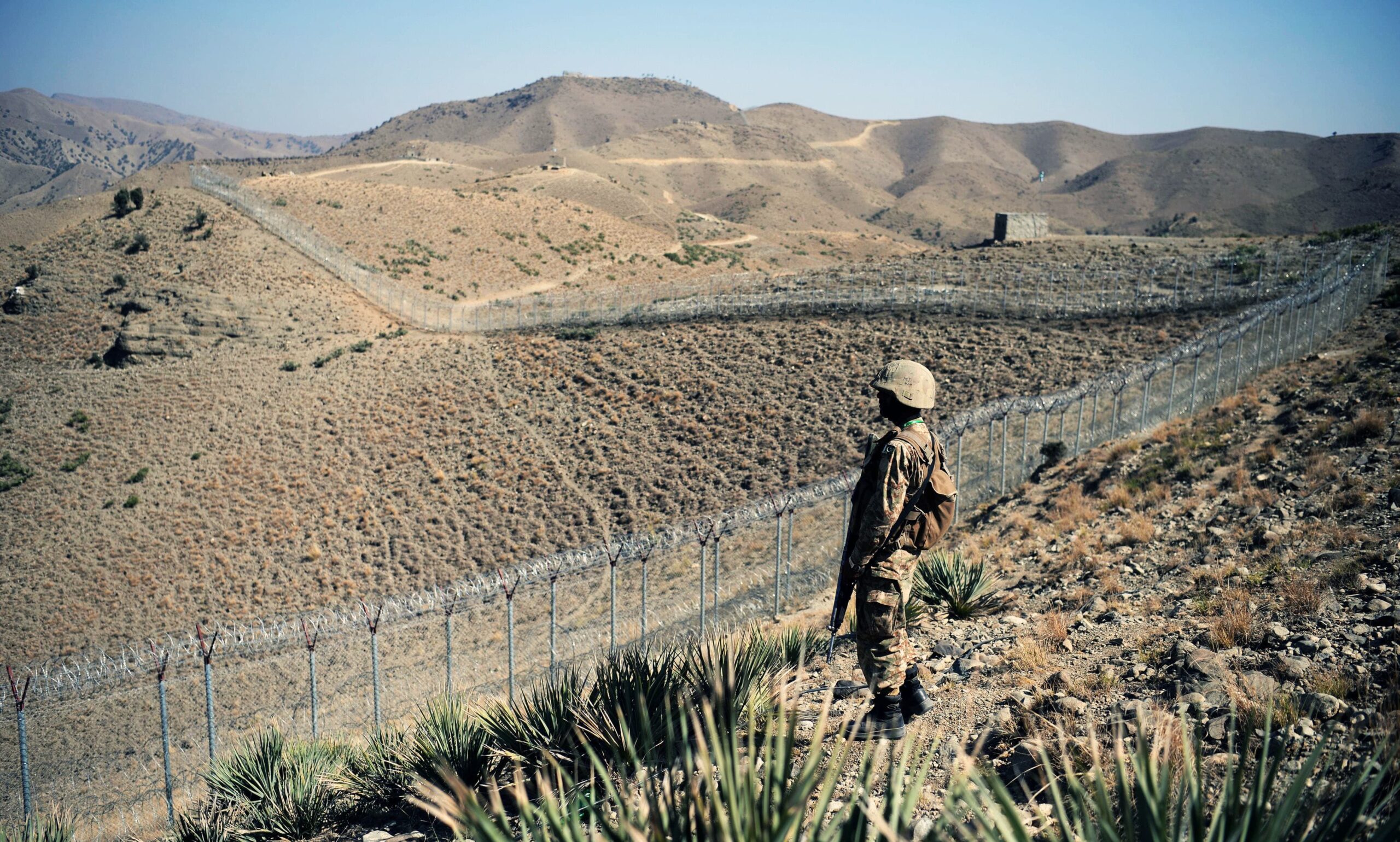
Only then can peace dividends blossom on either side of the 2600-kms fenced borders between the two countries.