



Operational Insights from the Largest Air Battle of 21st Century
The skies over South Asia in May 2025 glowed like a live wire; buzzing with radar beams, contrails, and the silent hum of targeting computers locked in deadly games. Above the jagged silhouette of the Himalayas, where thin air turns sound brittle, two of Asia’s most advanced air forces finally crossed paths… not as hunters stalking prey, but as equals.
A Rafale, sleek and confident, banked hard through the stratosphere, its cockpit awash in green holographic light. Its pilot’s gloved hands danced over switches, the soft chime of radar pings whispering new threats every second.
More than 200 km away, a J-10C rode its own invisible current, engines howling like a silver falcon, its pilot calm, his headset filled not with static, but with a voice… a fused picture of the sky, piped in from a hundred sensors. Far below, in buried command centers, radar operators murmured callsigns and vectors, their screens blooming with blue and red icons that flickered like living things. The world held its breath. This was no mere skirmish. It was the first great air battle of equals since World War II… a confrontation between tested machines, trained minds, and rival doctrines. Pakistan called it a defensive operation, India an act of restrained retaliation, but labels meant little. For the first time in eight decades, the sky itself would pass judgment.
Wings through Time: A 35-Year Tale of Air Power
For three decades before that day, air combat had been a one-sided affair… wars fought by uncontested champions against adversaries who barely left the ground.
The Gulf War 1991
F-117 Nighthawks ghosted through Iraqi skies, stealth cloaks wrapped around them like magic, while B-52s lumbered in the clouds, scattering steel over desert grids. Iraq’s air defenses cracked in days. Its pilots rarely saw the enemy before radar screens went dark. The coalition flew 100,000 sorties with impunity; proof that whoever controlled the air could shape the earth.
Kosovo 1999
NATO jets prowled the night, precision bombs slicing bridges and bunkers with surgical arrogance. The Yugoslav air force stayed grounded; their radars blinded; their sky stolen. It wasn’t war… it was a one-man show.
The same script played out in Afghanistan, Iraq, Libya, and Syria. Stealth jets and drones rained precision from heaven. The enemy could hide, run, or pray, but not fight back. Drones loitered lazily over valleys, plucking targets like hawks over a chicken pen.
Even in Ukraine, skies became killing grounds for missiles and drones, not pilots. Russia’s ambitions for air dominance wilted against a swarm of man-portable missiles and cheap UAVs. No dogfights. No duels. Just machines swatting machines. For 35 years, air power’s story was a solo act: victory without contest. But victory untested can breed complacency.
Then came May 2025: and the skies over Kashmir became a level field for the first time since the 1940s. Here, Pakistan’s J-10Cs, armed with Chinese PL-15 missiles and plugged into a network-centric web, met India’s Rafales, carrying the much-touted Meteor. Both sides had AESA radars, electronic warfare suites, and veteran pilots. Both had doctrine. Both had pride. But only one had a living network… a kill-chain that could fight even when the pilot turned silent.
AI Delivering the Sky: Air Superiority and Air Dominance
In the modern battlespace, victory is no longer decided by the fastest jet or the sharpest missile—it’s decided by who can think first and act fastest. Air power theorists draw a fine, deadly line between Air Superiority and Air Dominance.
Air Superiority, is like a fragile umbrella; enough control of the skies to fly and fight without being constantly swatted, but always under threat from a lurking adversary. It’s local, temporary, and hard-won.
Air Dominance, on the other hand is a thunderstorm of total control; the moment when the enemy’s wings are clipped, their radar screens go dark, and their aircraft stay grounded. It’s the sky turned sovereign.
And in May 2025, after just one brutal exchange over Kashmir, the Indian Chief of Defence Staff admitted the unthinkable: the IAF had to ground its fighters for three days; not from lack of equipment, but from loss of vision. In that silence, Pakistan owned the sky, the perfect definition of Air Dominance.
But how does a nation seize such overwhelming control today when milliseconds matter and the horizon hides invisible predators?
The answer hums quietly behind every radar ping and datalink whisper: Artificial Intelligence.
The Machine That Thinks at the Speed of Light
In the past, human pilots fought inside the OODA loop: Observe, Orient, Decide, Act, a mental circuit that determined who lived and who fell. AI has shattered that loop and rebuilt it in silicon. Across the PAF’s combat cloud, AI fuses streams of raw data: satellite scans, AWACS sweeps, ground radar echoes, ELINT whispers, and the heartbeat of every aircraft, into a single, shimmering picture of the sky. Where once a pilot saw only blips and bearings, AI now paints a living map: threats marked, priorities ranked, intercepts plotted, and firing solutions suggested; all before the pilot’s finger twitches. An enemy jet appears not as a surprise, but as a predicted pattern; its trajectory anticipated, its fate already written in code.
More than Combat: The Silent Edge – Data Dominance
The influence of AI isn’t confined to battle. It crawls through maintenance hangars, predicting failures before they happen; it sharpens training simulators, conjuring hyper-real dogfights against virtual adversaries that learn with every duel. It keeps aircraft flying longer, pilots learning faster, and squadrons ready for war before the first warning light blinks.
The race for the skies is no longer about who flies higher or who fires first; it’s about who knows more, sooner. In the data-saturated battlespace, information is ammunition, and AI is the trigger finger. The side that commands superior data fusion, predictive algorithms, and networked decision-making will not just achieve air superiority, it will evolve it into full-spectrum dominance, where the enemy’s every move is seen, anticipated, and countered before it begins.
In 2025, AI didn’t just assist the PAF, it rewrote the laws of air combat. It transformed dogfights into data duels and pilots into instruments of an invisible orchestra with AI as its conductor. Tomorrow’s wars won’t be won by the sharpest sword, but by the clearest sight, and in this new sky, the algorithm is mightier than the afterburner.
The 2025 Air Battle: Platforms and Doctrines
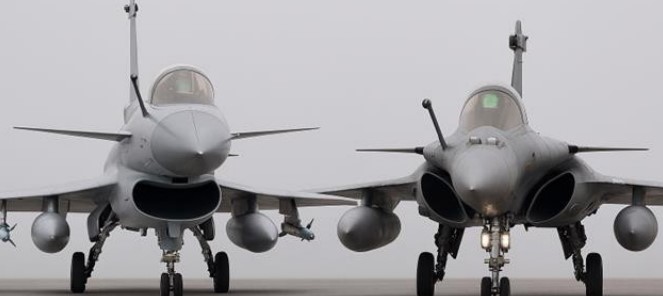
The confrontation was more than a clash of aircraft; it was a duel of philosophies. India’s Rafale, a 4.5-generation multirole marvel, embodied platform-centric warfare. Its Spectra EW suite, AESA radar, and Meteor missile made it a self-contained predator; sleek, intelligent, but alone.
Pakistan’s J-10C, another 4.5-generation fighter, played a different game: not the lone swordsman, but a node in a digital phalanx. Integrated with AWACS, ground radars, and AI-fusion centers, it fought as part of a shared intelligence organism.
On paper, the duel looked balanced
| Feature | J-10C (China) | Rafale (France) |
| Generation | 4.5 Gen | 4.5 Gen |
| Engine | WS-10B (single) | M88-2 (twin) |
| Max Speed | Mach 2.2 | Mach 1.8 |
| Combat Range | ~1,240 km | ~1,850 km |
| Radar | AESA (KLJ-7A) | AESA (RBE2-AA) |
| Primary BVR | PL-15 (~300 km) | Meteor (~200 km) |
| EW Suite | Data-linked integration | Spectra EW |
| Network-Centric Warfare | High (multi-platform fusion) | Limited (platform-bound) |
| Cost | ~$40M | ~$150M |
The 2025 Showdown: Tech, Tactics, and Tenacity
At 45,000 feet, in a theater where air is thin and time is measured in milliseconds, the difference between survival and obliteration lay not in speed, but in connectivity. The Rafale-Meteor combination was a jewel of French engineering, a platform-centric marvel. When the Meteor launched, it soared like a spearhead, its ramjet breathing fire, its onboard radar painting its prey. But its strength was also its shackle: the mid-course guidance link. The Rafale had to stay on station, radar lit, guiding its missile like a shepherd dog. Break the link too early, and the Meteor, still 50+ km from the target, would drift blind into the void.
That meant the Rafale couldn’t leave the fight. It had to linger, glowing like a beacon on enemy sensors, vulnerable to counterattack. If it junked too hard, or dove to evade, or… was shot down, the Meteor became an orphan. Across the sky, the PAF kill-chain was a different creature: distributed, multi-nodal, resilient. The J-10C didn’t carry the battle alone. It was a node in a sprawling combat cloud stitched together by AWACS eyes, ground radars, and AI-assisted fusion centers. Its PL-15, once fired, wasn’t a spear… it was a homing wolf guided by a chorus.
The J-10C pilot could launch and leave, diving out of radar cones, repositioning to safety, even switching targets if commanded. The missile’s updates came not from his cockpit but from the network brain, feeding live coordinates from AWACS, satellites, ground radars, and other airborne assets.
When a PL-15 streaked toward a Rafale, it remained cold and silent, coasting invisibly. Only when it crossed the no-escape zone; within 30 km, did its radar blink alive. By then, the Rafale’s threat receiver screamed too late; with options no more.
Meanwhile, the Meteor, majestic but dependent, betrayed its launcher’s position. The Rafale, leashed to its missile, became prey to the very doctrine it championed.
In the opening minutes of battle, once Rafale were forced defensive… Spectra jamming frantically, flares arcing behind it like molten rain. The Meteor it had launched still hung in the sky, blind and drifting, as its parent jet broke lock to survive. Moments later, a PL-15, silent and remorseless, finished the job. Across command rooms, observers realized: this wasn’t about aircraft generations.
It was kill-chain versus kill-chain… and the networked hunter devoured the isolated duelist.
A Co-Pilot in the Shadows
Inside PAF’s combat cloud, AI stitched together fragments from satellites, ELINT stations, AWACS sweeps, and ground radar pulses; each frame forming a living, breathing picture of the sky. It whispered into cockpits like a digital guardian angel. Inside the cockpit, AI doesn’t just assist, it whispers.
“Enemy lock at bearing 280. Counter with PL-15. Reposition 30 degrees east. Launch window in three… two…”
For pilots pulling 8 Gs, heart pounding, this isn’t just data; it was survival in stereo. The pilot nods, the missile screams free, and the aircraft banks away, already guided by the next command. AI juggles more than threats: it manages sensors, chooses maneuvers, and commands Loyal Wingmen, unmanned drones flying in formation, acting as extra eyes, decoys, jammers, or missile trucks. Together, they form a hive, not a squadron; each piece aware of the others, each move choreographed by an intelligence that never tires, never blinks. In Beyond-Visual-Range (BVR) combat, where missiles streak at supersonic speeds across invisible frontiers, AI becomes the unseen tactician, calculating trajectories, countering jamming signals, adjusting mid-course guidance in milliseconds. While human reflexes measure in seconds, AI fights in microseconds. Beneath the surface of this duel ran an invisible current: Artificial Intelligence: not as a pilot, but as the conductor of a symphony no human could play fast enough. In milliseconds, AI rerouted targeting priorities, predicted evasive maneuvers, and reassigned missile guidance. When one node blinked off, another took over; no gaps, no delays. This was warfare too fast for humans. In the time it took a Rafale pilot to process a radar ping, the network had already fired, updated, and repositioned the PAF assets. The IAF, still reliant on platform autonomy, fought as best as it could; but each pilot carried his own cognitive burden. Every lock, every flare, every evasive spiral demanded attention. The PAF, by contrast, flew as part of a collective mind, each pilot a cell in an organism that thought faster than any individual could. For the first time, AI wasn’t just assisting: it was commanding the tempo.
THE KILL-CHAIN SHOWDOWN : RAFALE VS J-10C
Rafale + Meteor (Platform- Centric)
1. Detects target using onboard radar.
2. Launches Meteor; missile linked to aircraft via datalink.
3. Stays on course to feed mid- course corrections.
4. Must maintain radar lock, becoming visible and vulnerable.
5. If threatened, evasive maneuvers break link; Meteor goes blind mid-flight.
6. If Rafale destroyed or disengages, missile loses guidance; target escapes.
J-10C + PL-15 (Network-Centric)
1. Target detected by any node: AWACS, ground radar, or another fighter.
2. J-10C receives data passively, no need to switch radar on.
3. Launches PL-15 from safe distance (~300 km).
4. Missile receives midcourse updates from network, not the launching jet.
5. J-10C breaks away, repositions,
6. or reengages elsewhere.
7. PL-15 stays silent, then activates radar only in terminal phase (~30 km), giving target seconds to react.
Result
● Rafale tied to its missile; J-10C free to fight another day.
● Meteor strong but dependent; PL- 15 autonomous and persistent.
In every engagement, the network dictates the fate.
Final Verdict: When Data Becomes Dominance
In the cold aftermath, when contrails faded and wreckage drifted across vast fields, analysts stared at the outcome in disbelief. The Rafale, once hailed as a game-changer had fallen victim not due to inferior performance, but to superior orchestration. The J-10C, cheaper and seemingly humbler, triumphed through a doctrine where missiles hunted through a shared consciousness, and pilots lived to fight again. In every engagement, PAF’s distributed kill-chain dictated the rhythm. Its pilots fired, repositioned, and vanished… while their weapons, guided by the omnipresent network, stalked targets unrelentingly. The IAF, tethered to single-platform logic, found itself shackled to its own missiles; forced to stay exposed to ensure their success. Break the link, and the Meteor drifted; stay connected, and the Rafale risked annihilation. In a sky teeming with AI-assisted sensors, it was a lose-lose equation.
The lesson was unambiguous
Air dominance is no longer about who flies fastest, but who thinks fastest. In 2025, PAF didn’t just outfly its rival… it out-thought it, leveraging a web of machines that saw beyond horizons, reacted without hesitation, and turned the sky into an intelligent battlefield.
The future belongs to those who weave networks, not legends; who wield algorithms, not arrogance. And as the smoke cleared over the Himalayas, one truth echoed through command halls and flight schools alike.
He who owns the data, owns the sky
References
● Warne, A. (2025, September 19). https://www.key.aero/article/afm-pakistan-understanding-rafale-kills (accessed 20 September, 2025)
● Defense News Aerospace, 2. (2025, May 07). From https://armyrecognition.com/news/aerospacenews/2025/pakistans-first-combat-use-of-chinese-pl-15e-air-to-air-missiles-confirmed-after-debris-found-in-india (accessed 01 June, 2025)
● MBDA (2025). https://www.mbda-systems.com/products/air-dominance/meteor?utm/ (accessed 01 October, 2025)
● Faraz Ansari (2025, May 08). https://focus-pakistan.com.pk/pakistan-confirms-first-combat-deployment-of/ (accessed 01June 2025)
● Maj Gen Sudhakar Jee (2025, July 21). https://www.indiasentinels.com/opinion/network-centric-warfare-pakistans-edge-and-indias-wake-up-call-6933?utm (accessed 01 October, 2025)