


Forming the plains watered by the Indus along mountain corridors where the Himalaya, Karakoram and Hindu Kush converge, Pakistan’s cultural heritage unfolds across millennia. From Neolithic Mehrgarh to the planned cities of the Indus Valley, from Buddhist Gandhara to living Sufi shrines and a musical culture that travels the world, the country’s heritage is both ancient and insistently alive. Pakistan’s cultural heritage is a living continuum—from Mehrgarh’s Neolithic pioneers to the urban genius of the Indus Valley, from Gandhara’s cosmopolitan Buddhism to a shared sacred geography of shrines, temples and gurdwaras, carried forward in the breath and pulse of qawwali and regional folk song.
It is a story of routes and roots: mountain corridors and riverine plains that moved ideas, artisans and faiths, and communities that translated encounter into art, learning and devotion. Today, as Nusrat Fateh Ali’s global qawwali legacy, Gandharan sculpture, Potohar’s scientific milestones, and Gilgit-Baltistan’s inscriptions meet contemporary fusion and platforms, Pakistan’s past is not an archive but an engine— binding plural identities in a common civic and spiritual grammar. To steward sites and lineages, and to protect the human custodians who keep them alive, is to invest in a future where the country’s oldest civilizations continue to teach the world how cities can be humane, art can be porous, and faith can be sung into fellowship.
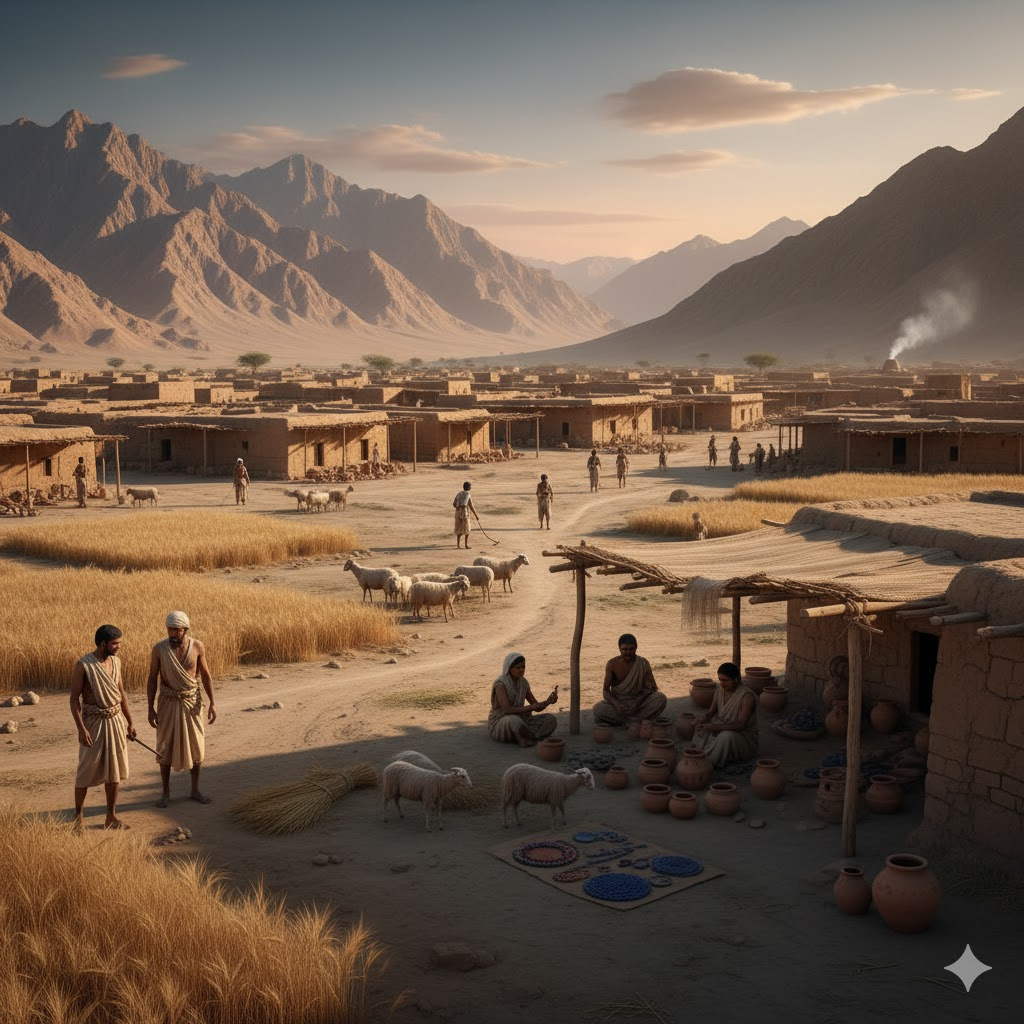
At the foot of the Bolan Pass in Balochistan, Mehrgarh marks one of humanity’s earliest experiments in settled life. Here, agro-pastoral communities cultivated barley and wheat, herded animals, and built with mud brick, laying foundations for craft technologies, ceramics and beadwork that would later underpin South Asia’s urban arcs.
Positioned on routes that link Central Asia to the Indus plains, Mehrgarh’s long Neolithic-to-Chalcolithic sequence documents the slow genius of village innovation—the first rung on Pakistan’s civilizational ladder. Far downstream, the Indus Valley Civilization engineered cities whose rationality still startles modern urbanists. Mohenjo-Daro and Harappa reveal gridded streets, standardized bricks, domestic wells, bathing platforms, and an elaborate underground drainage—public health made policy five thousand years ago. Commerce thrived through bead industries, weights and measures, and signature steatite seals. Among them, a recurring “unicorn” motif captured the imagination, even as the compact inscriptions of the undeciphered Indus script continue to tease linguists. If Mehrgarh is the experiment, the Indus is the metropolis: a civic ideal realized in brick, water and order. In the northwest, Gandhara formed a cosmopolis where Indic, Persian, Hellenistic and Central Asian currents met. Anchored at Taxila and Peshawar, with Swat Valley monasteries and influence stretching toward Gilgit-Baltistan and Kashmir, it stood at the crossroads of empires and ideas. Taxila’s world of learning nurtured philosophy, medicine and the arts; later tradition associates the scholar-administrator Chanakya with its scholastic milieu. Gandharan sculpture, with its Greco-Roman drapery and serene, human Buddhas, helped carry Buddhist imagery along the Silk Routes. Stone here speaks multiple languages—acanthus leaves and dharma wheels, Jataka tales carved in schist—signs of a region that translated between worlds.
Spiritual Heritage
Pakistan’s sacred geography is a palimpsest. Buddhist monastic complexes of Gandhara; Hindu sites like the Katas Raj Temple – Second most holiest site in Hinduism; Sikh pilgrimage centers from Nankana Sahib to Hasan Abdal; and extensive networks of Muslim Sufi shrines together map a landscape of devotion that is also one of dialogue. On the Potohar plateau where the Jhelum and Indus shape the land, Al-Biruni famously calculated Earth’s radius from Nandana Fort in the 11th century—an emblem of scientific inquiry amid spiritual topographies. In Gilgit-Baltistan, rock carvings and inscriptions in many scripts—along with manuscripts and graves—record the region’s role as a corridor linking China, Tibet, Central Asia and the subcontinent, and testify to deep cultural layering. Most palpably today, Sufi shrines function as social sanctuaries, hosting urs festivals, feeding the poor, and offering solace that cuts across class and creed. This inclusive devotional culture has long been a quiet adhesive in a diverse society.
Musical Heritage
If architecture and inscriptions give Pakistan’s past its outlines, music renders its heartbeat. Qawwali—the Sufi devotional ensemble form—has become the country’s global aural signature. In mehfil-e-sama settings, a lead qawwal, chorus and handclaps move with the harmonium, tabla and dholak through raga-based melodies and call-and-response refrains, building toward ecstatic release, or wajd. Texts draw on Amir Khusro, Rumi, Hafez, Bulleh Shah and Baba Farid, sung in Persian, Urdu, Punjabi, Saraiki and beyond. Hereditary lineages sustain the art at shrines even as concert stages, film, radio and digital media have widened its reach. Nusrat Fateh Ali Khan’s collaborations and world tours gave qawwali a planetary audience; the Sabri Brothers and Rahat Fateh Ali Khan extended the legacy, while contemporary platforms have fused devotional roots with new sensibilities. Alongside qawwali, kafi and ghazal advance poetic introspection; regional folk traditions—from Sindh’s bait and waee with yaktaro and narr to Punjab’s tumbi-and-dhol pulse, Baloch benju and suroz, and Pashto rubab-led song—anchor ritual, storytelling and communal life.
Continuity and Exchange
Pakistan’s heritage is not a sequence of silos but a continuum. Mehrgarh’s agricultural knowledge flows into the Indus cities’ surplus and specialization. Gandhara’s cosmopolitan arts mirror the region’s role as conduit and crucible. The rock art and manuscripts of Gilgit Baltistan and the Potohar’s scientific milestones, recall centuries of knowledge exchange. Sufi shrines knit these histories into a shared moral geography, while music carries that inheritance into ears and lives near and far. Modern studios and festivals have staged ambitious fusions without erasing foundations; Coke Studio’s pairings of folk, classical and contemporary idioms, for instance, have introduced younger audiences to village timbres and devotional verse, alongside rock and electronic textures. The result is a musical ecology that is devotional and daring, faithful and experimental.
Stewardship
Much of this patrimony is fragile—vulnerable to environmental stress, urban pressure, looting or neglect. Safeguarding Mohenjo-Daro’s bricks and drains, conserving Taxila’s layered ruins, protecting petroglyph corridors in the north, and maintaining shrines, gurdwaras and temples as shared patrimony require investment and public will. Preservation extends to people: craftspeople, hereditary qawwals, folk singers and instrument makers who carry techniques and repertoires in memory and hand. In a globalized soundscape, sustaining apprenticeship systems and context—shrines, courts, community gatherings—matters as much as funding recordings and tours.
A Living Archive
The Indus script’s mystery and the “unicorn” seal’s enigma remind us how much remains to learn. Yet Pakistan’s cultural heritage already offers a capacious archive of human strategies: how to build cities around water and hygiene; how to translate between civilizations; how to fashion inclusive devotion; how to let poetry and music make a public. In shrine, street and studio, that archive continues to be written—an old civilization, still becoming.
Qawwali’s global rise—from shrine courtyards to film soundtracks and international stages—owes to its improvisatory structure and intimate exchange between lead singer and audience, which together generate the ascent toward ecstasy; this interaction remains central to its appeal. Sindhi bait and waee, Punjabi dhol-and-tumbi folk, Baloch suroz and benju, and Pashto rubab traditions exemplify regional musical lineages that continue to feed contemporary fusion and broadcast platforms. Coke Studio’s deliberate pairing of folk and classical forms with contemporary idioms accelerated a revival that brought village voices to global headphones.
Discover the Timeless Wonders of Pakistan
Pakistan’s cultural heritage is a vibrant tapestry woven from millennia of history, diverse traditions, and a rich blend of influences. From the ancient cities of the Indus Valley to the spiritual sanctuaries of Sufi shrines, Pakistan offers a unique journey through time and culture. The country’s music, art, and architecture are not just relics of the past but living expressions of a dynamic and inclusive society. By visiting Pakistan, you will not only witness the grandeur of its historical sites but also experience the warmth and hospitality of its people. Come, explore the cradle of civilizations, and be part of a story that continues to inspire and connect us all.