




The May 2025 brief conflict between Pakistan and India witnessed a significant shift in the character of warfare. This included short but intense air combat and the exchange of longrange missile and drone attacks. Traditional formations including strike corps, were not mobilised by both sides though intense artillery and rocket barrages broke out over the Line of Control and Working Boundary. India deployed its premier stand-off weapons, the Brahmos and SCALP cruise missiles in contrast to Pakistan’s use of its Fatah-I MLRS. In the ensuing air combat, Pakistan Air Force’s multi-domain kill-web overwhelmed the Indian Air Force resulting in shooting down of several Indian fighter aircraft. This was a major humiliation for a country that spent at least eight times more on its defence than Pakistan. To reclaim some notion of victory, India resorted to use long-range vectors (LRV) i.e. drones and cruise missiles against Pakistan’s air bases. The resultant exchange of LRVs though limited, signaled the new form of warfare between the two nuclear-armed countries. As Pakistan struck back under its quidpro-quo-plus doctrine, the tone of Indian military changed, and it gladly agreed to a ceasefire brokered by mediating countries. However, in their minds, Indian political and military leadership seem to have carved out space for a limited war below the nuclear threshold and have signalled that they can now implement a strategy of ‘punitive deterrence’ against Pakistan.
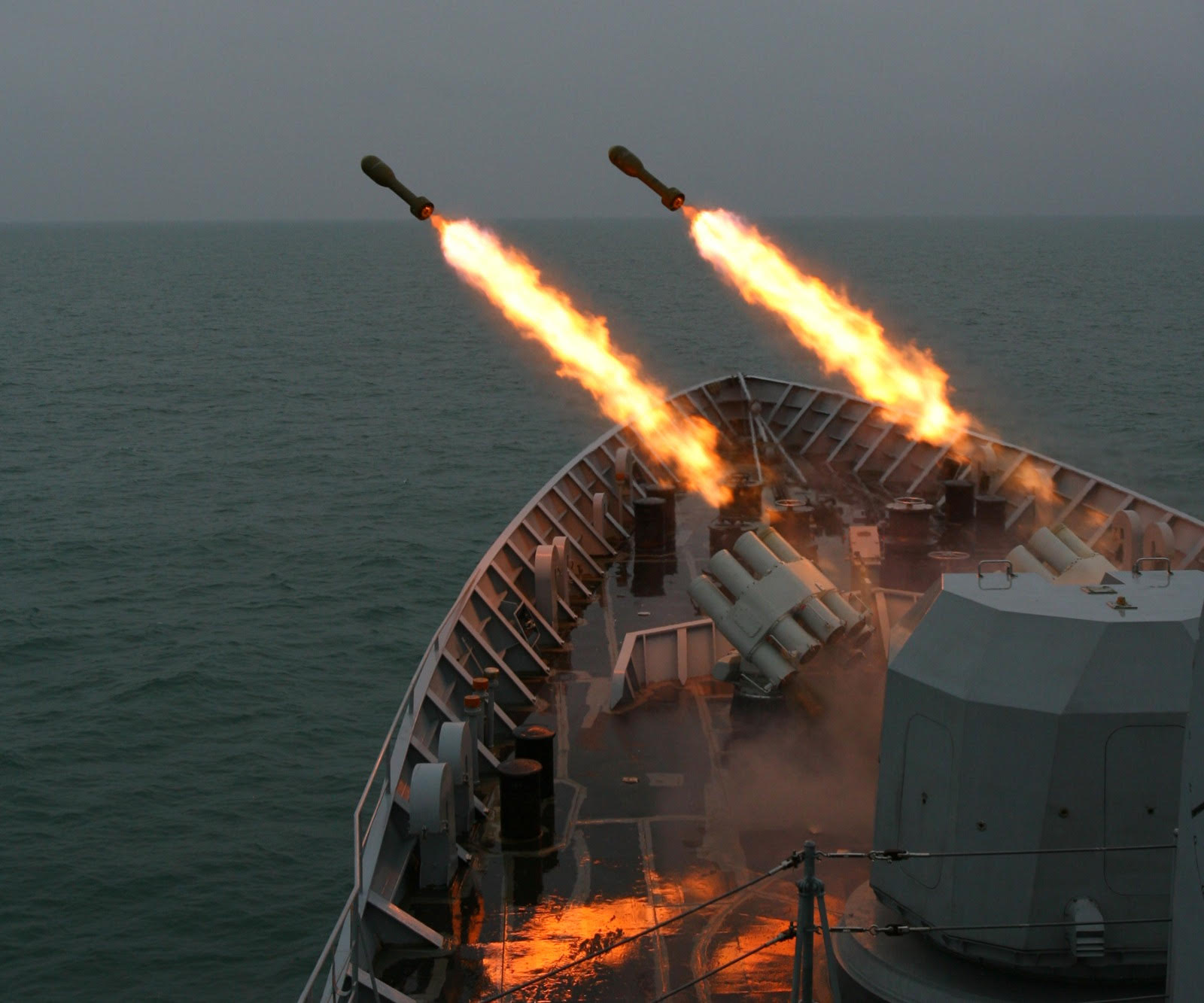
Following the conflict, the Indian defence minister issued a stark warning from the deck of Indian Navy aircraft carrier INS Vikrant: “This time, Pakistan did not have to face the firepower of the Indian Navy, but the world knows that if Pakistan does any unholy act this time, it is possible that the opening will be done by our Navy.”
However, India’s decision not to escalate the conflict into the maritime domain was not an act of restraint or concession; it was a deliberate and calculated choice.
The Indian leadership was acutely aware that engaging in naval warfare would risk significant disruption to its strategic and commercial maritime interests. Primarily, among these were India’s oil refineries; now a major source of national revenue and its shipping lanes to the Gulf, which run parallel to Pakistani coastline.
The damage to Indian commerce and economy would have been proportionally much higher than to Pakistan with a much lower trade volume. Notwithstanding this rational calculus, the Hindutva infused Indian leadership has demonstrated a tendency to miscalculate in pursuit of political objectives. As such, there remains a credible risk that it could act on its maritime threat, potentially dragging the region into a broader and more dangerous confrontation. This is a threat that Pakistan Navy must prepare to counter effectively.
In a US-led unipolar world, the post 9/11 decades were marked by the Global War on Terror (GWOT) where focus of navies around the world shifted to counter terrorism and counter piracy. For some time, it seemed that the space for traditional naval warfare had shrunk, and role of navies was to protect the global commons against terrorism and piracy in a thousand-ship naval force under US leadership. This phenomenon was even more pronounced in the North Arabian Sea where Task Forces 150 and 151 were formed by U.S. Naval Forces Central Command (NAVCENT) under the umbrella of Coalition Maritime Campaign Plan (CMCP) to coordinate multinational maritime operations in the Middle East, the Red Sea, the Arabian Sea, and parts of the Indian Ocean. Pakistan Navy being a US ally in the GWOT joined the CMCP, contributed ships and command teams and undertook countless counter piracy and counter terrorism operations. To further these cooperative efforts, PN initiated a multinational naval exercise AMAN (peace) to bring together navies from around the world to protect against the threats of piracy and terrorism. This exercise that continues to be held is the only venue bringing together at Karachi, navies from diverse and sometimes adversarial nations, including China, Russia, the United States, and Iran, in a shared mission to promote maritime security. The resurgence of great power competition fueled by China’s rise and renewed geopolitical tensions between the East and West, has fundamentally altered the focus of global navies. This intense strategic rivalry has brought traditional naval warfare back into focus, replacing the post-9/11 emphasis on constabulary roles. Amidst this evolving landscape and the relative waning of U.S. power and focus, middle powers like India are now carving out a space for regional influence. Taking advantage of its role in the anti-China QUAD coalition and vying for regional hegemony, India is asserting its naval dominance in the Indian Ocean, positioning itself as the “net security provider”.
These changing dynamics call for a higher emphasis to prepare for full spectrum deterrence by Pakistan against Indian designs and intentions in the Western Indian Ocean region. By design Pakistan’s strategy is defensive which at sea translates into Anti-access Area Denial (A2AD) aiming to deprive Indian Naval fire power to be used against Pakistan’s naval and maritime interests by holding Indian Naval ships, submarines and aircraft at risk over operationally significant distances and to increase the cost of war by destroying Indian energy, industrial, port and shipbuilding infrastructure in its littoral regions. This calls for a shift in focus on asymmetric warfare strategies including unmanned technologies that have marked naval warfare in the past few years. The wars in the Black and Red Seas have demonstrated the emergence of unmanned systems as effective tools in the naval warfare. Using small, Unmanned Surface Vehicles (USVs) and Unmanned Air Vehicles (UAVs), Ukraine has extracted disproportional cost on the Russian Navy sinking several naval vessels and practically bottling the Black Sea fleet into protected harbours. This devastating use of unmanned systems such as One Way Attack (OWA) drones was made effective by key enabling technologies such as the communication backbone based on Low Earth Orbit (LEO) satellite constellation Starlink and satellite-based ISR. These killchains enabled the small attack USVs like Magura and Sea Baby to be controlled at beyond line of sight (BLOS) distances to operate throughout the entirety of the Black Sea.
Ukraine’s traditional navy was wiped out in the opening salvoes of the war but with the kill chains established by NATO, Ukraine turned the tables against a much more powerful navy. Similar use of UAVs and USVs has been seen in the Red Sea where the US Navy has not been able to prevent Houthis attacks on merchant ships despite deploying its aircraft carriers and intercepting missiles and drones with more than 220 interceptors costing well over a billion dollars.
The unmanned systems have altered the cost equations in the naval arena. A cheap low technology easily replaceable USV or UAV can now threaten the largest warships costing over ten billion dollars. This is a true Revolution in Military Affairs (RMA) happening in the world around us and to a degree was employed both by Pakistan and India in the recent conflict. Traditionally, the developing navies are platform and weapon systems centric.
Typically, they induct the available and affordable systems based on their individual capabilities and then integrate them in existing frameworks. In the era of systems warfare, Pakistan Navy’s doctrine is evolving from a platform or weapon-centric approach towards establishing dynamic “kill-webs”. This networked system of sensors, shooters, and command nodes is essential for closing the Observe-Orient-Decide-Act (OODA) loop faster than an adversary. Unlike traditional, linear kill chains, a kill-web enables decentralized decision-making and simultaneous engagements across multiple domains, thereby enhancing a force’s speed, resilience, and lethality in modern multi-domain warfare.
To enhance this capability at sea, Pakistan Navy may employ space-based assets such as remote sensing satellites, complemented by High-Altitude Pseudo-Satellites (HAPS) and Medium-Altitude Long-Endurance (MALE) UAVs equipped with Electronic Intelligence (ELINT) payloads. These are integrated with a resilient communications backbone supported by dedicated communication satellites and UAV-based Mobile AdHoc Networks (MANET). While such capabilities could significantly constrain the operational freedom of an opposing surface fleet, their ultimate effectiveness would hinge on the resilience and integration of intelligence, surveillance, and targeting networks, as well as the ability to maintain tempo and coordination over prolonged operations.
In this context, technological superiority alone would not guarantee success—sustained readiness and adaptability to countermeasures would remain critical determinants of the outcome.