
India was the jewel in the crown of the British Empire during the 18th, 19th, and part of the 20th century; if that was so, the glare and shine emanated from the British Indian Army. The Air Force was still nascent, and the Navy had a secondary role per se.
In 1947, when the partition of the country was underway to create two independent and sovereign states, there was talk of keeping the British Indian Army undivided.
However, due to its impracticality, the idea soon died its own death. The two armies inherited the same culture, traditions, and attributes such as organisation, tactics, and training methodology.
With the passage of time, however, both adapted to the culture of their respective lands, and religion also found its way in. For a considerable period, the Indian Army retained a secular outlook. While we, to a greater extent, discarded British traditions, the Indians kept them alive. In April 1977, liquor was banned in the country by Mr. Z. A. Bhutto, further diminishing the old British Indian Army culture.
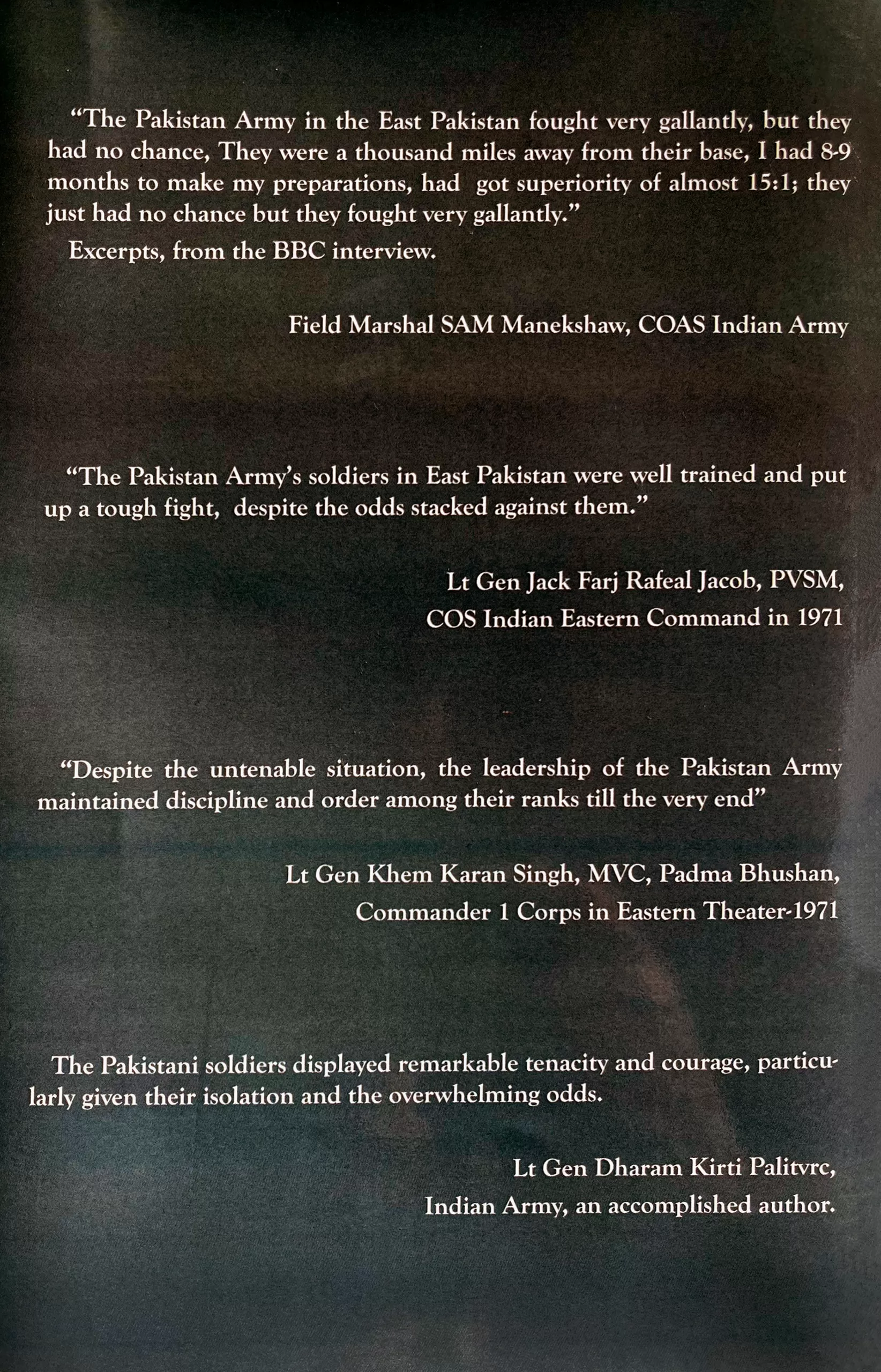
Indian Officers’ Messes, however, remain “wet” to this day. Between 1947 and 1999, the two countries fought three wars and a major conflict. I will not dwell on the results of these engagements, but I will acknowledge that the Indians displayed considerable chivalry and valour. They even praised our officers and, in some cases, wrote their citations—three examples being: Lt Col Raja Sultan Mahmood, SJ, 32 Baloch (East Pakistan, 1971); Lt Col Raja Muhammad Akram, SJ, 35 FF (Bara Pind, Sialkot, 1971); and Capt Karnal Sher Khan, NH, 7 NLI (Kargil, 1999). Recently, while republishing a book on the 1971 Indo-Pak War, I came across numerous statements by Indian Army officers praising the Pakistan Army—their enemy—in the Eastern Sector, a great gesture indeed. I have compiled these and placed them on the back cover of the newly republished book.