





Sehrish Mustafa Research Executive, KCFR
Asalam-o-Alikum and good morning, everyone. This is Sehrish Mustafa from Karachi Council on Foreign Relations. I welcome you all to Amaanibagh for the inauguration of two significant initiatives by the Pathfinder Group. I would like to invite Dr Huma Baqai to the stage. She is the director of Millennium Institute of Technology and Entrepreneurs, Karachi, and also the Vice Chairperson of Karachi Council on Foreign Relations, with a rich academic and professional journey spanning over 25 years. Dr Huma Baqai has made significant contributions as an educator, author, and scholar. She has three books to her credit and has also authored more than 40 national and international research articles and book chapters. She has over 20 years of association with electronic and print media. She’s also a certified corporate trainer and content developer. She’s the master of today’s ceremony.
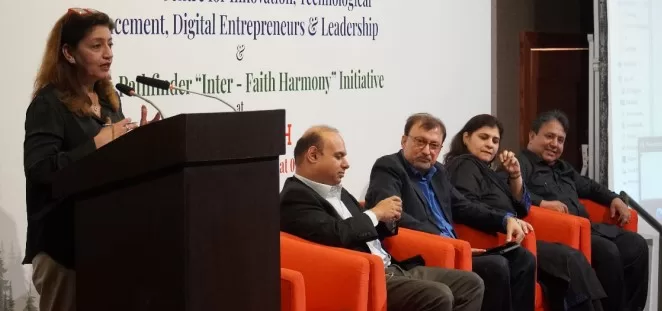
I would like to invite on stage the Chairman of Pathfinder Group, Mr Zarrar Sehgal, Air Cdre Dr Khalid Banuri, Imran Jattala, and Gulmina Bilal, the first female Chairperson of the National Vocational and Technical Training Commission of Pakistan.
Dr Huma Baqai Vice Chairperson, KCFR & Rector, MiTE
Asalam-o-Alikum and a very warm welcome, ladies and gentlemen, distinguished guests, innovators, and future leaders. I was in this room yesterday, the energy was electric, and today, once again, I see it’s the same. We are going to do something today that we have been working on for a while. I know Mr Ikram Sehgal, Co-Chairman, and the Pathfinder Group were working on it. Something I’d suggested, and I’m grateful to Mr Ikram Sehgal for taking it up and making it a part of CITADEL. Whenever someone talks about Mr Ikram Sehgal and Pathfinder Group, one also mentions excellence. So I’m not surprised that’s how it’s titled.
Let me introduce the Pathfinder Group to you. Most of us just know it as a security entity, but it is just a lot more than that, and it has touched so many lives that you’ll be surprised. I’m not going to spend much time on this one, but once I invited Mr Ikram Sehgal to an event at my place, I called his office, and they said there’s a wedding in the family, so he can’t come. I asked, who’s getting married in Ikram Sehgal’s family that I don’t know? Because I consider myself part of his extended family.
Later, I found out that two of his employees are getting married and he was hosting the event here in Islamabad for them. This has stayed with me. Pathfinder Group is Pakistan’s largest provider of integrated security services, employing around 12,000 people across more than 75 cities and towns nationwide. The group’s security division includes the country’s two largest private security companies, Security and Management Services Limited and Wackenhut Pakistan Limited, expanding beyond security. Its financial service divisions include Virtual Remittance Gateway, which is poised to transform Pakistan’s financial landscape, and iPath Limited, along with other related companies currently collaborating. I don’t think this introduction truly reflects what Pathfinder does because I know they do much more. I know they participate in Davos privately, representing Pakistan for decades, and they’re now making an impact and doing what needs to be done for Pakistan for a very long time. These two centers of excellence will be properly introduced by Mr Zarrar Sehgal himself.
I want to share that it’s with immense pride and great anticipation that I welcome you all to the official launch of the “Pathfinder School of Excellence and Center for Innovation, Technological Advancement, Digital Entrepreneurship, and Leadership.”
Today is more than just unveiling an academic institution; it’s the launch of an idea, a bold, future-focused initiative rooted in excellence, aimed at equipping Pakistan’s next generation with the skills, mindsets, and vision they need to lead in a digital age. That was the dialogue with Gen Z yesterday. Every 22-year-old, 21-year-old, and 19-year-old who spoke said they want teaching methods to improve. They want soft skills to be part of the curriculum. They want the curricula to be reinvented. They want to understand what AI can do with us and why we are only learning the theory and not the practical applications. This is Pathfinder’s contribution to all of that. CITADEL was built on four foundational pillars: Innovation, Technological Advancement, Digital Entrepreneurship, and Leadership. I believe leadership is key for three of them, but that’s just my opinion. We envisioned this space not just as a place of learning but as a launch pad for ideas, ventures, and young minds ready to disrupt and redefine.
This initiative wouldn’t have been possible without the vision and leadership of the Pathfinder Group, along with the tireless efforts of everyone working behind the scenes to make this dream happen. To help us better understand the mission and promise of CITADEL, it’s my honor to invite Mr Zarrar Sehgal, Chairman of the Pathfinder Group, to say a few words on the official inauguration of the Pathfinder School of Excellence.
Zarrar Sehgal Chairman, Pathfinder Group
Thank you, Dr Huma Baqai, and everyone, for joining us today. On behalf of the Pathfinder group and the Sehgal Family, I’d like to welcome you all to this inauguration ceremony. As Dr Huma Baqai rightly said, it’s the inauguration of CITADEL, which will be done in the first half of the program, but equally important is the inauguration of the Pathfinder Inter-Faith Harmony Initiative. This initiative is very close and dear to our family, and particularly to my daughter Elena Sehgal. It is very gratifying to see members of our minority faith over here today for giving value to this meaningful initiative, which we will be discussing in the second part of our program.
I think it’s critical to find the future leaders, and we saw the enthusiasm of the young students yesterday, and also witnessed how interestingly they expressed their concerns. I think that’s why CITADEL is formed to give a path to the young minds and find real future leadership. I agree with Dr Huma Baqai, I’ve also got a bias as far as the leadership is concerned, we all know that digital and technological innovation part is very important but it’s also true that we stand on the brink of that technological innovation which is reshaping industries, and also redefining our daily lives and possibilities that are being opened up in Pakistan and abroad as well, and I think as we navigate this ever evolving landscape we’ve designed CITADEL to take maximum advantage in Pakistan and this landscape, this will also help us in finding the technological leaders of tomorrow, and these leaders will be not just people who can do everyday tasks but will be the true visionaries and the true problem solvers.
We want to find people who will act as the true catalysts of change, and to do this, we need to look beyond traditional metrics and utilize the people who exhibit creativity. For example, who look beyond status quo, who not just possess basic technical skills, the one with basic technological skills, but also have emotional intelligence. We have seen a lot about mental health issues, and I think we can see how emotional intelligence is important. What we’re finding out is that there is a commitment to ethical practices; you can see a convergence over here with Inter-Faith Harmony; this is where religion plays its part. We have observed that where technology and religion converge with each other.
Where are ethics derived from? A lot of ethics are derived from religious practices, and there is a fundamental link between both CITADEL and our Inter-Faith Harmony initiative, even though we’ve kept the two separate; there is a bridge between the two. I think the idea of CITADEL is to foster an environment where we nurture these qualities and find an investment in education where there is collaboration between ourselves and the youth of Pakistan. We want to create mentorship programs where we truly establish a vision for the future of Pakistan, and that’s where Pathfinder Group has always done that all and now we’re doing this in a more formalized setting. We collectively, as the Sehgal Family and the Co-Chairman Ikram Sehgal, have always done that in the past, and we’ll continue to do it in the future. CITADEL will move this forward, which is our pledge to Pakistan and to the youth of Pakistan. Thank you very much.
Dr Huma Baqai, Moderator
Thank you, Mr Zarrar. This is very nicely put. Now I’m going to invite Air Cdre (Retd) Khalid Banuri, the man behind this initiative. He’s the man who does the running around, brings all of us here, and is a pillar of strength.
Air Cdre (Retd) Khalid Banuri Advisor, CITADEL
Bismillah-ir-Rehman ur Rahim, ladies and gentlemen, I’ve been given this singular honor to open the discussion about CITADEL, the Center for Innovation, Technological Advancement, Digital Entrepreneurs and Leadership. I’m Khalid Banuri. I have spent most of my professional life as a user of cutting-edge technologies, mostly flying fast jets of various vintage, thereby experiencing the evolution of some technologies that were considered truly innovative for their time. Thereafter, I spent 22 years in various facets of strategic planning, and I’m currently interested in inspiring the next generations through education and leadership pursuits. Through the force of habit, allow me the liberty to talk about the CITADEL as a concept first.
By definition, it denotes a fortress typically situated on high ground overlooking the city. The CITADEL was traditionally the center of gravity of the city hub. The CITADEL that will be presented to you today is not thus a mere acronym. It has a certain character and inspiration to become a center of gravity for the futuristic digital Pakistan. The notion of a fortress does not merely depict a safe place but the fortified intent of its sponsor, the Pathfinder Group, to help the next generations in creating a sustainable ecosystem of innovation and creativity. It aims at breaking out from the chains of stereotyping and becoming the lead in creativity and sustainability.
Traditionally, CITADELs were known for their core of young men and women who lived, trained, and worked under a system that made leadership and character an essential part of their inspiration and hence innovation, technological entrepreneurship, along leadership. If you look at the extent of the market of the emerging technologies, it suggests a huge potential for the future. It is imperative, thus, that the Pakistani industry endeavors to get its share. Take artificial intelligence and machine learning, for example. Now, these are popular buzzwords today. Its market is expected to be in the tune of $190 billion or more at this time, and it is continuously growing. For example, the potential in predictive analysis or NLP is significant. The Internet of Things is expected to grow to 1.6 trillion dollars this year. Never mind the US-China tiff. The 5G technologies are expected to fetch 667.9 billion by next year. Blockchain, which has swiftly become a household topic, is now around 39.7 billion for the centralized finance, supply chain, and health sector. Robotic process automation, the RPA along leaves aside its high infrastructure cost but is already transforming how businesses operate, and that was around 1.89 billion in the year 2020, expected to grow by 2028 to 13.74 billion dollars. Now I’m cautious of this, that there could be different ways of looking at it and the market, but the point here is that business is significant and it is growing, and there’s potential in growing continuously.
The Oxford dictionary saw a CITADEL as a fort with up to six bastions. The CITADEL that you learn of today has three distinct passions. The career jumpstart, the escape velocity jet, and the strategic innovation. I’m cautious of the fact that my Air Force background seems to be playing a role here in choosing these names, but these are the concepts that are telling you that this is the way to go for the future. CITADEL, perhaps, is the first such center that acknowledges that the technology human interface is also a recognized skill that merits leadership training as part of its entrepreneurship. A recent example of human-machine interface is what we saw in the May war that was thrust upon Pakistan, in which technology and leadership and human skills, and innovation all played along to bring success to Pakistan.
Alongside the need for development of stable economies and the need for innovation and technological advancement, there are soft skills. The World Economic Forum highlights several soft skills as crucial for future success in the workplace, emphasizing the importance of adaptability, communication, and problem-solving in an increasingly complex and technology-driven world. The key soft skills include analytical thinking, creativity, resilience, leadership, and emotional intelligence. To the youth, it aspires to augment skills for employability. To the industry, it endeavors to fill the gap between academic knowledge and the skill set desired by the manufacturer.
It aims for the upskilled aspirant to have a wholesome personality, focusing on the leadership desired of the 21st-century digital world. Now, these may sound like tall claims. They indeed are, but the design has already been created. What it desires out of leaders like some of you in this audience is the identification of what the future industry needs, and we have come across this a lot. The universities are providing the right kind of education. But when the fresh graduates go to um the employers, the employers think that they are not ready, they need training, and the employers don’t have the time to train them. CITADEL aims to fill this kind of a gap and work with others uh to complete this dream.
It aims as a win-win by aiming to collaborate at all levels of the triple helix, the government, the industry, and the academia for the benefit of the total good. Now I can go on and on, but all good things need to come to an end. So suffice it to end this intervention with a popular line. What do stars do? They shine. What does Pathfinder do? Show everyone interested in the path. That’s the Pathfinder intent. Then, now that was the why question to see how CITADEL intends to do it. Let me request the next speaker for his curtain raiser briefing, and I’ll have the pleasure to introduce two of my colleagues.
The next speaker is Mr Imran Jattala. He’s a founder of the National Incubation Center for Aerospace Technologies, NICAT. He’s an eminent figure in the global innovation landscape, recognized for his pioneering work in establishing the South Asian Middle East’s first aerospace and deep technology incubation center. He’s a passionate advocate of innovation. Imran has been instrumental in leading largescale innovation programs across Pakistan and the MINA region. His leadership has impacted over 25,000 entrepreneurs and university students, guiding more than 700 startup companies to success and facilitating over $10 million in investments in Pakistan. I also want to introduce another colleague who will be joining us later, Air Cdre (Retd) Farhan Ahmed, the managing partner of Innovation Garage International, who has also previously worked as a senior official at the National Aerospace Science and Technology Park, leading all aerospace initiatives across Pakistan. Directly managed all aspects of strategy, human resources, business development, and project management. Led over 50 projects geared toward the development of innovation and startup ecosystems, trained 10,000 entrepreneurs on startup culture.
Imran Jattala – Advisor, CITADEL
As-salamu alikum and good morning, everyone. I would like to extend a warm welcome to the curtain raiser for CITADEL. This initiative is a school of excellence focused on three key areas: skill development, job creation, and economic empowerment. I want to express my gratitude to Mr Ikram Sehgal, as this vision originated from his belief that we needed to do something for the youth. It began with the idea of establishing a center of excellence for Lawrence College, Murree. We designed the project, and after presenting it, it received approval. The construction of the required building will take place in due course.
Mr Ikram Sehgal was so enthusiastic about the project that he proposed creating another center of excellence, or school of excellence, in Islamabad. This will allow us to get started as soon as possible to empower our youth. I am Imran Jattala, one of the co-pilots for Pathfinder CITADEL, and I will guide you through the details of this initiative and what we aim to achieve.
Firstly, I will introduce CITADEL, explaining the three interventions we have designed and why they are well-suited for Pakistan. We will discuss how we plan to implement these initiatives and the importance of building an innovation-driven economy.
CITADEL initiatives are essential for developing the economy of the future. According to a UNDP report, Pakistan needs to create 2.5 million jobs annually until 2035. Currently, 30% of the graduates we produce are unemployed, and 70% of our population is under 30. Pakistan will remain a youthful nation until 2040, making the next 15 years critical for our growth. If we fail to seize this opportunity, we risk missing out on significant economic advancement. This is a crisis. While we may be strong in defense, we also need to become a resilient economy. To address this, we have designed three key interventions. The first is aimed at improving graduate employability by helping graduates secure jobs locally and internationally. The second focuses on job creation, with CITADEL serving as a model that can be replicated in other regions of Pakistan. This initiative is groundbreaking for the private sector.
Traditionally, job creation and economic growth have been seen as government responsibilities, often emphasized by the Prime Minister as part of state policy. However, we are now facing a crisis that necessitates private sector involvement. In response, Mr Ikram Sehgal has taken a bold step in launching this initiative. The private sector is stepping up to create a platform where jobs can be generated and economic growth can be achieved.
I will outline how we plan to achieve three key interventions. The first is the Career Jump Start Institute, where we aim to provide students with essential skills for the future to enhance their employability. The focus will be on a module designed for graduating students or those who have recently graduated. This intervention will be driven by market demands and emerging technologies, ensuring relevance and leading to job placements. We will offer a 90-day course for students, after which we anticipate that 90% of participants will secure employment, either locally or internationally.
The second intervention is the Escape Velocity Accelerator. The concept is inspired by the rocket launch mechanism; just as a rocket must reach a certain speed termed escape velocity to break free from the Earth’s atmosphere, businesses need a similar momentum to overcome challenges and achieve growth. Our goal is to help companies reach the stage of becoming million-dollar enter prises. While there are numerous incubation centers in Pakistan, we see a significant gap in accelerator programs. We intend to establish a state-of-the-art accelerator that will guide businesses past the million-dollar threshold.
To ensure sustainability for this privately funded initiative, we will offer strategic innovation consulting to the corporate sector, focusing initially on two areas: corporate productivity and competitiveness, both of which are critical for any organization’s growth. We have crafted a comprehensive master plan detailing how these three verticals will be launched and how they will collaboratively foster an innovation ecosystem that contributes to job creation, innovation, productivity, and economic growth.
Career Jump Start addresses graduate employability, the Escape Velocity Accelerator focuses on job creation, and our Strategic Innovation Consulting aims for enhanced productivity and overall economic growth. The foundation of our innovation ecosystem includes innovation, entrepreneurship, and community engagement, with a primary focus on building a strong community. Youth will serve as our first community members, forming the backbone of our innovation ecosystem.
An inclusive environment is essential for any ecosystem, economy, or nation to thrive. It is the vision of Mr Ikram Sehgal to ensure this initiative is inclusive, and we will eventually extend our support to startup SMEs and MSEs and work with larger corporations as well. The key pillar of this entire ecosystem is the Triple Helix Model of Innovation, which inte grates government, industry, and academia. This description offers a high-level overview of our initiatives.
Now, let’s discuss emerging technologies specifically, artificial intelligence (AI), which is currently paramount. Discussions with the Pakistan Software Export Board revealed that they successfully implemented a program called P@sha TechLift in collaboration with industry leaders three years ago. They indicated a need for an advanced version of this program, and we are currently working on that, given the rapid evolution of technology. The NAVTTC and the Ministry of IT are continuously developing technologies and interventions based on AI.
Training in AI, cloud computing, and development must be market-driven to meet industry needs. In Pakistan, 95% of the IT sector consists of service-based companies, which are increasingly at risk due to advancements in AI. Thus, our immediate need is to upskill these workers to ensure their survival, while we also focus on placing talent both locally and internationally. Without this shift in placement, the desired return on investment cannot be achieved.
As part of the Escape Velocity Accelerator Program, we will leverage the broader network of Pathfinder Growth to create an investment value chain, enabling companies to secure seed funding and Series A rounds, ultimately helping them earn millions of dollars. Additionally, our Corporate Innovation Programs will support businesses in increasing their top-line growth. This design is based on a future foresight framework, and we conducted an analysis to identify key sectors in Pakistan’s industry where we can implement this intervention. We found that the IT, banking, FMCG (fast-moving consumer goods), and high-tech manufacturing sectors are crucial for Pakistan’s growth. This entire initiative is envisioned and sponsored by the Pathfinder Group, with special thanks to Mr Ikram Sehgal, a leader in Pakistan’s private business sector, who is taking a bold step to create jobs and uplift the economy.
Let’s discuss Pakistan’s potential. The country adds 4 million people to its workforce annually, and there are already 8 to 10 million educated individuals in the workforce. With a very young population, 70% of whom are under 30, Pakistan has one of the largest workforces in the world, totaling approximately 70 million. However, there are challenges; building a business in Pakistan is difficult, as we rank very low on various competitiveness indices. In every economy, small businesses are the engine of growth, with the SME (small and medium enterprises) sector typically constituting 90% of the economy. Therefore, our biggest challenge is to create and nurture small businesses.
We need to study Pakistan’s historical potential to determine if growth is achievable within one or two decades. In the 1800s, the subcontinent accounted for 25% of global GDP, and since Pakistan represents roughly 20% of that, its true global potential could be around 5% of global GDP. Thus, Pakistan should aim to become a $5 trillion economy. We’ve achieved this in the past, and we can do it again. Countries like Ethiopia and Indonesia serve as global examples of remarka bly steady GDP growth in just two decades. Historically, Pakistan experienced maximum growth in the 1960s, but unfortunately, we have not replicated that success in recent years. By looking to Ethiopia and Indonesia for inspiration, we can see that nations can experience exponential growth in just two decades. The next 15 years present a golden window of opportunity for Pakistan.
While we often claim to have created million-dollar companies, it’s crucial to understand the concept of a unicorn in the startup world, which refers to companies valued at a billion dollars or more. Unfortunately, Pakistan currently lacks any billion-dollar startups. Interestingly, the concept of the unicorn was first discovered in the Indus Valley Civilization, so we must embrace this idea and strive to create our unicorns.
The Triple Helix Model of Innovation involves integrating government, industry, and academia. Every science and technology park, as well as innovation ecosystems, including universities, should be modeled on this framework, as it plays a vital role in research commercialization. Pakistan has a promising concept of the Office of Research, Innovation, and Commercialization, but it’s currently focused on research without progressing to the other necessary steps. At the Pathfinder School of Excellence, we aim to make research applicable and facilitate its commercialization.
We must also explore how an innovation economy is built; various frameworks can guide this process. Some individuals have significantly contributed to these frameworks, and we plan to integrate their innovations into our model for Pakistan. Kamran Elahi, a Pakistani-American based in the US, has successfully built four unicorns and advises heads of state on fostering innovation economies. He will be on our advisory board, helping to guide us in building an effective innovation economy in Pakistan. Additionally, we will be adding Dr Olaf J. Groth and Dr Mark Esposito, who conducted a study for the European Union. A decade ago, Europe faced challenges similar to those of Pakistan, as its population was aging and its economic growth was moderate. They developed a framework to establish a startup ecosystem and create the next Silicon Valley, which has led to remarkable advancements in the last decade, resulting in numerous innovation ecosystems and unicorns.
Why is innovation essential for a country, and what can it achieve? China creates 50,000 startups per month and has grown into an $18 trillion economy. In 2020, they announced the eradication of absolute poverty, lifting 800 million people into the middle class. The fundamental promise of entrepreneurship is to cultivate the next middle class. The World Bank defines the middle class as individuals earning $4,000 annually. In Pakistan, many live on less than $10 a day, but if we can increase their income by just 25%, they could transition into the middle class. A prime example in Pakistan is Bykea; riders can significantly improve their earnings and move from the lower class to the middle class. This potential extends to other technology-driven businesses, such as Careem and Uber, which can also help elevate people into the middle class. The reasons for pursuing this opportunity are compelling, and it’s essential that we act now. Mapping the innovation ecosystem in Pakistan reveals the existence of 85 incubation centers. This comprehensive initiative will be the first of its kind in the country. Among the science and technology parks, the NASTP stands out as a significant intervention. The state of-the-art science and technology parks developed across Pakistan provide an innovation ecosystem that supports startups, MSMEs, and corporations, with many government institutions, such as NAVTTC, playing vital roles.
We have conservatively estimated that the Pathfinder CITADEL will, in five years, contribute at least $100 million to annual wealth creation if executed successfully. Dr Khalid Banuri and I are serving as co-pilots for this program, which will be led by AVM (Retd) Asad Ikram, with Air Cdre (Retd) Farhan as the pilot for the project. The mission of our initiative is “From Vision to Execution.”
Dr Huma Baqai, Moderator
I thought I knew about CITADEL, but I learned a lot today. Before I express my thoughts, I want to emphasize that a slide with four elements must include a villain; it’s essential. This was my first observation: while we often discuss various aspects, gathering all these factors in one place and giving them strategic direction while creating a roadmap to move forward is being done for the first time. This initiative, led by a private sector company, gives me high hopes. I want to mention an experience at Davos when Shahid Khaqan Abbasi was the Prime Minister of Pakistan. During that event, the only question posed to him was why the government was not doing anything while the private sector was contributing extensively at the World Economic Forum. The attendees at Davos understand the significance of the large-scale initiatives that Pathfinder arranges. Shahid Khaqan Abbasi, standing on stage, replied, “You should be grateful that it is in the hands of the private sector; if it were managed by the state, it could have collapsed already.”
In 1980, Ron Daniel, the former managing partner of McKinsey, coined the term “Factory of Leaders” to signify future growth and progress. Leadership should not be limited to one or two individuals; it needs to be pervasive. Every individual should embody leadership qualities that keep their team motivated, allowing them to focus on advancing larger institutional interests.
CITADEL is doing more than just this. When discussing the middle class, we often reference the Indian miracle attributed to its middle class, but unfortunately, statistics indicate that in Pakistan, due to a regressive tax culture, the middle class has shrunk. This decline is largely due to placing the burden of taxation on the salaried class, which has adversely affected the middle class. Moreover, the number of graduates produced and their fit in the job market raise concerns. A recent report suggested that every university should adopt the mantra “Let’s create job creators rather than job seekers.” We should focus on mentoring job creators, as this is precisely what CITADEL aims to accomplish.
Congratulations once again, and I will now hand over the stage to Mr Khalid Banuri, who has many more speakers to introduce.
Air Cdre (Retd) Khalid Banuri It’s my pleasure to introduce AVM (Retd) Asad Ikram. We will show you a very brief message from him. He’s an alumnus of Purdue University, USA, and a fellow of the Royal Aeronautical Society, UK. He’s been the commandant of Pakistan Air Force College of Aeronautical Engineering and the founding director general of aviation research innovation and development. Post his retirement from the PAF, he helped set up the Jinnah Center for Character and Leadership at the Air Force Academy and the National Incubation Center for Aerospace Technologies, NICAT, at Rawalpindi. He has also served as DG corporate NASTAP and presently serves as Director General of innovation and RTC. He’s the team lead of CITADEL. I note what Dr Huma said about not having a woman on this team, and that was the reason Imran gave the apology before showing you that slide. We are in the process of talking to some experts, including some ladies, to join this team. While this message is played, may I request Mr Farhan Ahmed to come and also join us on the stage? Thank you.
AVM (Retd) Asad Ikram – President, CITADEL
Bismillah-ir-Rehman-ur-Rahim, esteemed guests, ladies and gentlemen, Aslam-o-alaikum and a very good morning. It is my distinct honor to welcome you all to the inaugural event of the Pathfinder’s CITA DEL. Ladies and gentlemen, everything starts with a dream. For it is through our dreams that we envision a brighter future and set the foundation for transformation. All of us can identify nations, communities, companies, families, and individuals who have made it to the top because they dared to dream and think big. The power of a dream combined with dedication can inspire action and create meaningful impact. As we embark on this exciting chapter, I’m reminded of the recipe for success and leadership stated by a national leader, Allama Muhammad Iqbal: “Sabaq phir parh sadaqat ka, adalat ka, shujaat ka, lia jaye ga tujh say kam duniya ki imamat ka.” These three essential values, truthfulness, fairness, and courage, serve as the guiding prin ciples for leadership in innovation, technology development, and entrepreneurship, as they do in any other dimension. Our pursuit of excellence at the center is based on these varied values. The Sehgal Family, especially Mr Ikram Sehgal, needs to be commended for their courage to think big and put dreams to action for a wider national cause. I encourage everyone present to seize the opportunities ahead, collaborate with us, and aspire towards collective excellence. Together, we can cultivate an environment where ideas flourish freely towards a shared destiny brighter than the sun. Thank you for your presence and commitment. Let us move forward with purpose and vigor, realizing the full potential of this remarkable nation, Pakistan Paindabad.
Dr Huma Baqai, Moderator
We have Gulmina Bilal, the Chairperson of NAVTTC, with us today. She is dedicated to serving the nation by providing training and developing individuals in various skills. The term “factory of leaders” that I mentioned signifies that many of us have been trained to train others. We have been instilled with liberal values and an understanding of the market economy, which has enabled us to become multipliers who ultimately contribute to Pakistan’s development. Dr Gulmina, who heads the skill center in KPK, is making a significant impact by implementing changes inclusively, thanks to her well-rounded grooming.
Gulmina Bilal Chairperson, NAVTTC
Thank you very much, ladies and gentlemen, and thank you, Dr Huma, for the introduction. It is customary to start by acknowledging and thanking your hosts, but I have never been someone who follows convention. So, let me not thank my hosts or recognize the esteemed gathering here at the panel. Instead, let me avoid the usual formalities of acknowledging educationists, young people, current and former members of parliament, and development practitioners traditionally. As I listened to the presentation and explored the Sehgal Family’s new initiatives, I couldn’t help but think that these efforts are aligned with my own goals.
Mr Ikram Sehgal, Zarrar Sehgal, and other members of the Sehgal Family, please accept my apologies for this thought, but it seems that these initiatives reflect conversations that often lead to little action in our offices. It is time for us to find a committed partner, one with a proven history and a demonstrated ability to excel, not just for two, three, or four years, but for decades.
I see here our young future leaders, as well as current leaders, from different universities and Lawrence College, Murree. You are the leaders of today, tomorrow, and the days to come. The National Vocational Technical Training Commission (NAVTTC) is a federal government regulatory body responsible for regulating and ensuring the quality of vocational education and technical training within the geographical boundaries of Pakistan.
We operate under the Prime Minister’s office and, regardless of who the Prime Minister is, NAVTTC is accountable for funding and implementing technical vocational education programs, including the Prime Minister Youth Skill Development Program, the Overseas Program, and the Summer of Code Program, among others.After the 18th Amendment, we now have provincial affiliate partners: Sindh TEVTA, Punjab TEVTA, Balochistan, and KPK TEVTA. Despite the resources available across the provinces, a significant 83% to 85% of all technical education and training in Pakistan is still funded by NAVTTC.
This brings both substantial financial responsibility and challenges regarding transparency. In the past, NAVTTC’s focus was solely on training; however, last year, when I was given this responsibility, I had mentors like Imran Masood, who emphasized the importance of understanding our charter and laws before taking any action. When I reviewed the 2011 charter, I realized that NAVTTC’s mandate extends beyond training; it is to produce a market-ready workforce.
However, the current job market is not well-defined or understood. I remember reaching out to Mr Ikram Sehgal, who hosted me for an excellent breakfast at his Karachi clubhouse. I shared my concerns about the charter, expressing my confusion about its purpose because the industry seemed unwilling to engage with us. They were uninterested. Small and medium enterprises are struggling, and despite having over 500,000 institutions funding them, some of which are questionable, with either few or no students, we began, slowly but surely, to make sense of the situation with the support of friends and mentors.
Today, we have discussed innovation and leadership, with the majority of us hailing from Islamabad. On H-9 Sector Road, there exists a university called the National Skills University. I wonder how many of you have seen it. It occupies 12 acres of land, and when I first encountered it, I assumed it would fall under the purview of the Higher Education Commission (HEC) since it is a university. However, since its focus is on skills, I believe it should have some connection to that. Upon reviewing their charter, I discovered they were meant to serve as the research and innovation hub for NAVTTC. I went to their office to inquire, asking, “What are you researching? Can you provide some ideas for innovation?” I emphasized that they were supposed to be my hub, yet the intended purpose was not being fulfilled.
I would like to extend my gratitude to Mr Ikram Sehgal and the Sehgal family, especially as I see the younger generation of Sehgals continuing this legacy. Thank you for demonstrating what public-private partnerships in leadership, innovation, and entrepreneurship should look like. This reinforces my belief that this seminar has indeed been organized for the benefit of my department. In closing, I want to highlight that we are initiating an important conversation at a time when we have introduced international certifications, such as those from Pearson, HighField, and City & Guilds.
Previously, we had the factories producing young individuals who simply needed further development. Now, with the support of an improved ecosystem featuring international certifications and revised curricula, we are confident in our ability to cultivate a skilled workforce. Moving forward, Pakistan’s private sector must take on this responsibility, which it has already begun to do. Thank you for the opportunity.
Dr Huma Baqai, Moderator
Thank you so much, Gulmina. By the way, Gulmina has also written a book titled “Swimming against the Tide.” I attended its launch, and it just hit me that she continues to swim against the tide. We will now open the forum for discussions and conversations. If you have any questions about CITADEL that you’d like to ask the panel, please feel free to do so. Before we begin, I would like to invite Air Commodore (Retd) Farhan to share his thoughts.
Air Cdre (Retd) Farhan Project Director, CITADEL
Our primary goal is to manifest the dream and vision shared by Mr Ikram Sehgal. We aim to address the challenges we have encountered in NASTAP and NICAT by leveraging insights gained from other organizations and industry leaders. This initiative is focused on developing a skilled workforce that is prepared from day one to meet the responsibilities and needs of the industry.
Rather than creating courses in isolation, we strive to align our offerings with the requirements of the industry. Our approach involves understanding the demands of the 21st century and then designing our programs to equip young individuals with the necessary knowledge and skills.
We believe that all industries, businesses, and startups will join us in this mission. Together, we can contribute to the economy of Pakistan and drive progress in our society.
Dr Huma Baqai, Moderator
I always say that wars are not only fought on conventional battlefields. We have successfully won the conventional military front, but the real battles occur on several other fronts: diplomatic, narrative, economic, and intellectual. If these areas are not adequately defended, we risk defeat. Therefore, I believe there are several key positions that the Pathfinder Group is now preparing to fill, and Pakistan is getting ready for this. Ladies and gentlemen, the floor is now open for any questions.
Question & Answer Session
Air Cdre (Retd) Mansoor Malik
I am the founding Director General of the new NUST campus in the H-12 Sector of Islamabad. In 2004, we established our first incubator, led by Mr Imran Jattala, which became Pakistan’s first technology information center. I retired in 2010, and since then, I have been involved in voluntary work. We established the stateof-the-art Pakistan Aerospace Council, which now includes over 45 high-tech private sector industrial members across three clusters: Karachi, Lahore, and Islamabad. My message to all the strategic planners at CITADEL is this: after 40 years of public service and 15 years of voluntary work, I believe we need to shift the paradigm from public-private partnerships to private-public partnerships. The private sector must take the lead. Through my experience with various voluntary programs for the public sector, I’ve come to realize that traditional public-private partnerships often result in inefficiency. For CITADEL to succeed, we need to embrace this change in perspective toward a private-public partnership.
Dr Huma Baqai, Moderator
Thank you for your input. I agree that there is a lot of discussion happening around the Chinese growth model. This model differs significantly from the Washington Consensus, representing what is often referred to as the Beijing Consensus. In contrast, India’s economic success model faces similar challenges to those we encounter. Issues such as corruption, bureaucratic obstacles, and red tape persist. However, India has allowed its private sector to grow to a point where it cannot be constrained by the public sector. This is what many refer to as the Indian miracle. I believe we need to see a similar shift here in Pakistan. It is essential to start respecting and recognizing the private sector’s contributions to our country’s growth. Currently, the private sector does not receive the acknowledgment it deserves for its role in advancing Pakistan’s economy.
Adnan, Catholic Priest
My name is Adnan, and I am a Catholic priest who has just moved to Murree. There is only one Catholic Church in Murree, but I am grateful to meet some wonderful pastors from different churches at this event. It is an honor and a privilege for us to be part of this discussion. I would like to congratulate Mr Ikram Sehgal and Mr Zarrar Sehgal. Before attending this event, I was not familiar with the Pathfinder Group and their initiatives. I recently returned to the country after studying abroad for several years. It is encouraging to hear that there are people not only talking about change but also actively creating jobs and taking action for the future of Pakistan. The credit for this goes to the Pathfinder Group. I also learned that you are focused on job creation, which is amazing.
Living in Pakistan, I often think about our younger generation, especially considering that 70% of the population is under the age of 30. By the way, I am over 30, so I am not part of that statistic. Nevertheless, it is mind-blowing to see such a high percentage. I hope the Pathfinder Group will also work towards creating investors in the next five years. Here in Pakistan, many people have a limited understanding of what it means to be an investor; we often believe that it requires a lot of money. We are currently in a cycle where we spend more than we earn, making it difficult to build wealth. While we can become rich by working for the next 60 years, we need to cultivate a mindset where people can build true wealth. I sincerely hope and pray that when I return in five years, the Pathfinder Group will share news not only about creating jobs but also about empowering individuals to become investors through the establishment of unicorns.
Imran Jattala
The priest raised a valid point regarding some of the challenges we face in Pakistan. One major issue is that the only assets most people recognize are property and gold. A survey would likely show that 99% of people do not invest in anything beyond these two asset classes. As part of the startup ecosystem, we are working to establish startups as a recognized asset class. We aim to attract angel investors, those who provide the initial small-ticket-sized checks to help start a business. This first investment is the most valuable and significant asset for a startup. Once we successfully establish the startup ecosystem as an asset class, we will be able to build a comprehensive investment value chain.
Ikram Sehgal Co-Chairman, Pathfinder Group
Aslam-o-Alaikum, everyone. I wanted to take a moment to address something unrelated to CITADEL. The pastor mentioned that he is from the Catholic Church in Murree. I would like to inform the Christian community that following the attack on the Catholic Church in Murree, we began guarding 120 churches across Pakistan on Sundays, free of charge. Currently, we still provide security for 30 churches at no cost. We have not publicized this initiative for several reasons, particularly because we wish to avoid attracting attention that could lead to further attacks on Christian churches. However, it’s worth noting that even the Vatican has recognized our efforts. Thank you.
Mian Imran Masood, Former Education Minister of Punjab
Thank you very much for inviting me. I would like to start by congratulating you on the launch of CITADEL, which is an excellent initiative. Mr Ikram Sehgal, in 1997, I traveled to Bangladesh as part of a delegation sent by the Chief Minister to study the microfinancing banking system. During my visit, I had the honor of meeting Dr Muhammad Yunus and Mr Abid, as well as representatives from BRAC (Bangladesh Rural Advancement Committee), one of the largest international donor recipients globally. BRAC has opened 80,000 schools in Bangladesh, and one of these schools was constructed from bamboo, which was a remarkable initiative. We sensed that due to the vast network of schools established by BRAC, the government might feel a bit threatened. In Pakistan, there is another educational system called Pak-Turk Schools, which has branches around the world and receives donations, including Zakat, to operate its facilities. Unfortunately, due to political rivalries, Tayyip Erdogan decided to shut down their operations. In my opinion, the private sector is performing exceptionally well and is assisting entrepreneurs in their growth.
Over the past 30 years, we have seen tremendous growth in private schools, universities, and other educational institutions in Pakistan. However, the government often perceives this growth as a threat. To counter this, governments introduce strict policies, regulations, and create regulatory bodies, imposing additional tariffs and taxes.
I suggest that CITADEL remain independent from the public sector. I fail to understand why there seems to be a reluctance to support growth. If NAVTTC partners with CITADEL and invests public funds into it, it could lead to accountability for both Ms. Gulmina and the Pathfinder Group. The Pathfinder Group has a very strong network. Let’s join hands, and I promise we, as a private sector, will support this program. We will promote entrepreneurship and digital marketing to students and encourage them to start their businesses.
Ikram Sehgal:
My son gave me a wonderful birthday gift, a huge collection of books I grew up reading in the Army, the book name “Atlas Shrugged” written by Ayn Rand. I have a copy in my house, and it says: “Do nothing with the governments.” Currently, we have no contracts with the government, and I make it a point to decline any requests for undue favors. We understand the potential consequences of such actions and how they can lead to negative outcomes.
When we first began collaborating with NAVTTC and Gulmina, the situation was different. Our goal was to address an issue: our plumber, who went to the UAE without any certification, was earning only 10 dirhams, whereas a certified plumber from Tamil Nadu was making 40 dirhams. The Tamil Nadu plumber had little experience but was supervising our plumber, who was actually skilled. This disparity motivated us to offer assistance in helping them obtain certification. We did not accept any funding from them; we simply helped wherever we could.
Gulmina Bilal
I believe that the relationship between public and private contracts needs to be reevaluated, and I completely agree with Mr Imran Masood and Mr Ikram Sehgal. However, we must also remind ourselves that public representatives and infrastructure are funded by taxpayer money. I often joke with my bureaucratic colleagues, much to their dismay, that the people are our customers, and the customer is always right. We receive complaints via email, and at NAVTTC, my colleague often asks if I will be checking the emails daily. I always respond that yes, they should be checked. We need to change our mindset, especially when we introduce credible partners like the Pathfinder Group into our ecosystem. With credible institutions, questions and doubts will diminish. When I refer to credible institutes, I maintain the same standards for international certification. I went directly to the source to acquire those certifications. We need to focus on the concept of entrepreneurship. I have been trying to launch the “Davit Entrepreneur” initiative, for which we have had a budget over the last three years. My team has stated that it’s not our responsibility to open shops for people; that task falls to SEMEDA. We must change this mindset and educate people about startups and entrepreneurship.
Zarrar Sehgal
On behalf of the Pathfinder Group, I would like to thank all our speakers. I want to emphasize that, for CITADEL, we have a sense of responsibility as part of the Pathfinder group. We take this responsibility seriously for the community. However, it’s important to note that we are a private enterprise, so our efforts are not entirely altruistic. We are also looking to identify leaders who may join our organization in the future. Thank you again for your contributions.
Dr Huma Baqai
Once again, congratulations on the first step of CITADEL. We wish all the success for the future, and we need more partners. Thank you.