



Abstract
With the advent of the era of fast globalization, child labor drew equal attention from perpetrators as well as the protectors. In case of Carpet Industry in Pakistan, once highlighted by the international media, global actors impacted positively to eliminate child labor from the industry. However, this success has not been free of loopholes.
The most commonly recognized exports from Pakistan that use child labor are carpets1 along with footballs. In a meeting with an official of the U.S. Department of Labor, the Pakistan Secretary of Labor maintained that carpet weaving is the only major export industry employing children (The U.S. State Department Country Reports on Human Rights Practices for 1993 concurs)2. In Pakistan, young children whose parents take money in advance for their work on carpet looms are victims of a debt-bondage system. The children are paid half the wages of older workers and are not allowed to leave the premises until the debt is fully paid. Older workers sexually abuse these children, about a quarter of whom are girls under the age of 15 (A Rapid Assessment of Bonded Labor in the Carpet Industry of Pakistan, International Labor Office, March 2004)3. The handmade woollen carpet industry is extremely labor intensive and one of the largest export earners for India, Pakistan, Nepal and Morocco. During the past 20 years, it has been one of the fastest growing industries and most of this growth has been achieved through the use of child labor4.Carpet weaving is included in the national list of 29 most hazardous occupations5. The number of workshops and loom sheds producing hand-knotted oriental carpets grew rapidly in India and Pakistan after children were banned from the carpet industry in Iran in the 1970s. Research carried out in the 1980s showed that much of this production involved child labor. In 1990, 2463 children under 14 and another 4,246 between 14 and 17 years old were working in the carpet industry (statistics compiled by the Provincial Labor Departments)6.
A 1992 UNICEF-Punjab report stated that at least 1 million out of 1.5 million workers in the carpet industry in Pakistan were children7. Another report said 1.2 million children are bonded in the carpet factories8 and yet another report in 1992, from UNICEF/Government of Pakistan stated that 90% of 1 million workers in the carpet industry were children, many of whom began working in the carpet industry before age 109. In 1994 US Department of Labor stated that millions of children suffer under the bonded labor system in brick kilns, carpet industries, agriculture, fisheries, stone/brick crushing, shoe-making, power looms, refuse sorting10. US Department of Labor again stated in 1996 that the number of child workers in carpet industry was 500,00011 or more12. In its 1997 report it stated that about 120,000 to 1 million children worked in the carpet industry. The figure included children in debt-bondage also13.Human Rights Commission of Pakistan in 1997 reported that bonded labor in sectors such as brick manufacture, construction, sports goods manufacture and carpet-weaving, was still unfortunately prevalent in Pakistan14. The ILO report on Pakistan indicates approximately 50,000 children working as bonded laborers in the carpet sector15. According to Anti-Slavery Organization though difficult to assess but about 300,000 children were working in the carpet industry in Pakistan in 199416. Jonathan Silver in Atlantic Monthly in 1994 estimated between 0.5 to 1 million child laborers in carpet industry17. According to Kailash Satyarthi, head of South Asian Coalition against Child Servitude, a group of 50 NGOs working in South Asia, there are about half million children involved in carpet industry in Pakistan18. The wide difference of figures simply reflects the unreliability of the exact number of carpet weaving children but they do reflect their existence. The Human Rights Commission of Pakistan found that weaving thrives in self-contained homesteads, where labor is cheap and readily available. The Pakistan Carpet Manufacturers and Exporters Association (PCMEA) claims that the carpet industry is a cottage based industry and only 8% of 1.5 million people in the industry are children. They also claim that 90% of the work is done in village homes where the amount of work done is the choice of the family unit and out of the manufacturer’s and contractor’s control19. In 1994 The Asian-American Free Labor Institute investigated 5 factories and found child labor in 4 of the factories, none of which used the “parent-child” operation described by the manufacturers. Additionally, the bonded labor system (peshgi) is still in use despite the 1992 Bonded Labor System (Abolition) Act20. Despite legal limitations, child labor is widespread in the carpet industry, where much production comes from the family-run cottage industry21. The Government of Pakistan is fully aware of the existence of child labor in the carpet industry. In March 1992, the Center for the Improvement of Working Conditions and Environment, within the Labor Department of the Government of Punjab, in conjunction with UNICEF, reported that over 80% of the carpet weavers in Punjab are children under 15, including 30% under 1022.
“Our country has historically suffered from a labor shortage, a deficit of able-bodied men,” says Imran Malik, a prominent Lahore carpet exporter and the vice-chairman of the Pakistan Carpet Manufacturers and Exporters Association. “Children have compensated for this shortage. They have worked when adults could not. They have helped construct Pakistan’s infrastructure and advanced its industry. For thousands of years children have worked alongside their parents in their villages. The work they now do in factories and workshops is an extension of this tradition, and in most ways an improvement on it. The children earn more than they would elsewhere. They contribute significantly to their family’s security and raise their standard of living23.”
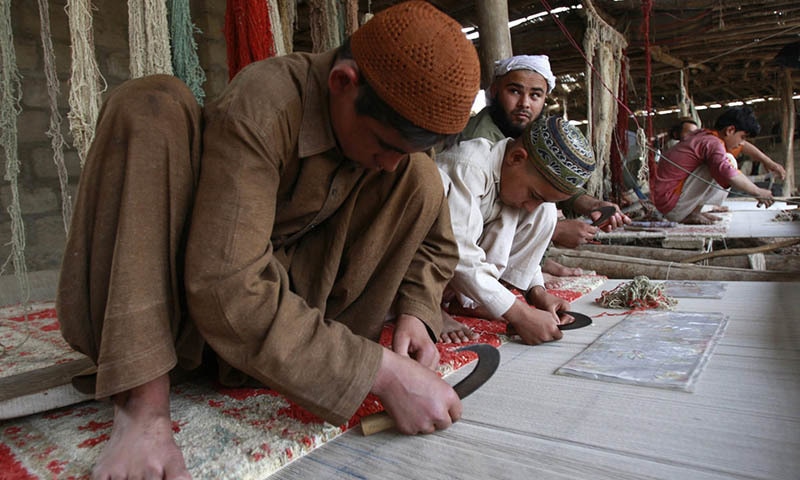
Children working in the carpet industry suffer work-related injuries, earn minimal pay and remain uneducated. Most children in the industry have been injured using sharp instruments, experienced respiratory tract infections, body aches or suffered physical abuse. Even the children who weave at home experience poor conditions, being kept at the loom longer hours in rooms that are generally not better ventilated or lit than the factories24. The maximum wage is the equivalent of $1.50 per day25. They work 9 to 10 hours per day, with a one-hour break. They remain uneducated, 42% having never attended school and 58% having dropped out26. The 1992 UNICEF-Punjab report details the conditions of child labor in the carpet weaving industry in Punjab. The study surveyed 10 villages and interviewed 175 children in carpet weaving centers in Punjab. It concluded that carpet weaving is done mostly by children27. Eighty-three percent of the survey were male children, but access to predominantly female carpet weaving centers was restricted28. The study found the earnings depended on the number of knots per square foot29. They ate three meals a day, consisting of bread/rice, dal (lentils) or vegetables30. Fifty-one percent of the children expressed dissatisfaction with their jobs. Ninety-four percent of the children suffered one or more work-related illness or injuries, which included fingertip and hand injuries due to handling sharp knives, as well as physical abuse31.
The “economic” argument that it costs much less to employ children than adults collapses under close scrutiny. Children are usually paid less than adults. Yet, the International Labor Organization has found that the labor-cost savings from the use of child labor is very small: less than 5% compared to the final foreign retail price of bangles; and less than 5-10% compared to the final foreign retail price of carpets32. Foreign retailers typically mark up carpets approximately 200 percent. Carpets can easily cost four times as much to the consumer as the Indian export price.
The carpet industry is very complex, but is generally controlled by the export companies. These exporters arrange, either directly or through contractors, for a carpet to be produced on a particular loom. The looms are normally owned by small entrepreneurs and range from single loom in private houses to small factories with 30 or more looms. The exporter supplies the wool and design and after a price and quality is agreed, the loom owner is responsible for producing the carpet to specification. Agents for the loom masters and owners find their workforce from a variety of sources. The children may be their own children and other children from within the village. These remain in their own family. The child labor may also be obtained from outlying villages to small towns in Pakistan33. Manufacturers also avoid labor regulations by dividing their company into small units. Factories with less than 10 workers are not covered by most labor laws34 so these small companies, often scattered throughout the countryside, circumvent the rules. These village units generally use even more child labor than the urban units and have very poor working conditions.
The Human Rights Commission of Pakistan states that work units in rural areas have more child labor than urban areas. In these village units, the children are mostly girls, some only six or seven years old; boys are barely eight. Working conditions are poor, lighting and ventilation inadequate, hygienic conditions substandard, and the work area hot and humid. Workers complain of coughs and sickness. The workers usually work 10-hour days, with no holidays and are paid on a piece-rate basis. Child workers pay is as low as 10 rupees (approximately 37 cents) per day; teenagers, however, earned 20-30 rupees (74 cents to $1.13) per day, and can even get 50 to 75 rupees ($1.87 to $2.81) per day for superior quality carpets. UNICEF describes the work as painful and unhealthy; children sit in cramped positions for long periods of time, breathing wool dust, working under poor lighting conditions, straining their eyes and working with chemical dyes. The children also develop spinal deformities35. Human Rights Watch/Asia notes that many of the children in the carpet industry are bonded. Many of these children, bonded into labor despite the laws passed forbidding this, are sold by their parents and separated from their families36. They are kept in small buildings, which house looms. The children are often beaten. In some situations, parents force the children to work. In other situations, children are separated from their families and kept in small buildings which house several carpet looms. Human Rights Watch/Asia interviewed several children in such factories who were beaten frequently and rarely allowed to return home. It was noted that if the children attempted to escape they were forcibly returned to the looms with the help of the local police37.
In 1990 a consumer awareness campaign against the use of child labor in carpet industry was initiated in Germany with the collaboration of different groups – trade unions, religious and human rights organizations, and consumer groups. The campaign quickly spread to other European countries and the USA. Impact of this international or global campaign on the carpet trade was significant, leading to the fear of a collapse of the industry, which had become important to the economy. A partnership was created including development and human rights organizations, carpet exporters both individually and through their trade association, and UNICEF. Together these agencies and organizations devised a project to set up and administer a special label for hand-knotted carpets made without the use of child labor, “Rugmark” is the most renown label indicating the child labor free product. As of December 2002, more than 3 million carpets bearing the “Rugmark” label had been sold in Europe and North America. This label is now the best known among all labels in the carpet industry.
RugMark’s work is also having a profound effect. Since 1995, RugMark has freed more than 3000 children from looms and deterred thousands more from entering the work force. Educational programs funded by the sale of RugMark-certified rug and donations to RugMark help these children through rehabilitation, day care, literacy, formal schooling and vocational training38. Labor Department Director Saeed Awan said that till 2007, the department had approached 26,000 children involved in the carpet weaving industry39.
In Pakistan, carpet manufacturers sign a contract with Rugmark in which they pledge not to use child labor and to register all looms and to allow access to them for unannounced inspections. Trained inspectors hired by the Rugmark Foundation perform the inspections. Each loom is registered and each carpet woven on it is individually tracked in order to assure that no child has worked on it. The label is a registered international trademark: only carpets inspected in this way can legally carry it. Rugmark has a rehabilitation and education program and, since 1995, schools in Pakistan, India, and Nepal have offered educational opportunities to some 2,300 former child weavers and to other children and adults from weaving communities. The Rugmark initiative has attracted a great deal of publicity and documentary films have been made about it.
This huge project launched in the wake of global campaign against the child labor in carpet industry reflects in the following passage the encouraging highlights of the progress and achievements of the project as of March 200740.Under this project international and national organizations in collaboration with government, trade unions and local communities organized 775 Village Education Committees (VECs) and 752 Family Education Committees (FECs) were organized, most of these continue to function even after the completion of the program time, 781 contractors/sub-contractors have become members of VECs.
746 NFEs (Non Formal Education) centres and 240 ESS (Education Support Service) centres were established. 36975 children (carpet-weavers + younger siblings ) have graduated from the NFE + ESS centres. 6452 children from NFE centers have been mainstreamed into the formal education system, thus completely withdrawn from carpet weaving. 2,167 monitoring visits were conducted by the ILO-IPEC monitors in the NFE centers to monitor children attending NFEs. 2,879 monitoring visits were conducted in the households and carpet-weaving sheds by the ILO-IPEC monitors to verify the absence of child labor. Linkages for effective collaboration have been developed with different Governments departments including Education and Labor. MOUs have been signed with Education departments in the district Toba Tek Singh and Faisalabad in order to facilitate the mainstreaming of NFE enrolled children into Government education system. 10,261 children profile were completed and entered into the database. Working hours of children were reduced by four to five hours daily (on average).
337 VEFs (Village Education Fund) established in the project areas with the community contribution of Rs. 477889 to benefit 414 NFE centers in 250 villages. 25 Apex bodies established covering 29 villages and 94 NFEs. Systematic advocacy and awareness raising campaign have been targeted towards community leaders, carpet weaving families, carpet manufacturers/exporters and suppliers, labor groups and district/provincial governments. 340 new family enterprises, such as small grocery shops, cow milking, bangle selling, embroidery etc., have been established so far under this program. 996 families have been provided with income generation skill training. 171 Pre-Vocational Education centers established. 4996 carpet-weaving children in the age group (11-14) have been provided/enrolled with PVE. Trainings in four basic trades have been imparted i.e. tailoring, embroidery, tie & dye craft and carpet designing and color schemes. 31 trainers have been trained, in collaboration with government training institutes reserved for females (called Sanatzars) of Punjab Social Welfare Department. 35 PVE center have been sustained by the community. The Program on Income-Generation and Micro-Credit for families of carpet weaving children, has made the following progress;119 Groups for Income Generation (GIG) formed, comprising 869 members. Savings of Rs. 348,646 (USD 6,117) made by GIGs, 111 saving accounts opened. Micro Credit of Rs. 6,404,000 (USD 112,350) has been disbursed to 705 families, at average credit size of Rs. 9,084 (USD 160). 100% recovery of due amount has been made. 144 women have been trained in skills having income-generating potential. The child labor survey conducted in 2001 in the carpet industry in Punjab has estimated 107,065 child weavers active in the carpet industry in the Punjab, with the highest concentration in eight districts, namely, Sheikhupura, Multan, Faisalabad, Toba Tek Sing, Kasur, Vehari, Jhang, and Narowal. Out of these, 17,803 carpet weaving children have so far been withdrawn by the project and placed in the social safety nets; including non-formal education centers.
The study on ‘Occupational Safety and Health (OSH) Risk Assessment of Child Workers in the Carpet Industry’ conducted by the Center for the Improvement of Working Conditions & Environment, Punjab Labor Department, recommended: gradual reduction in working hours of the children, awareness raising for employers/ parents/communities etc., providing basic healthcare facilities to working children, improving working conditions and environment, and designing ergonomic loom to minimize discomfort in carpet weaving for adult labor.
A program on health screening and treatment of common ailments suffered by carpet-weaving children has been implemented. Under this 8,710 children have been examined and provided with medication for common ailments related to carpet weaving; such as respiratory congestions, skin diseases and painful hands and legs. 100 awareness raising sessions have been conducted for 9,620 participants (66% females) consisting of parents, community leaders, contractors & children. Awareness raising material consisting 3 training videos, 3 booklets and around 24,000 posters produced focusing on OSH. A prototype ergonomic loom has been designed and tested at the model worksites. 30 model workplaces have been established with improved working conditions and environment.
The Action Program is being implemented in Toba Tek Singh, Faisalabad, Multan, Sheikhupura districts in Punjab. The implementing partner for the action program is “Centre for the Improvement of Working Conditions and Environment (CIWCE), Government of the Punjab, Labor Department”. 20,000 posters on eight themes illustrating OSH measures have been designed and printed, suitable to the level of literacy among the carpet weaving families. Two Urdu training booklets have been produced focusing on OSH improvement. 500 holding kits for OSH material have also been produced containing posters, booklets and videos on different OSH issues. Two posters on promotion of ergonomic loom have been designed and printed. 154 training sessions have been held in project areas to provide OSH awareness to around 12,977 participants (9,691 females and 3,286 males). Modifications in the existing adult-friendly ergonomic carpet loom, in light of the recent feedback from the beneficiaries, have been made and the improved loom is now going through the testing process.
Ergonomic Loom
Reaction of the international society against the use of child labor in the carpet industry in terms of drastic reduction in exports to international markets is being realized. The stakeholders have paid attention to bring innovation in the carpet weaving techniques. The carpet weaving industry is considered hazardous, due to its isolated, confined workplaces and woolen dust. Weavers become vulnerable to respiratory diseases and joint pains due to sitting in the squatting postures for hours. Considering this, the stakeholders are working in two different directions: firstly they are encouraging contactors/weavers to adopt measures to improve working conditions for the weavers, and secondly, convincing them to replace the traditional (old) looms with newly developed ergonomic looms. As these looms are more sophisticated and user-friendly in their nature and lead less to musclo-skeletal problems, more adults are attracted to working with it. The ILO-PCMEA have established 30 Model Worksites with the help of the Punjab Government’s Center for Improvement in Working Conditions and Environment (CIWCE), and the contractors. The ergonomic looms have been installed and tested at these work-sites and have proved very useful in improving the health status of the adult carpet weavers and encouraged them to send their children to schools.
The prototype ergonomic loom financed and designed in collaboration with the Center for the Improvement of Working Conditions and Environment (CIWCE), Labor department, government of the Punjab, has been given the prestigious Tech Museum Award in the Equality category for the year 2005. This Award was given in November 2005 in San Jose, California, USA. The main OSH features incorporated in the loom include an adult-height bench, a foot rest and an arm rest. Overhanging metal pipes and wooden rods of the traditional loom have been replaced, as it was a major cause of head injuries to adult weavers. The steel frame of the ergonomic loom keeps the loom stable even on uneven earthen floors and the wool dust accumulates on a thick mat that has been provided which can be easily swept and cleaned on a regular basis.
On the occasion of announcement of Award, a press conference was organized by the Chief Minister of Punjab, in which he appreciated the efforts of ILO, PCMEA and Government to qualify for the Tech Award. Furthermore, the government has committed to provide these ergonomic looms through Punjab Bank on subsidized rates. To promote the sustainability of the interventions, district governments in Multan, Faisalabad and Toba Tek Singh have been fully involved in the project activities. Child labor advisory committees have been established in these districts. For the same reason, the Project Management helped the Department of Labor, Government of Punjab, in preparing the ‘Manual on Child Labor’ and the ‘Guidelines on Child Labor Monitoring’ for the use of Government child labor inspectors. The government of the Punjab (Labor and Human Resource Department) has approved a four-year project for the subsidized financing of the ergonomic looms in 12 districts. Around 3,000 looms would be distributed to about 3,000 poorer carpet weaving families and its cost would be recovered in instalments during the project period. Total cost of the project would be Pak Rs. 70 million (USD 1.207 m). The beneficiaries of the project would be selected in close coordination with the ILO-IPEC carpet project. Therefore the intervention would have a direct impact on the child labor elimination from the sector, besides tackling the poverty and debt-bondage issues.
The baseline survey on child labor in the carpet industry in Sindh has been carried out in association with the Federal Bureau of Statistics (FBS), Government of Pakistan. According to this survey, there are over 25,752 carpet weaving households in the Sindh province with an estimated 33,735 carpet weaving children. Out of which 24,023 (71% ) are estimated to be below 14 years of age and 9,712 (29% ) are between 14 – 18 years of age.
Capacity of the Pakistan Workers’ Federation (PWF) is being enhanced to Combat Hazardous Child Labor in the Carpet Industry, through an Action Program on Awareness Raising on Child Labor issues. Under this action program, the establishment of a Child Labor Cell in Pakistan Workers’ Federation (PWF) office in Lahore, followed by series of awareness raising workshops for the adult workers, capacity building of a network of small trade unions would result (assumingly) in 300 trainers (around 40% females), including 60 Master Trainers.
This is important that whether child labor in the carpet industry has vanished or still exists but the amount of attention drawn towards the issue by the international society has brought the miseries of the child labor to the limelight and the executors of the child labor are forced to take more stringent precautions than what they used to take before this happening.
Pressure from the international society made the carpet exporters from Pakistan and importers and retailers from USA and other western countries to assure the world through an announcement that child labor no longer existed in the carpet-weaving industry41. To verify these claims, the Anti-Slavery Society funded a Mission to Pakistan which negates the claims as according to this undercover investigation there is still extensive use of children in the industry42.
Similarly, the Harkin Bill, the Child Labor Deterrence Act in the United States and successive amendments suggested by other international non government organizations have also added the much needed pressure on the exporters of carpet industry to put efforts to eliminate child labor from this sector43.
“The only success we have seen has been through consumer pressure. It was only after our consumer campaign that the industry even admitted the problem of child labor existed. Until that time, the industry and government claimed children working in the industry were working in family looms, learning a craft. There are now over 50 exporters who have pledged not to use child labor. They have even formed their own association for carpet manufacturers who do not use child laborers. This has also created pressure for reform in other industries where child labor is a problem, involving industries where we are not active44“, said Kailash Satyarthi in an interview.
While consumer pressure can create a new market for child labor-free carpets, the impact of these initiatives is limited without certain legal measures. Ethically-produced coffee, for example, only maintains a five or six percent share of the market. It is more expensive than other coffee and can only compete to a limited degree. Therefore, in the context of carpets, South Asian Coalition against Child Servitude has advocated a ban on the import of carpets made with child labor in addition to promoting the rug mark. But this should not be done in a protectionist manner. The children must have somewhere to go when they are released from the industry. Funds from any multilateral sanctions on the industry must be made available for follow up – for free and compulsory primary education. The World Bank , IMF , European Union and other international bodies are giving huge amounts of money for “education for all”. But this can never be implemented if the children remain working for 12 or 16 hours a day. These funds should be diverted to children who are freed from the carpet or any other industry45.
In the past ten years, there has been a gathering movement in India, Pakistan and Nepal to end the exploitation of so many children in the industry. As a result, the UN Working Group on Contemporary Forms of Slavery and the International Labor Organization have called on the Union Government (ie, the federal government) in India and the federal government in Pakistan to enforce their own laws and to stop the use of child labor46.
The above discussion though contains claims and disclaims about the prevalence of child labor in the carpet industry of Pakistan, but it does portray one positive change i.e. the realization and acceptance of the existence of the issue. For long the government did not even admit this was an issue to tackle. Carpet industry had reasonable revenues through exports and as a result of the direct impacts of the campaigns in the outside world the exports drastically decreased. The revenue decrease coupled with the pressure from the international community to put efforts to curb this menace made Pakistan sign several agreements with the international community to exhibit its intentions to address the issue. In the wake of these agreements the government of Pakistan allowed and cooperated with the national and international organizations to give these marginalised children a better day. Its efforts are also praised by international community. BBC (British Broadcast Company) gave the news that ILO (the largest representative of the international community) praised the efforts of Pakistani government to curb this menace in the carpet industry and admitted a “marked decrease” in the child labor in this sector47.
End Notes
1. Rug Mark,http://www.rugmark.org/index.php?cid=29, (31/5/2008)
2. Anti Slavery, http://www.anti-slaverysociety.addr.com/carpets.htm, (24/5/2008)
3. ILO, http://www.ilo.org/public/english/region/asro/newdelhi/ipec/responses/pakistan/p2.htm (3/5/2008)
4. Mount Holyoke College, http://www.mtholyoke.edu/~ekwalsh/carpetindustry.html, (14/5/2008) also: “Government of Pakistan’s Replies to the Questions/Points Raised in the Non-Paper on GSP Worker Rights” [unofficial document] released to the GSP Sub-Committee (April 11, 1994).
5. UNICEF, “Child labor in the carpet weaving industry in Punjab” (Punjab: UNICEF, 1992),p. 7
6. EI Barometer on Human and Trade Union Rights in the Education Sector, 1998. also ICFTU, No Time to Play, 1996, citing UNICEF
7. Mount Holyoke College, http://www.mtholyoke.edu/~ekwalsh/carpetindustry.html, (14/5/2008), also: Situation Analysis of Children & Women in Pakistan (UNICEF and Government of Pakistan, 1992), p.84.
8. US Dept of Labor, “Sweat and Toil of Children, 1994”, citing “Pakistan: Bonded Labor Abolition Act Passed at Last”, Social & Labor Bulletin, (April 1992) http://globalmarch.org/virtual-library/sweat-and-toil-1/pakistan.html, (12/4/2008)
9. Ibid.
10. Ghazanfer, Abbas.”Child Labor in Pakistan”, Child Workers in Asia, Vol. 10, No. 3, (July – September 1994), http://www.globalmarch.org/virtual-library/cwa/10-3/Contents.htm, (17/5/2008)
11. Sweat and Toil of Children, Op.Cit.
12. Shakeel Ahmed, Pathan. HRCP, submission to the ECOSOC Commission on Human Rights, (June 1997)
13. ICFTU and ETUC, Pakistan: Forced Labor, (June 1995)
14. Anti Slavery Society, http://www.anti-slaverysociety.addr.com/carpets.htm, (24/5/2008)
15. http://130.94.183.89/magazine/pakistan.html, (26/5/2008)
16. Multi National Monitor, http://multinationalmonitor.org/hyper/issues/1994/10/mm1094_07.html, (2/6/2008)
17. “A Study on Child Laborers in Pakistan Hand-Knotted Carpet Industry” Pakistan Carpet Manufacturers and Exporters Association (PCMEA),(April 11, 1994)
18. Mount Holyoke College, http://www.mtholyoke.edu/~ekwalsh/carpetindustry.html, (14/5/2008), also: A Report on Child Labor in Pakistan (Asian-American Free Labor Institute, June 1994), pp.5-6.
19. Dept of Labor, USA, http://www.dol.gov/ilab/media/reports/iclp/sweat/pakistan.htm#12#12, (13/6/2008)
20. UNICEF Punjab Report p.iv
21. http://130.94.183.89/magazine/pakistan.html, (26/5/2008)
22. UNICEF Punjab Report p.11
23. Ibid. p.13
24. “Statement of Human Rights Watch/Asia”,International Child Labor Hearing, U.S. Department of Labor (April 12, 1994)
25. UNICEF Punjab Report p.11
26. Ibid.
27. Ibid. p.13.
28. Ibid. p.14.
29. Ibid. pp.15-16.
30. ILO-IPEC, “Child Labor: What is to be done”, (June 1996), http://www.ilo.org/public/english/standards/ipec/publ/policy/what/what1.htm; (23/3/2005).
31. ILO, “Refuting the ‘nimble fingers’ argument”, WORLD OF WORK, No. 17, (September/October 1996), http://www.ilo.org/public/english/bureau/inf/magazine/17/finger.htm; (3/3/2004)
32. Anti Slavery Society, http://www.anti-slaverysociety.addr.com/carpets.htm , (24/5/2008)
33. UNICEF Punjab Report p.2, See also Discover the Working Child p.19
34. US Department of Labor, http://www.dol.gov/ilab/media/reports/iclp/sweat/pakistan.htm, (4/6/2008)
35. http://www.digitalrag.com/iqbal/index.html, (25/5/2008)
36. Rug Mark,http://www.rugmark.org/index.php?cid=29, (31/5/2008)
37. Daily Times, , (12/5/2008)
38. United Nations, http://www.un.org.pk/gend-proj/ilo-4.htm, (20/2/2007)
39. ILO, http://www.ilo.org/public/english/region/asro/newdelhi/ipec/responses/pakistan/p2.htm (24/5/2008)
40. Ibid.
41. Multi National Monitor, http://multinationalmonitor.org/hyper/issues/1994/10/mm1094_07.html, (2/6/2008)
42. Kailash Satyarhti, Interview, http://multinationalmonitor.org/hyper/issues/1994/10/mm1094_07.html, (25/5/2008)
43. Ibid.
44. Anti Slavery Society, http://www.anti-slaverysociety.addr.com/carpets.htm , (24/5/2008)
45. BBC, http://news.bbc.co.uk/2/hi/south_asia/4974022.stm, (15/5/2008)
46. Hamri Web, http://hamariweb.com/article.aspx?id=91 (23/8/2009)
47. BBC, http://news.bbc.co.uk/2/hi/south_asia/4974022.stm, (15/5/2008)